

Understanding the nuances of language is crucial, especially when discussing complex concepts like justice. Adjectives play a pivotal role in shaping our perception and understanding of justice by adding depth, precision, and emotional weight to our descriptions.
This article offers a comprehensive exploration of adjectives used to describe justice, its various forms, and related concepts. Whether you’re a student, a legal professional, or simply someone interested in improving your vocabulary, this guide will provide valuable insights and practical examples to enhance your understanding and usage of these powerful words.
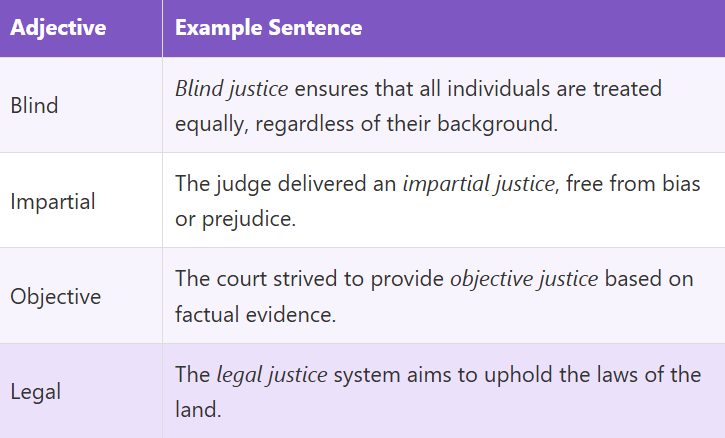
Table of Contents
- Introduction
- Definition of Adjectives for Justice
- Structural Breakdown
- Types and Categories of Adjectives for Justice
- Examples of Adjectives for Justice
- Usage Rules for Adjectives for Justice
- Common Mistakes
- Practice Exercises
- Advanced Topics
- FAQ
- Conclusion
Definition of Adjectives for Justice
Adjectives for justice are words that describe or modify the noun “justice,” providing more specific information about its nature, quality, or characteristics. They help to paint a clearer picture of what kind of justice is being referred to, whether it’s fair, impartial, swift, or flawed.
These adjectives are essential in legal, ethical, and social contexts, where precision and nuanced understanding are paramount.
In essence, adjectives for justice function like any other adjective in the English language, but their semantic weight carries significant implications. They influence how we perceive the fairness, equity, and moral correctness of actions, decisions, and systems.
The choice of adjective can dramatically alter the tone and interpretation of a statement about justice.
Consider the difference between “blind justice” and “delayed justice.” The former evokes an image of impartiality and objectivity, while the latter suggests inefficiency and potential unfairness. Both phrases concern justice, but the adjectives drastically change their meaning.
Structural Breakdown
Structurally, adjectives for justice occupy the same positions as other adjectives in English sentences. They typically appear before the noun they modify (attributive position) or after a linking verb (predicative position).
Attributive Position: In the attributive position, the adjective directly precedes the noun “justice.” This is the most common usage. For example: “fair justice,” “corrupt justice,” “swift justice.”
Predicative Position: In the predicative position, the adjective follows a linking verb such as “is,” “seems,” “appears,” or “becomes.” For example: “Justice is blind,” “The decision seemed just,” “Their pursuit of justice became relentless.”
Adjectives can also be modified by adverbs to further refine their meaning. For example, “Justice was remarkably swift,” where “remarkably” modifies the adjective “swift.”
Moreover, adjectives for justice can be part of more complex phrases, such as adjective clauses or participial phrases, adding layers of description to the concept of justice. For example: “Justice, which is often delayed, is justice denied,” or “Seeking justice, the lawyer worked tirelessly.”
Types and Categories of Adjectives for Justice
Adjectives for justice can be categorized based on the aspect of justice they describe. Here are several key categories:
Descriptive Adjectives
Descriptive adjectives provide factual or objective information about justice. They describe the characteristics, qualities, or attributes of justice without necessarily expressing an opinion or judgment.
They often relate to the process, implementation, or appearance of justice.
Evaluative Adjectives
Evaluative adjectives express an opinion, judgment, or assessment of justice. They indicate whether justice is considered good or bad, fair or unfair, effective or ineffective.
These adjectives often reflect subjective viewpoints and moral assessments.
Procedural Adjectives
Procedural adjectives describe the way justice is administered or carried out. They focus on the methods, processes, and systems involved in achieving justice.
These adjectives often relate to the legal and administrative aspects of justice.
Comparative Adjectives
Comparative adjectives are used to compare different instances or aspects of justice. They indicate whether one form of justice is better, worse, or equal to another.
These adjectives often involve comparisons of fairness, efficiency, or effectiveness.
Examples of Adjectives for Justice
This section provides extensive examples of adjectives for justice, categorized by type. Each table includes a variety of adjectives and illustrative sentences to demonstrate their usage.
Descriptive Adjectives Examples
The following table presents descriptive adjectives for justice, along with example sentences demonstrating their use. These adjectives focus on the factual characteristics and attributes of justice.
| Adjective | Example Sentence |
|---|---|
| Blind | Blind justice ensures that all individuals are treated equally, regardless of their background. |
| Impartial | The judge delivered an impartial justice, free from bias or prejudice. |
| Objective | The court strived to provide objective justice based on factual evidence. |
| Legal | The legal justice system aims to uphold the laws of the land. |
| Formal | Formal justice is administered through established court procedures. |
| Public | Public justice must be transparent and accessible to all citizens. |
| Systematic | The investigation sought to uncover systematic justice failures within the institution. |
| Procedural | Procedural justice requires adherence to established rules and protocols. |
| Criminal | The criminal justice system deals with offenses against the law. |
| Civil | Civil justice addresses disputes between individuals or organizations. |
| Restorative | Restorative justice focuses on repairing harm and reconciliation. |
| Due | Every citizen is entitled to due justice under the law. |
| Equitable | The goal is to ensure equitable justice for all members of society. |
| Judicial | The judicial justice system is responsible for interpreting and applying the law. |
| Administrative | Administrative justice deals with disputes involving government agencies. |
| Statutory | Statutory justice is based on laws enacted by legislative bodies. |
| Constitutional | Constitutional justice ensures that laws comply with the constitution. |
| Technical | The case was dismissed due to a technical justice issue with the evidence. |
| Practical | The practical justice of the situation led the judge to a lenient sentence. |
| Theoretical | The theoretical justice of the law did not always translate into real-world fairness. |
| Documented | The investigation revealed a history of documented justice abuses. |
| Historical | The study explored the evolution of historical justice systems. |
| Contemporary | Contemporary justice faces new challenges in the digital age. |
| Territorial | The dispute involved issues of territorial justice and boundary lines. |
| Federal | The case was tried under federal justice guidelines. |
| State | State justice systems vary across different regions. |
| Local | Local justice initiatives aim to address community-specific issues. |
| International | International justice seeks to hold individuals accountable for war crimes. |
Evaluative Adjectives Examples
The following table showcases evaluative adjectives for justice, along with example sentences. These adjectives express opinions and judgments about the quality or fairness of justice.
| Adjective | Example Sentence |
|---|---|
| Fair | The trial resulted in fair justice for all parties involved. |
| Unfair | Many felt that the sentencing was an example of unfair justice. |
| Just | The judge made a just justice decision based on the evidence. |
| Unjust | The imprisonment of innocent people is an example of unjust justice. |
| Equitable | The goal of the legal system is to provide equitable justice for everyone. |
| Inequitable | The distribution of resources was seen as an inequitable justice outcome. |
| Righteous | The people demanded righteous justice for the victims of the crime. |
| Corrupt | The investigation uncovered widespread corrupt justice within the government. |
| Biased | The judge’s ruling was perceived as biased justice toward one side. |
| Impartial | An impartial justice system is essential for maintaining public trust. |
| Effective | The new policies aimed to create a more effective justice system. |
| Ineffective | The reforms were criticized for being ineffective justice measures. |
| Humane | The prison system should strive to provide humane justice for inmates. |
| Inhumane | The harsh punishment was seen as an example of inhumane justice. |
| Moral | The decision was grounded in a sense of moral justice and ethical principles. |
| Amoral | The company’s actions demonstrated an amoral justice disregard for ethical considerations. |
| Swift | Swift justice is important to deter crime and provide closure. |
| Delayed | Delayed justice is often seen as justice denied. |
| True | The victims sought true justice and accountability for the harm they suffered. |
| False | The conviction was overturned due to false justice evidence. |
| Genuine | The community rallied together to demand genuine justice for the marginalized. |
| Illusory | The promise of reform turned out to be an illusory justice hope. |
| Ideal | The pursuit of ideal justice is a continuous and ongoing process. |
| Realistic | The court aimed for a realistic justice outcome given the constraints of the law. |
| Exemplary | The judge’s handling of the case was an example of exemplary justice. |
| Terrible | The miscarriage of justice was a terrible justice blow to the community’s faith in the system. |
| Superior | The new legal framework promised a superior justice compared to the old system. |
| Inferior | The quality of legal representation resulted in an inferior justice outcome for the defendant. |
Procedural Adjectives Examples
The following table presents procedural adjectives for justice, along with example sentences. These adjectives describe the methods, processes, and systems used to administer justice.
| Adjective | Example Sentence |
|---|---|
| Adversarial | The adversarial justice system relies on opposing sides presenting their cases. |
| Inquisitorial | The inquisitorial justice system involves the judge actively investigating the case. |
| Due Process | Due process justice ensures that individuals are treated fairly under the law. |
| Summary | The court issued a summary justice judgment without a full trial. |
| Expedited | The case was handled through an expedited justice process to resolve it quickly. |
| Lengthy | The lengthy justice trial dragged on for several months. |
| Comprehensive | The investigation provided a comprehensive justice review of the evidence. |
| Limited | The court had limited justice jurisdiction over the matter. |
| Judicial | The judicial justice procedure requires adherence to established rules. |
| Administrative | The administrative justice process involves resolving disputes through agencies. |
| Formal | The formal justice hearing followed established protocols. |
| Informal | The dispute was resolved through an informal justice mediation process. |
| Open | The open justice trial was accessible to the public and the media. |
| Closed | The closed justice hearing was conducted in private. |
| Transparent | The transparent justice process ensured accountability and public trust. |
| Opaque | The opaque justice procedures raised concerns about fairness. |
| Collaborative | The collaborative justice approach involved all stakeholders working together. |
| Competitive | The competitive justice environment fostered innovation and efficiency. |
| Standardized | The standardized justice procedures ensured consistency across different courts. |
| Customized | The customized justice approach tailored the process to the specific needs of the case. |
| Traditional | The traditional justice practices were rooted in cultural customs and norms. |
| Modern | The modern justice system incorporates technological advancements and contemporary legal theories. |
| Primary | The primary justice focus was on addressing the immediate harm caused by the crime. |
| Secondary | The secondary justice considerations involved long-term rehabilitation and prevention. |
| Preventative | The preventative justice measures aimed to reduce crime and recidivism. |
| Punitive | The punitive justice system emphasized punishment as a deterrent. |
| Corrective | The corrective justice approach focused on rehabilitation and reintegration. |
| Transformative | The transformative justice initiatives sought to address the root causes of crime and inequality. |
Comparative Adjectives Examples
The following table illustrates comparative adjectives for justice, along with example sentences. These adjectives compare different instances or aspects of justice.
| Adjective | Example Sentence |
|---|---|
| More Fair | The new system is more fair justice than the previous one. |
| Less Fair | The revised law provides less fair justice for certain groups. |
| More Just | The outcome of the second trial was more just justice than the first. |
| Less Just | The plea bargain resulted in less just justice for the victims. |
| More Equitable | The reformed policies aimed to create a more equitable justice system. |
| Less Equitable | The current distribution of resources provides less equitable justice for marginalized communities. |
| More Effective | The new strategies have proven to be more effective justice in reducing crime rates. |
| Less Effective | The previous methods were less effective justice in addressing the root causes of the problem. |
| More Swift | The expedited process resulted in more swift justice for all parties involved. |
| Less Swift | The appeals process often leads to less swift justice and prolonged uncertainty. |
| More Transparent | The new regulations ensure a more transparent justice system with increased accountability. |
| Less Transparent | The previous procedures were less transparent justice, raising concerns about potential corruption. |
| More Humane | The prison reforms aimed to provide more humane justice and improved conditions for inmates. |
| Less Humane | The harsh penalties were criticized for being less humane justice and excessively punitive. |
| More Impartial | The independent investigation ensured a more impartial justice review of the evidence. |
| Less Impartial | The judge’s personal biases resulted in a less impartial justice ruling. |
| More Comprehensive | The revised guidelines provide a more comprehensive justice framework for addressing complex issues. |
| Less Comprehensive | The initial investigation was less comprehensive justice and failed to uncover key evidence. |
| More Consistent | The standardized procedures ensure a more consistent justice application of the law. |
| Less Consistent | The varying interpretations of the law resulted in less consistent justice outcomes. |
| More Accessible | The new legal aid programs aim to make more accessible justice to low-income individuals. |
| Less Accessible | The high cost of legal representation makes less accessible justice for many people. |
| More Restorative | The community-based programs promote a more restorative justice approach to crime. |
| Less Restorative | The traditional punitive measures are less restorative justice and focus primarily on punishment. |
| More Transformative | The social justice movements advocate for a more transformative justice approach to address systemic inequalities. |
| Less Transformative | The superficial reforms are less transformative justice and fail to address the root causes of injustice. |
Combined Usage Examples
This table shows examples where multiple adjectives modify “justice,” creating richer and more nuanced descriptions.
| Example Sentence |
|---|
| The pursuit of fair and impartial justice is the cornerstone of a democratic society. |
| Swift and effective justice is essential for maintaining law and order. |
| The victims demanded true and righteous justice for the crimes committed against them. |
| The investigation uncovered a pattern of corrupt and biased justice within the organization. |
| The goal is to create a more equitable and humane justice system for all. |
| The reforms aimed to provide more transparent and accountable justice to the public. |
| The court strived to deliver objective and impartial justice based on the evidence presented. |
| The new policies promote a more restorative and transformative justice approach to crime. |
| The community demanded genuine and meaningful justice for the marginalized and oppressed. |
| The trial sought to achieve just and equitable justice for all parties involved. |
| The investigation revealed a history of systematic and widespread justice abuses. |
| The court aimed to provide fair and speedy justice to the victims of the crime. |
| The reforms sought to create a more accessible and affordable justice system for everyone. |
| The goal is to ensure equal and impartial justice under the law. |
| The victims sought true and lasting justice for the harm they suffered. |
| The investigation aimed to uncover corrupt and unethical justice practices. |
| The court strived to deliver just and proportionate justice in every case. |
| The reforms sought to create a more humane and rehabilitative justice system. |
| The community demanded fair and equitable justice for all its members. |
| The trial aimed to achieve true and complete justice for the victims and their families. |
Usage Rules for Adjectives for Justice
Using adjectives for justice correctly involves understanding their specific meanings and connotations. Here are some key usage rules:
- Choose adjectives that accurately reflect the intended meaning. “Fair justice” and “unjust justice” convey opposite meanings, so select the adjective that best represents your viewpoint.
- Consider the context. The appropriateness of an adjective depends on the specific situation and the aspect of justice being discussed. “Swift justice” may be desirable in some cases but inappropriate if it compromises thoroughness.
- Be aware of subjective vs. objective adjectives. Evaluative adjectives express opinions, while descriptive adjectives provide factual information. Use evaluative adjectives carefully, acknowledging that they reflect a particular perspective.
- Avoid redundancy. Some adjectives are inherently implied by the concept of justice. For example, “equitable justice” may be redundant since justice is generally understood to be equitable.
Common Mistakes
Here are some common mistakes to avoid when using adjectives for justice:
| Incorrect | Correct | Explanation |
|---|---|---|
| “Very justice” | “Fair justice” | “Very” is an adverb and doesn’t modify nouns properly. Use adjectives like “fair” or “just” instead. |
| “Justice fair” | “Fair justice” | Adjectives generally precede the noun they modify in English. |
| “More justice” | “More just” or “Fairer justice” | “More” requires an adjective to create a comparative. |
| “Justiced decision” | “Just decision” | “Justiced” isn’t a recognized adjective form. Use “just” as the adjective. |
| “Unbias justice” | “Unbiased justice” | The correct adjective form is “unbiased,” not “unbias.” |
| “Moral justice decision” | “Moral decision” or “Just decision based on morality” | Justice already implies morality. Adding “moral” can be redundant; rephrase for clarity. |
Practice Exercises
Test your understanding of adjectives for justice with these exercises. Choose the best adjective to complete each sentence.
Exercise 1: Fill in the Blanks
| Question | Answer |
|---|---|
| 1. The court aimed to provide _______ justice to all citizens. | Fair |
| 2. _______ justice is often seen as justice denied. | Delayed |
| 3. The investigation revealed _______ practices within the legal system. | Corrupt |
| 4. The goal is to create a _______ and equitable society. | Just |
| 5. The new policies promote a _______ approach to crime. | Restorative |
| 6. The trial sought to achieve _______ justice for the victims. | True |
| 7. The judge delivered an _______ verdict based on the evidence. | Impartial |
| 8. The community demanded _______ for the injustices they had suffered. | Accountability |
| 9. The reforms aimed to create a _______ and accessible legal system. | Transparent |
| 10. The court strived to provide _______ justice to all parties involved. | Objective |
Exercise 2: Correct the Errors
| Question | Answer |
|---|---|
| 1. The very justice system needs reform. | The fair justice system needs reform. |
| 2. Justice fair is what we seek. | Fair justice is what we seek. |
| 3. This is more justice than before. | This is more just than before. |
| 4. The justiced decision was welcomed. | The just decision was welcomed. |
| 5. The unbias justice system must be impartial. | The unbiased justice system must be impartial. |
| 6. The moral justice was served. | Justice was served. |
| 7. Quick justice is always best. | Swift justice is always best. |
| 8. The legal justice law was passed. | The legal law was passed. |
| 9. The equal justice system is important. | The equitable justice system is important. |
| 10. The true justice decision was made. | The just decision was made. |
Advanced Topics
For advanced learners, consider exploring more complex aspects of adjectives for justice, such as:
- The philosophical underpinnings of different adjectives. Explore the philosophical concepts of justice that inform the use of adjectives like “distributive,” “retributive,” and “procedural.”
- The rhetorical use of adjectives for justice. Analyze how adjectives are used to persuade and influence opinions about justice in legal arguments, political discourse, and media reporting.
- The cross-cultural variations in the understanding of justice. Investigate how different cultures and legal systems conceptualize justice and how this affects the choice of adjectives used to describe it.
- The evolution of adjectives for justice over time. Trace the historical changes in the usage and meaning of adjectives related to justice, reflecting evolving social and ethical norms.
FAQ
Here are some frequently asked questions about adjectives for justice:
- What is the difference between “just” and “fair” when describing justice?While often used interchangeably, “just” typically refers to adherence to moral or legal principles, whereas “fair” emphasizes impartiality and equal treatment. A decision can be legally just but perceived as unfair if it disproportionately affects certain groups.
- Why is it important to use precise adjectives when discussing justice?Precision is crucial because justice is a multifaceted concept. Using specific adjectives helps to avoid ambiguity and ensures that the intended meaning is accurately conveyed. This is particularly important in legal and ethical contexts, where misunderstandings can have serious consequences.
- Can an adjective for justice be subjective?Yes, evaluative adjectives such as “fair,” “unfair,” “just,” and “unjust” inherently involve subjective judgments. These adjectives reflect personal opinions and moral assessments, which can vary depending on individual values and perspectives.
- How do procedural adjectives influence our understanding of justice?Procedural adjectives highlight the methods and processes used to administer justice. They focus on whether the procedures are fair, transparent, and efficient, which can significantly impact public trust and confidence in the legal system.
- What are some examples of redundant adjectives for justice?Some adjectives are inherently implied by the concept of justice and can be redundant. For instance, “equitable justice” may be redundant because justice is generally understood to be equitable. Similarly, “moral justice” can be redundant as justice often carries a moral connotation.
- How can adjectives for justice be used to manipulate public opinion?Adjectives can be used rhetorically to frame justice in a positive or negative light. For example, using “swift justice” can create a sense of efficiency and effectiveness, while “delayed justice” can evoke feelings of frustration and unfairness. These choices can influence how people perceive and respond to legal and political issues.
- What role do adjectives for justice play in legal arguments?In legal arguments, adjectives are used to emphasize certain aspects of justice and persuade decision-makers. Lawyers might argue for “impartial justice” to highlight the need for unbiased decision-making or advocate for “restorative justice” to emphasize the importance of rehabilitation and reconciliation.
- How do cultural differences affect the use of adjectives for justice?Different cultures may have varying conceptions of justice, which can influence the adjectives used to describe it. For example, some cultures may prioritize “collective justice” or “social justice,” while others may emphasize “individual justice” or “retributive justice.” These cultural differences can lead to different linguistic expressions and interpretations.
- Are there specific adjectives for justice that are unique to certain legal systems?Yes, some legal systems may have unique adjectives that reflect their specific values and principles. For example, some indigenous legal systems may use adjectives that emphasize community harmony, ecological balance, or spiritual well-being. These adjectives may not have direct equivalents in other legal systems.
- How can I improve my understanding and use of adjectives for justice?To improve your understanding, read widely on topics related to law, ethics, and social justice. Pay attention to how adjectives are used in different contexts and consider their specific meanings and connotations. Practice using these adjectives in your own writing and speaking, and seek feedback from others to refine your usage.
Conclusion
Adjectives for justice are powerful tools that enable us to describe, evaluate, and compare different aspects of this complex concept. By understanding their meanings, usage rules, and potential pitfalls, we can communicate more effectively and contribute to a more nuanced and informed discussion of justice.
Remember to choose adjectives that accurately reflect your intended meaning, consider the context, and be aware of the subjective vs. objective nature of these words. With practice and careful attention, you can master the art of
art of using adjectives for justice, enhancing your ability to articulate your thoughts and advocate for a more just and equitable world.