

Adjectives are the spice of language, adding color, detail, and specificity to our descriptions. Mastering adjectives is crucial for anyone looking to improve their English writing and speaking skills.
This comprehensive guide will explore the definition, types, structural use, and common mistakes associated with adjectives, empowering you to use them effectively and confidently. Whether you’re a beginner or an advanced learner, this article will provide valuable insights and practical exercises to enhance your understanding and application of adjectives.
This article is designed to benefit English language learners of all levels, from those just starting to grasp the basics to advanced speakers seeking to refine their grammatical accuracy and stylistic expression. By the end of this guide, you’ll have a strong foundation in adjective usage, enabling you to communicate more clearly and engagingly.
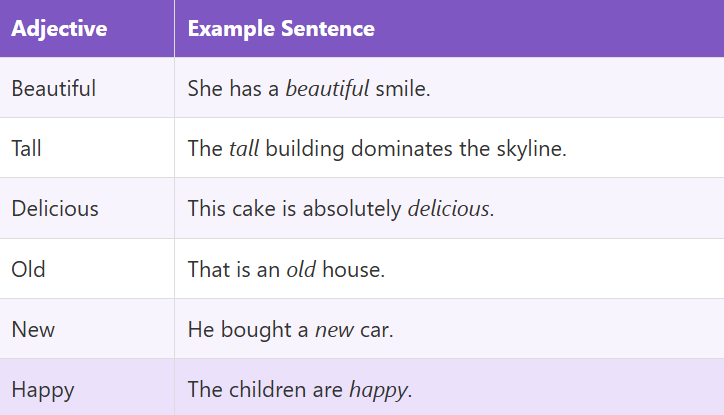
Table of Contents
- Definition of Adjectives
- Structural Breakdown of Adjectives
- Types of Adjectives
- Examples of Adjectives
- Usage Rules for Adjectives
- Common Mistakes with Adjectives
- Practice Exercises
- Advanced Topics in Adjective Usage
- Frequently Asked Questions (FAQ)
- Conclusion
Definition of Adjectives
An adjective is a word that modifies or describes a noun or pronoun. Its primary function is to provide additional information about the noun or pronoun, such as its qualities, characteristics, or attributes. Adjectives answer questions like “What kind?”, “Which one?”, “How many?”, or “How much?” They enrich our language by adding detail and specificity, making our descriptions more vivid and engaging.
Adjectives can appear before the noun they modify (attributive position) or after a linking verb (predicative position). In the attributive position, the adjective directly precedes the noun, for example, “a red car.” In the predicative position, the adjective follows a linking verb, such as “is,” “are,” “was,” “were,” “seems,” or “becomes,” for example, “The car is red.” Furthermore, adjectives can sometimes be used as nouns themselves, though this is less common (e.g., “the poor,” “the rich”).
Structural Breakdown of Adjectives
Adjectives can be simple, compound, or derived. Simple adjectives consist of a single word, such as big, small, red, or happy. Compound adjectives are formed by combining two or more words, often with a hyphen, such as well-known, high-quality, or English-speaking. Derived adjectives are formed by adding prefixes or suffixes to other words, such as unhappy (prefix un-), beautiful (suffix -ful), or agreeable (suffix -able).
The order of adjectives in a sentence typically follows a specific pattern, although native speakers often intuitively follow this order without consciously thinking about it. A general guideline for the order of multiple adjectives before a noun is: opinion, size, age, shape, color, origin, material, and purpose. For example, “a beautiful (opinion) large (size) old (age) round (shape) blue (color) Italian (origin) wooden (material) dining (purpose) table.” While it’s rare to have so many adjectives describing a single noun, this order helps to ensure clarity and coherence.
Types of Adjectives
Adjectives can be classified into various types based on their function and the kind of information they provide about the noun they modify. Understanding these different types can help you use adjectives more effectively and precisely.
Descriptive Adjectives
Descriptive adjectives, also known as qualitative adjectives, describe the qualities or characteristics of a noun. They answer the question “What kind?” and provide details about the noun’s appearance, taste, smell, sound, or feel. These are the most common type of adjectives and are essential for creating vivid and detailed descriptions.
Examples of descriptive adjectives include: tall, short, beautiful, ugly, delicious, sour, loud, quiet, soft, and hard. These adjectives help to paint a picture in the reader’s mind and make your writing more engaging.
Quantitative Adjectives
Quantitative adjectives indicate the quantity or amount of a noun. They answer the question “How many?” or “How much?” and provide information about the number or extent of the noun. Quantitative adjectives can be definite (exact numbers) or indefinite (approximate amounts).
Examples of quantitative adjectives include: one, two, three (definite); many, few, several, some, all, and no (indefinite). These adjectives are crucial for providing precise or approximate information about the quantity of a noun.
Demonstrative Adjectives
Demonstrative adjectives indicate which specific noun is being referred to. They answer the question “Which one?” and are used to point out or identify a particular noun. The demonstrative adjectives are this, that, these, and those. This and these refer to nouns that are near in proximity or time, while that and those refer to nouns that are farther away.
Examples of demonstrative adjectives include: This book is interesting. That car is expensive. These apples are delicious. Those birds are singing.
Possessive Adjectives
Possessive adjectives indicate ownership or possession. They show who or what owns the noun. The possessive adjectives are my, your, his, her, its, our, and their. Possessive adjectives always come before the noun they modify.
Examples of possessive adjectives include: My house is small. Your dog is friendly. His car is new. Her dress is beautiful. Its bone is old. Our garden is blooming. Their children are well-behaved.
Interrogative Adjectives
Interrogative adjectives are used to ask questions about a noun. The interrogative adjectives are which, what, and whose. These adjectives are always followed by a noun and are used to inquire about specific information.
Examples of interrogative adjectives include: Which book do you want? What color is your car? Whose phone is this?
Distributive Adjectives
Distributive adjectives refer to individual members of a group. They describe nouns collectively or individually within a group. The distributive adjectives are each, every, either, and neither.
Examples of distributive adjectives include: Each student received a prize. Every citizen has the right to vote. Either road leads to the town. Neither option is acceptable.
Proper Adjectives
Proper adjectives are formed from proper nouns (names of specific people, places, or things). They are always capitalized and describe something that is associated with the proper noun. For example, Italian (from Italy), Shakespearean (from Shakespeare), and Victorian (from Victoria).
Examples of proper adjectives include: Italian food, Shakespearean drama, Victorian architecture, American culture, and French wine.
Compound Adjectives
Compound adjectives are formed by combining two or more words, often with a hyphen, to act as a single adjective. These adjectives provide a more precise and nuanced description than single-word adjectives. Compound adjectives can be formed from various combinations of words, such as nouns + adjectives, adjectives + adjectives, or adverbs + past participles.
Examples of compound adjectives include: well-known, high-quality, English-speaking, state-of-the-art, long-term, and short-sighted.
Examples of Adjectives
The following tables provide a variety of examples of adjectives organized by category to illustrate their usage in different contexts.
Table 1: Descriptive Adjectives
This table showcases a wide range of descriptive adjectives and their corresponding nouns, emphasizing how they enhance descriptions.
| Adjective | Example Sentence |
|---|---|
| Beautiful | She has a beautiful smile. |
| Tall | The tall building dominates the skyline. |
| Delicious | This cake is absolutely delicious. |
| Old | That is an old house. |
| New | He bought a new car. |
| Happy | The children are happy. |
| Sad | She felt sad after the movie. |
| Angry | He was angry about the delay. |
| Quiet | The library is a quiet place. |
| Loud | The music was too loud. |
| Soft | The blanket is very soft. |
| Hard | The test was very hard. |
| Bright | The sun is bright today. |
| Dark | The room was dark. |
| Clean | The house is very clean. |
| Dirty | The car was dirty after the trip. |
| Strong | He is a strong man. |
| Weak | She felt weak after the illness. |
| Expensive | That watch is very expensive. |
| Cheap | This shirt is cheap. |
| Interesting | The book was very interesting. |
| Boring | The lecture was boring. |
| Kind | She is a kind person. |
| Cruel | He was a cruel ruler. |
| Healthy | Eating vegetables is healthy. |
| Sick | He felt sick yesterday. |
Table 2: Quantitative Adjectives
This table illustrates the use of quantitative adjectives to specify amounts and quantities, both definite and indefinite.
| Adjective | Example Sentence |
|---|---|
| One | I have one sister. |
| Two | There are two cats in the garden. |
| Three | She has three children. |
| Many | Many people attended the concert. |
| Few | Few students failed the exam. |
| Several | I have several books on that topic. |
| Some | I need some sugar for my coffee. |
| All | All the students passed the test. |
| No | There is no milk in the fridge. |
| Little | I have little time to spare. |
| Much | There is not much water left. |
| A lot of | We have a lot of work to do. |
| Enough | Do we have enough chairs for everyone? |
| Half | I ate half the pizza. |
| Double | I would like a double portion, please. |
| Triple | We need a triple dose of medicine. |
| Numerous | There were numerous complaints about the service. |
| A number of | A number of factors contributed to the problem. |
| A great deal of | She has a great deal of experience in this field. |
| Sufficient | He had sufficient funds to cover the expenses. |
| Zero | There were zero errors in the report. |
| Several | Several options are available. |
| Multiple | The project had multiple phases. |
| Countless | He faced countless challenges in his career. |
| Many | Many opportunities arose during the conference. |
Table 3: Demonstrative, Possessive, and Interrogative Adjectives
This table provides examples of demonstrative, possessive, and interrogative adjectives, highlighting their roles in specifying, indicating ownership, and asking questions about nouns, respectively.
| Adjective Type | Adjective | Example Sentence |
|---|---|---|
| Demonstrative | This | This book is mine. |
| That | That car is very fast. | |
| These | These apples are delicious. | |
| Those | Those birds are flying south. | |
| Possessive | My | My name is John. |
| Your | Your house is beautiful. | |
| His | His car is new. | |
| Her | Her dress is red. | |
| Its | The dog wagged its tail. | |
| Our | Our team won the game. | |
| Their | Their children are well-behaved. | |
| Interrogative | Which | Which way should we go? |
| What | What time is it? | |
| Whose | Whose book is this? | |
| Interrogative | What | What kind of music do you like? |
| Which | Which option do you prefer? | |
| Whose | Whose responsibility is this? |
Table 4: Distributive and Proper Adjectives
This table presents examples of distributive and proper adjectives, demonstrating how they are used to refer to individual members of a group and to indicate association with a specific noun, respectively.
| Adjective Type | Adjective | Example Sentence |
|---|---|---|
| Distributive | Each | Each student must submit their assignment. |
| Every | Every citizen has the right to vote. | |
| Either | You can choose either option. | |
| Neither | Neither answer is correct. | |
| Proper | Italian | I love Italian food. |
| American | He is an American citizen. | |
| French | She speaks French fluently. | |
| Shakespearean | We studied Shakespearean plays in class. | |
| Distributive | Any | Any student can participate. |
| All | All members are invited. | |
| No | No single person is responsible. |
Table 5: Compound Adjectives
This table provides examples of compound adjectives, illustrating how they combine multiple words to form a single, descriptive unit.
| Adjective | Example Sentence |
|---|---|
| Well-known | She is a well-known author. |
| High-quality | This is a high-quality product. |
| English-speaking | We need an English-speaking guide. |
| Long-term | This is a long-term investment. |
| Short-term | We need a short-term solution. |
| State-of-the-art | The hospital has state-of-the-art equipment. |
| Part-time | I have a part-time job. |
| Full-time | She is a full-time student. |
| Home-made | This is a home-made cake. |
| World-famous | He is a world-famous chef. |
| Self-sufficient | The community is self-sufficient. |
| Open-minded | She is an open-minded person. |
| Good-looking | He is a good-looking man. |
| Hard-working | She is a hard-working employee. |
| Easy-going | He has an easy-going personality. |
| Up-to-date | The information is up-to-date. |
| Far-reaching | The decision had far-reaching consequences. |
| Record-breaking | The athlete achieved a record-breaking performance. |
| Time-saving | This tool is time-saving. |
| User-friendly | The software is user-friendly. |
| Cost-effective | This method is cost-effective. |
| Well-behaved | The children are well-behaved. |
| Short-sighted | That was a short-sighted decision. |
| Long-lasting | This is a long-lasting product. |
Usage Rules for Adjectives
Using adjectives correctly involves understanding several key rules. These rules help ensure clarity and grammatical accuracy in your writing and speaking.
- Adjective Placement: Adjectives usually come before the noun they modify (attributive position). For example, “a blue sky.” However, after linking verbs (e.g., is, are, was, were, seems, becomes), adjectives come after the verb (predicative position). For example, “The sky is blue.”
- Order of Adjectives: When using multiple adjectives before a noun, follow the general order: opinion, size, age, shape, color, origin, material, purpose. For example, “a beautiful large old round blue Italian wooden dining table.”
- Comparative and Superlative Forms: Use comparative adjectives (e.g., taller, more beautiful) to compare two things and superlative adjectives (e.g., tallest, most beautiful) to compare three or more things.
- Proper Adjectives: Always capitalize proper adjectives, as they are derived from proper nouns. For example, “Italian food” and “American culture.”
- Use of Articles: When an adjective modifies a singular countable noun, use an article (a, an, or the) before the adjective. For example, “a beautiful flower” or “the old house.”
Common Mistakes with Adjectives
Even experienced English speakers sometimes make mistakes with adjectives. Being aware of these common errors can help you avoid them.
- Misplaced Adjectives: Placing an adjective in the wrong position can change the meaning of the sentence.
- Incorrect: He ate the cold only pizza.
- Correct: He only ate the cold pizza.
- Incorrect Comparative/Superlative Forms: Using the wrong form of comparative or superlative adjectives.
- Incorrect: This is the most tallest building.
- Correct: This is the tallest building.
- Double Comparatives/Superlatives: Using “more” or “most” with adjectives that already have comparative or superlative endings.
- Incorrect: She is more taller than her brother.
- Correct: She is taller than her brother.
- Confusing Adjectives with Adverbs: Using an adjective when an adverb is needed, or vice versa.
- Incorrect: He sings good.
- Correct: He sings well.
- Incorrect Order of Adjectives: Failing to follow the correct order of adjectives when using multiple adjectives before a noun.
- Incorrect: a wooden old chair
- Correct: an old wooden chair
Practice Exercises
Test your understanding of adjectives with these practice exercises.
Exercise 1: Identify the Adjectives
Underline the adjectives in the following sentences.
| Question | Answer |
|---|---|
| 1. The tall man wore a black hat. | tall, black |
| 2. She has a beautiful voice. | beautiful |
| 3. The old house is on a quiet street. | old, quiet |
| 4. He bought a new car. | new |
| 5. The delicious cake was gone quickly. | delicious |
| 6. I saw three birds in the tree. | three |
| 7. This book is very interesting. | This, interesting |
| 8. My dog is very friendly. | My, friendly |
| 9. Which movie should we watch? | Which |
| 10. Each student received a certificate. | Each |
Exercise 2: Fill in the Blanks
Choose the correct adjective to fill in the blank.
| Question | Options | Answer |
|---|---|---|
| 1. She is a _______ girl. | (a) tall (b) taller (c) tallest | (a) tall |
| 2. This is the _______ building in the city. | (a) high (b) higher (c) highest | (c) highest |
| 3. He has _______ friends. | (a) many (b) much (c) more | (a) many |
| 4. _______ car is that? | (a) Whose (b) Which (c) What | (a) Whose |
| 5. I want _______ apple. | (a) this (b) that (c) these | (a) this |
| 6. I need _______ information to complete the report. | (a) many (b) much (c) few | (b) much |
| 7. We need to find _______ solutions to the problem. | (a) creative (b) creatively (c) creation | (a) creative |
| 8. The movie was _______, and I almost fell asleep. | (a) boring (b) bored (c) bore | (a) boring |
| 9. She is _______ than her sister. | (a) old (b) older (c) oldest | (b) older |
| 10. The restaurant serves _______ cuisine. | (a) Italian (b) Italy (c) Italians | (a) Italian |
Exercise 3: Correct the Mistakes
Identify and correct the mistakes in the following sentences.
| Question | Answer |
|---|---|
| 1. He is more taller than me. | He is taller than me. |
| 2. This is the most tallest building. | This is the tallest building. |
| 3. She sings good. | She sings well. |
| 4. I have less books than you. | I have fewer books than you. |
| 5. The wooden old chair is broken. | The old wooden chair is broken. |
| 6. The recipe calls for two cup of flour. | The recipe calls for two cups of flour. |
| 7. This is a interested book. | This is an interesting book. |
| 8. She is the most intelligent student in the class. | She is the most intelligent student in the class. (Correct). |
| 9. He drives very quick. | He drives very quickly. |
| 10. The movie was very bore. | The movie was very boring. |
Advanced Topics in Adjective Usage
For advanced learners, there are several more complex aspects of adjective usage to consider. These nuances can help you refine your writing and speaking skills even further.
- Adjective Phrases: Adjective phrases are groups of words that function as adjectives. They can include prepositional phrases (e.g., “the house with the blue door“) or participial phrases (e.g., “the book written by a famous author“).
- Absolute Adjectives: Absolute adjectives describe qualities that are either present or absent, without degrees of comparison. Examples include unique, perfect, complete, and dead. While traditionally these adjectives were not considered gradable, it is now common to use them with modifiers like “almost” or “nearly” in informal contexts.
- Stacked Adjectives: Using multiple adjectives to describe a noun can create a rich and detailed image, but it’s important to consider the impact on rhythm and clarity. Overuse of stacked adjectives can make your writing sound cluttered and awkward.
- Adjectives as Nouns: In some cases, adjectives can function as nouns, particularly when referring to groups of people. For example, “the poor” refers to people who are poor, and “the elderly” refers to people who are old.
Frequently Asked Questions (FAQ)
Here are some frequently asked questions about adjectives.
- What is the difference between an adjective and an adverb?Adjectives modify nouns or pronouns, while adverbs modify verbs, adjectives, or other adverbs. Adjectives describe qualities or characteristics, while adverbs describe how, when, where, or to what extent an action is performed. For example, “a beautiful flower” (adjective) vs. “She sings beautifully” (adverb).
- How do I know which adjective order to use?The general order of adjectives is opinion, size, age, shape, color, origin, material, and purpose. While it’s not always necessary to follow this order strictly, it can help ensure clarity and coherence when using multiple adjectives. When in doubt, trust your ear; the correct order often sounds more natural.
- Can I use more than three adjectives before a noun?While it’s grammatically possible to use more than three adjectives before a noun, it’s generally best to avoid doing so. Using too many adjectives can make your writing sound cluttered and awkward. If you need to provide a lot of detail, consider breaking up the description into multiple sentences or using adjective phrases.
- What are some common mistakes to avoid with adjectives?Some common mistakes include misplacing adjectives, using incorrect comparative or superlative forms, using double comparatives or superlatives, confusing adjectives with adverbs, and failing to follow the correct order of adjectives.
- How can I improve my use of adjectives?To improve your use of adjectives, practice identifying and using different types of adjectives, pay attention to the order of adjectives, avoid common mistakes, and read widely to see how skilled writers use adjectives effectively. Also, try to expand your vocabulary of adjectives to add more variety and precision to your writing.
Conclusion
Adjectives are essential for adding detail, specificity, and color to your writing and speaking. By understanding the different types of adjectives, their structural properties, and the rules that govern their usage, you can greatly enhance your communication skills.
Whether you’re describing a scene, providing information about a quantity, or expressing an opinion, adjectives allow you to convey your message more effectively and engagingly. Continue to practice and refine your understanding of adjectives, and you’ll find that your ability to express yourself with clarity and precision will grow significantly.