

Hawaii, a land of stunning natural beauty and vibrant culture, offers a rich tapestry of experiences. To truly capture the essence of this island paradise in writing or conversation, a strong command of descriptive language is essential.
This article delves into the world of adjectives, specifically those that can vividly portray the unique aspects of Hawaii. Whether you’re a student, a writer, or simply someone who loves the Hawaiian Islands, this guide will equip you with the tools to paint a thousand words with just a few carefully chosen adjectives.
By understanding their nuances and proper usage, you’ll be able to evoke the spirit of Aloha in your communication.
Mastering adjectives for Hawaii not only enhances your descriptive abilities but also deepens your appreciation for the islands’ diverse landscape, culture, and history. This guide provides a comprehensive overview of adjectives, their types, usage rules, and common mistakes to avoid.
Through clear explanations, numerous examples, and practical exercises, you’ll learn how to use adjectives effectively to bring Hawaii to life in your descriptions.
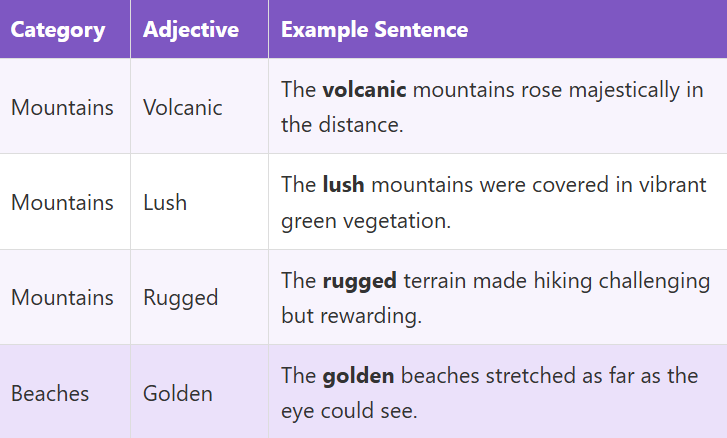
Table of Contents
- Introduction
- Definition of Adjectives
- Structural Breakdown of Adjectives
- Types and Categories of Adjectives
- Examples of Adjectives for Hawaii
- Usage Rules for Adjectives
- Common Mistakes with Adjectives
- Practice Exercises
- Advanced Topics
- Frequently Asked Questions (FAQ)
- Conclusion
Definition of Adjectives
An adjective is a word that modifies a noun or pronoun, providing more information about it. Adjectives add detail, clarity, and richness to our language, allowing us to paint vivid pictures with words.
They answer questions like “What kind?”, “Which one?”, “How many?”, and “How much?” about the nouns or pronouns they modify.
Classification
Adjectives can be classified based on their function and the type of information they provide. Some adjectives describe qualities, while others specify quantity, identity, or possession.
Understanding these classifications helps in using adjectives more effectively. For example, knowing whether an adjective is descriptive or quantitative can influence its placement in a sentence and its impact on the reader.
Function
The primary function of an adjective is to modify a noun or pronoun. This modification can involve describing a quality (beautiful sunset), specifying a quantity (three surfers), identifying a particular item (this island), or indicating possession (my lei). Adjectives enhance our understanding of the nouns and pronouns they accompany, making our language more precise and expressive.
Contexts
Adjectives are versatile and can be used in various contexts, from formal writing to casual conversation. The choice of adjectives can significantly impact the tone and style of your communication.
In academic writing, precise and informative adjectives are preferred, while in creative writing, more evocative and imaginative adjectives are often used to create a specific mood or atmosphere. Consider the audience and purpose of your communication when selecting adjectives.
Structural Breakdown of Adjectives
Adjectives typically precede the nouns they modify (e.g., blue ocean) but can also follow linking verbs like “is,” “are,” “was,” and “were” (e.g., The ocean is blue). Understanding this structural flexibility allows for more varied and engaging sentence construction. Some adjectives can be modified by adverbs to further refine their meaning (e.g., very beautiful).
The structure of adjectives themselves can be simple (e.g., big) or complex, involving prefixes (e.g., unforgettable) and suffixes (e.g., tropical). Recognizing these structural elements helps in understanding the meaning and usage of a wider range of adjectives. For instance, understanding the suffix “-al” can help decipher the meaning of words like “cultural” and “historical.”
Types and Categories of Adjectives
Adjectives come in various types, each serving a distinct purpose in describing nouns and pronouns. Understanding these categories can help you choose the most appropriate adjective for a given context.
Descriptive Adjectives
Descriptive adjectives, also known as qualitative adjectives, describe the qualities or characteristics of a noun. They answer the question “What kind?” and provide details about appearance, color, size, shape, texture, and other attributes. Examples include beautiful, large, blue, and soft.
Quantitative Adjectives
Quantitative adjectives indicate the quantity or amount of a noun. They answer the question “How many?” or “How much?” and can be specific numbers (five) or general terms (many, few, some). These adjectives are crucial for providing precise information about the quantity being described.
Demonstrative Adjectives
Demonstrative adjectives point out specific nouns. They include words like this, that, these, and those. They answer the question “Which one?” or “Which ones?” and help to identify particular items from a group. The choice of demonstrative adjective depends on the proximity and number of the nouns being referred to.
Possessive Adjectives
Possessive adjectives indicate ownership or belonging. They include words like my, your, his, her, its, our, and their. They answer the question “Whose?” and specify who or what owns the noun being described. These adjectives are essential for expressing possession clearly and accurately.
Interrogative Adjectives
Interrogative adjectives are used to ask questions about nouns. They include words like which and what. They are always followed by a noun and are used to inquire about specific characteristics or identities. For example, “Which island is your favorite?”
Proper Adjectives
Proper adjectives are formed from proper nouns and are always capitalized. They describe something related to a specific person, place, or thing. For example, “Hawaiian culture” and “American history.” These adjectives add specificity and context to the nouns they modify.
Compound Adjectives
Compound adjectives are formed by combining two or more words, often connected by a hyphen. They act as a single adjective and describe a noun with a specific combined meaning. Examples include world-famous, sun-kissed, and well-known. These adjectives add detail and nuance to descriptions.
Examples of Adjectives for Hawaii
Hawaii offers a wealth of opportunities for descriptive writing. Here are some examples of adjectives that can be used to describe various aspects of the islands.
Describing Landscapes
Hawaii’s landscapes are incredibly diverse, ranging from volcanic mountains to lush rainforests and golden beaches. The following table provides examples of adjectives that can be used to describe these landscapes effectively.
| Category | Adjective | Example Sentence |
|---|---|---|
| Mountains | Volcanic | The volcanic mountains rose majestically in the distance. |
| Mountains | Lush | The lush mountains were covered in vibrant green vegetation. |
| Mountains | Rugged | The rugged terrain made hiking challenging but rewarding. |
| Beaches | Golden | The golden beaches stretched as far as the eye could see. |
| Beaches | Sandy | We walked barefoot on the sandy beaches. |
| Beaches | Secluded | We found a secluded beach perfect for relaxation. |
| Water | Turquoise | The turquoise water was crystal clear. |
| Water | Azure | The azure sea sparkled in the sunlight. |
| Water | Calm | The calm waters were ideal for swimming. |
| Rainforests | Tropical | The tropical rainforest teemed with life. |
| Rainforests | Dense | The dense rainforest was filled with exotic plants. |
| Rainforests | Verdant | The verdant rainforest was a sight to behold. |
| Volcanoes | Active | The active volcano drew many tourists each year. |
| Volcanoes | Dormant | We hiked up a dormant volcano. |
| Cliffs | Dramatic | The dramatic cliffs plunged into the ocean. |
| Cliffs | Sheer | The sheer cliffs were a challenge for climbers. |
| Valleys | Picturesque | The picturesque valleys were perfect for hiking. |
| Valleys | Fertile | The fertile valleys grew many crops. |
| Caves | Mysterious | We explored the mysterious caves near the coast. |
| Caves | Dark | The dark caves were home to bats. |
| Gardens | Exotic | The exotic gardens showcased local flora. |
| Gardens | Lush | The lush gardens were filled with flowers. |
| Waterfalls | Majestic | The majestic waterfalls cascaded down the mountain. |
| Waterfalls | Powerful | The powerful waterfalls roared as they fell. |
| Coastline | Scenic | The scenic coastline offered breathtaking views. |
| Coastline | Rocky | The rocky coastline was home to seals. |
The adjectives in the table above provide a variety of options for describing the diverse landscapes of Hawaii, helping to create vivid and engaging descriptions.
Describing Culture
Hawaiian culture is rich in traditions, music, dance, and art. The following table provides examples of adjectives that can be used to describe various aspects of Hawaiian culture.
| Category | Adjective | Example Sentence |
|---|---|---|
| Music | Melodic | The melodic Hawaiian music filled the air. |
| Music | Traditional | The traditional Hawaiian music told ancient stories. |
| Dance | Graceful | The graceful hula dancers captivated the audience. |
| Dance | Expressive | The expressive hula dance conveyed deep emotions. |
| Festivals | Vibrant | The vibrant festivals celebrated Hawaiian traditions. |
| Festivals | Joyful | The joyful festival brought the community together. |
| People | Friendly | The friendly locals welcomed us with open arms. |
| People | Hospitable | The hospitable people made us feel at home. |
| Art | Intricate | The intricate carvings told stories of the past. |
| Art | Colorful | The colorful artwork depicted scenes of nature. |
| Traditions | Ancient | The ancient traditions have been passed down for generations. |
| Traditions | Sacred | The sacred traditions are deeply respected. |
| Language | Beautiful | The beautiful Hawaiian language is very musical. |
| Language | Unique | The unique Hawaiian language is spoken only in Hawaii. |
| Clothing | Traditional | The traditional Hawaiian clothing is colorful and festive. |
| Clothing | Festive | The festive Hawaiian clothing is worn during celebrations. |
| Leis | Fragrant | The fragrant leis are given as a sign of love. |
| Leis | Beautiful | The beautiful leis are made of fresh flowers. |
| Stories | Fascinating | The fascinating stories are told by elders. |
| Stories | Ancient | The ancient stories are part of Hawaiian history. |
| Crafts | Handmade | The handmade crafts are sold at the local market. |
| Crafts | Unique | The unique crafts represent Hawaiian culture. |
| Values | Respectful | The respectful values are taught to children. |
| Values | Communal | The communal values are important in Hawaiian society. |
These adjectives provide a descriptive vocabulary for discussing and appreciating the rich cultural heritage of Hawaii. They help to convey the beauty and significance of Hawaiian traditions.
Describing Food
Hawaiian cuisine is a delicious blend of flavors and ingredients. From fresh seafood to tropical fruits, there’s something for everyone to enjoy.
The following table provides examples of adjectives that can be used to describe Hawaiian food.
| Category | Adjective | Example Sentence |
|---|---|---|
| Seafood | Fresh | The fresh seafood was caught that morning. |
| Seafood | Delicious | The delicious seafood was cooked perfectly. |
| Fruits | Tropical | The tropical fruits were sweet and juicy. |
| Fruits | Exotic | The exotic fruits had a unique flavor. |
| Poi | Starchy | The starchy poi is a staple food in Hawaii. |
| Poi | Traditional | The traditional poi is made from taro root. |
| Kalua Pig | Smoky | The smoky kalua pig was cooked in an underground oven. |
| Kalua Pig | Tender | The tender kalua pig melted in our mouths. |
| Lomi Salmon | Salty | The salty lomi salmon was refreshing. |
| Lomi Salmon | Savory | The savory lomi salmon was a great appetizer. |
| Haupia | Creamy | The creamy haupia was a delightful dessert. |
| Haupia | Sweet | The sweet haupia was made from coconut milk. |
| Poke | Flavorful | The flavorful poke was seasoned with soy sauce. |
| Poke | Spicy | The spicy poke was a favorite among locals. |
| Shave Ice | Refreshing | The refreshing shave ice was perfect on a hot day. |
| Shave Ice | Colorful | The colorful shave ice was a treat for the eyes. |
| Malasadas | Warm | The warm malasadas were freshly baked. |
| Malasadas | Sweet | The sweet malasadas were covered in sugar. |
| Plate Lunch | Hearty | The hearty plate lunch was a filling meal. |
| Plate Lunch | Satisfying | The satisfying plate lunch was perfect after a long day. |
| Pineapple | Juicy | The juicy pineapple was very sweet. |
| Pineapple | Tangy | The tangy pineapple was a delicious treat. |
| Mango | Ripe | The ripe mango was ready to eat. |
| Mango | Sweet | The sweet mango was very flavorful. |
These adjectives help to describe the diverse and delicious flavors of Hawaiian cuisine, making it easier to share your culinary experiences with others.
Describing People
The people of Hawaii are known for their warmth, friendliness, and Aloha spirit. Here are some adjectives to describe the people you might meet in Hawaii.
| Category | Adjective | Example Sentence |
|---|---|---|
| General | Friendly | The friendly locals greeted us with smiles. |
| General | Kind | The kind people were always willing to help. |
| General | Warm | The warm people were always inviting. |
| Hospitality | Welcoming | The welcoming people made us feel at home. |
| Hospitality | Generous | The generous people shared their food with us. |
| Culture | Traditional | The traditional people uphold Hawaiian customs. |
| Culture | Proud | The proud people shared their heritage with us. |
| Appearance | Tanned | The tanned surfers walked along the beach. |
| Appearance | Relaxed | The relaxed people enjoyed the island life. |
| Spirit | Aloha | The Aloha spirit was felt everywhere we went. |
Describing Activities
Hawaii offers a wide range of activities, from surfing and swimming to hiking and exploring. The following table provides examples of adjectives that can be used to describe these activities.
| Category | Adjective | Example Sentence |
|---|---|---|
| Surfing | Exhilarating | The exhilarating surfing experience was unforgettable. |
| Surfing | Challenging | The challenging waves tested our skills. |
| Swimming | Relaxing | The relaxing swimming in the calm waters was soothing. |
| Swimming | Refreshing | The refreshing swim in the ocean was invigorating. |
| Hiking | Scenic | The scenic hiking trails offered breathtaking views. |
| Hiking | Strenuous | The strenuous hike was worth the effort. |
| Exploring | Adventurous | The adventurous exploration of the island was exciting. |
| Exploring | Educational | The educational tour taught us about Hawaiian history. |
| Snorkeling | Amazing | The amazing snorkeling experience allowed us to see colorful fish. |
| Snorkeling | Peaceful | The peaceful snorkeling in the reef was beautiful. |
Usage Rules for Adjectives
Using adjectives correctly involves understanding their placement, order, and relationship with other words in a sentence.
Adjective Order
When using multiple adjectives to describe a noun, there is a general order to follow. This order is: Opinion, Size, Age, Shape, Color, Origin, Material, and Purpose (OSASCOMP). For example: “a beautiful (opinion) large (size) old (age) round (shape) blue (color) Hawaiian (origin) wooden (material) surf (purpose) board.” While this order isn’t always strictly followed, it provides a helpful guideline for creating natural-sounding sentences.
Here are a few more examples to illustrate adjective order:
- A lovely (opinion) small (size) red (color) flower.
- An old (age) stone (material) wall.
- A delicious (opinion) Hawaiian (origin) dish.
Comparative and Superlative Forms
Adjectives can be used to compare two or more nouns. The comparative form is used to compare two nouns (e.g., bigger, more beautiful), while the superlative form is used to compare three or more nouns (e.g., biggest, most beautiful). For short adjectives, add “-er” for the comparative and “-est” for the superlative. For longer adjectives, use “more” for the comparative and “most” for the superlative.
Here are some examples:
- Comparative: This beach is cleaner than that one.
- Superlative: This is the cleanest beach on the island.
- Comparative: This hike is more challenging than the last one.
- Superlative: This is the most challenging hike on the island.
Articles with Adjectives
When using adjectives with nouns, it’s important to use the correct articles (a, an, the). Use “a” before adjectives that begin with a consonant sound (e.g., a beautiful sunset) and “an” before adjectives that begin with a vowel sound (e.g., an amazing experience). Use “the” when referring to a specific noun that has already been mentioned or is understood (e.g., The beautiful sunset was breathtaking).
Here are some examples:
- A beautiful beach
- An amazing view
- The friendly local
Common Mistakes with Adjectives
Many learners make common mistakes when using adjectives. Here are some of the most frequent errors and how to avoid them:
| Incorrect | Correct | Explanation |
|---|---|---|
| The ocean is more blue than green. | The ocean is bluer than green. | Use “-er” for short adjectives in comparative form. |
| This is the most big island. | This is the biggest island. | Use “-est” for short adjectives in superlative form. |
| A amazing view. | An amazing view. | Use “an” before adjectives starting with a vowel sound. |
| The sunset was very beauty. | The sunset was very beautiful. | Use the correct adjective form. |
| I saw a wooden Hawaiian old surf board. | I saw an old Hawaiian wooden surf board. | Follow the correct adjective order (Age, Origin, Material). |
Practice Exercises
Test your understanding of adjectives with these practice exercises.
Exercise 1: Identifying Adjectives
Identify the adjectives in the following sentences.
| Question | Answer |
|---|---|
| 1. The turquoise water was crystal clear. | turquoise, clear |
| 2. We enjoyed the delicious Hawaiian food. | delicious, Hawaiian |
| 3. The friendly locals welcomed us with open arms. | friendly, open |
| 4. This scenic hike offered breathtaking views. | scenic, breathtaking |
| 5. The warm sun shone brightly. | warm |
| 6. The fragrant flowers filled the air. | fragrant |
| 7. The ancient traditions are still respected. | ancient, respected |
| 8. The adventurous travelers explored the island. | adventurous |
| 9. The quiet beach was perfect for relaxing. | quiet, perfect, relaxing |
| 10. We saw two dolphins swimming. | two |
Exercise 2: Using Comparative and Superlative Adjectives
Complete the following sentences using the comparative or superlative form of the adjective in parentheses.
| Question | Answer |
|---|---|
| 1. This beach is ______ (clean) than that one. | cleaner |
| 2. This is the ______ (beautiful) island in Hawaii. | most beautiful |
| 3. This hike is ______ (challenging) than the last one. | more challenging |
| 4. This is the ______ (big) wave I’ve ever seen. | biggest |
| 5. The weather today is ______ (good) than yesterday. | better |
| 6. This is the ______ (bad) food I have ever tasted. | worst |
| 7. The first lesson was ______ (easy) than the second. | easier |
| 8. This is the ______ (interesting) book I’ve ever read. | most interesting |
| 9. She is ______ (tall) than her sister. | taller |
| 10. This is the ______ (small) town I’ve ever visited. | smallest |
Exercise 3: Describing Hawaii
Write sentences describing Hawaii using the following adjectives. Try to use at least two adjectives in each sentence.
| Adjective | Example Sentence |
|---|---|
| turquoise, clear | The turquoise water was so clear that we could see the fish swimming below. |
| lush, green | The lush, green rainforests are a sight to behold. |
| friendly, welcoming | The friendly, welcoming locals make you feel right at home. |
| delicious, fresh | We enjoyed the delicious, fresh seafood at the local restaurant. |
| scenic, breathtaking | The scenic hike offered breathtaking views of the coastline. |
| warm, sunny | The warm, sunny weather is perfect for swimming. |
| ancient, sacred | The ancient, sacred traditions are still practiced today. |
| peaceful, quiet | The peaceful, quiet beaches are perfect for relaxing. |
| unique, vibrant | The unique, vibrant culture is unlike anything else. |
| exotic, tropical | The exotic, tropical fruits are a delicious treat. |
Advanced Topics
For advanced learners, understanding participial adjectives and adjective clauses can further enhance your descriptive abilities.
Participial Adjectives
Participial adjectives are formed from verbs and function as adjectives. They can be present participles (ending in “-ing”) or past participles (ending in “-ed” or “-en”). For example, “a fascinating story” (present participle) and “a broken surfboard” (past participle). These adjectives add dynamism and action to descriptions.
Here are a few more examples:
- The smiling child waved to us.
- The fallen leaves covered the ground.
- We watched the setting sun.
Adjective Clauses
Adjective clauses, also known as relative clauses, are dependent clauses that modify nouns or pronouns. They begin with relative pronouns (who, whom, which, that) or relative adverbs (where, when, why). These clauses provide additional information about the nouns they modify, adding depth and detail to sentences. For example, “The island that I visited was beautiful.”
Here are some examples:
- The surfer who won the competition is from Hawaii.
- The beach where we swam was very crowded.
- The restaurant that serves local cuisine is highly recommended.
Frequently Asked Questions (FAQ)
Here are some frequently asked questions about using adjectives effectively.
What is the difference between a descriptive adjective and a quantitative adjective?
Descriptive adjectives describe the qualities or characteristics of a noun (e.g., beautiful beach), while quantitative adjectives indicate the quantity or amount of a noun (e.g., three surfers).
How do I know when to use “a” or “an” before an adjective?
Use “a” before adjectives that begin with a consonant sound (e.g., a beautiful sunset) and “an” before adjectives that begin with a vowel sound (e.g., an amazing experience).
What is the correct order of adjectives when using multiple adjectives to describe a noun?
The general order of adjectives is: Opinion, Size, Age, Shape, Color, Origin, Material, and Purpose (OSASCOMP). For example: “a beautiful large old round blue Hawaiian wooden surf board.”
How do I form the comparative and superlative forms of adjectives?
For short adjectives, add “-er” for the comparative and “-est” for the superlative (e.g., cleaner, cleanest). For longer adjectives, use “more” for the comparative and “most” for the superlative (e.g., more beautiful, most beautiful).
What are participial adjectives, and how are they used?
Participial adjectives are formed from verbs and function as adjectives. They can be present participles (ending in “-ing”) or past participles (ending in “-ed” or “-en”). For example, “a fascinating story” (present participle) and “a broken surfboard” (past participle).
Conclusion
Mastering adjectives for Hawaii is an ongoing journey that enhances your ability to describe and appreciate the unique beauty and culture of the islands. By understanding the different types of adjectives, their usage rules, and common mistakes to avoid, you can effectively communicate your experiences and impressions of Hawaii.
Whether you’re writing stories, giving presentations, or simply sharing your travel adventures, a strong command of descriptive language will help you bring the spirit of Aloha to life.