

Understanding the nuances of adjectives that describe height is crucial for effective communication. While “tall” is a common and straightforward descriptor, English offers a rich variety of words to depict different degrees and types of tallness.
Mastering these adjectives allows for more precise and vivid descriptions, enhancing both written and spoken language. This guide provides an in-depth exploration of adjectives for tall, their specific meanings, and how to use them correctly.
This article is perfect for English language learners, writers, and anyone looking to expand their vocabulary and improve their descriptive abilities.
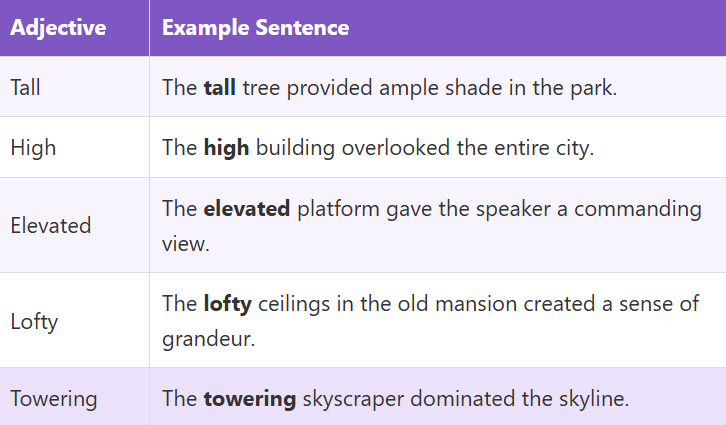
Table of Contents
- Introduction
- Definition of Adjectives for Tall
- Structural Breakdown
- Types and Categories of Adjectives for Tall
- Examples of Adjectives for Tall
- Usage Rules for Adjectives for Tall
- Common Mistakes
- Practice Exercises
- Advanced Topics
- FAQ
- Conclusion
Definition of Adjectives for Tall
Adjectives for “tall” are words that describe something exceeding the average or expected height. These adjectives modify nouns, providing more specific information about their vertical dimension.
They can convey different aspects of tallness, such as impressive stature, slenderness, or awkwardness. Understanding the nuances of these adjectives is essential for precise and descriptive writing and speech.
The function of these adjectives is to add detail and create a clearer mental image for the reader or listener.
The classification of these adjectives falls under descriptive adjectives, as they describe a quality or characteristic of a noun. The context in which these adjectives are used is crucial.
For instance, “towering” might be appropriate for describing a building but less so for describing a person. Similarly, “lanky” is suitable for describing a person but not a tree.
The choice of adjective depends on the specific noun being modified and the desired effect.
Structural Breakdown
Adjectives for “tall” typically precede the noun they modify in English. This is the standard adjective-noun order.
For example, “a towering skyscraper” or “a lanky teenager.” However, they can also follow a linking verb such as “be,” “seem,” or “appear.” For example, “The building is towering,” or “He seems lanky.”
Many adjectives for “tall” can be modified by adverbs of degree, such as “very,” “extremely,” “incredibly,” or “slightly.” For example, “a very tall building” or “a slightly lanky boy.” These adverbs further refine the degree of tallness being described. Some adjectives, particularly those that are already strong in meaning (e.g., “towering,” “sky-high”), are less commonly modified by adverbs.
Comparative and superlative forms are also common. The comparative form (e.g., “taller,” “more towering”) is used to compare the height of two things, while the superlative form (e.g., “tallest,” “most towering”) is used to indicate the greatest height among three or more things.
The formation of comparative and superlative forms depends on the length and structure of the adjective. Shorter adjectives typically add “-er” and “-est,” while longer adjectives use “more” and “most.”
Types and Categories of Adjectives for Tall
General Height
These adjectives describe height without implying any particular characteristic beyond being above average. They are neutral and widely applicable.
Impressive Height
These adjectives convey a sense of grandeur, dominance, or awe-inspiring height. They often suggest that the height is remarkable or imposing.
Slender Height
These adjectives describe height combined with thinness or a lack of bulk. They often suggest a graceful or delicate appearance.
Awkward Height
These adjectives describe height that is perceived as ungainly, disproportionate, or causing clumsiness. They often suggest a lack of coordination or grace.
Comparative Height
These are adjectives used to compare heights of different objects or people. They indicate how one entity’s height relates to another’s.
Examples of Adjectives for Tall
General Height Examples
The following table provides examples of adjectives describing general height, showcasing their usage in sentences. These examples illustrate how these adjectives are used in context to describe objects and people with above-average height.
| Adjective | Example Sentence |
|---|---|
| Tall | The tall tree provided ample shade in the park. |
| High | The high building overlooked the entire city. |
| Elevated | The elevated platform gave the speaker a commanding view. |
| Lofty | The lofty ceilings in the old mansion created a sense of grandeur. |
| Towering | The towering skyscraper dominated the skyline. |
| Soaring | The soaring mountains reached towards the sky. |
| Giant | The giant sequoia trees are a sight to behold. |
| Big | He is a big man, standing over six feet tall. |
| Long | The long bridge stretched across the wide river. |
| Extended | The extended antenna improved the radio’s reception. |
| Upright | The upright statue stood proudly in the town square. |
| Vertical | The vertical climb was challenging for the hikers. |
| Stilted | The stilted houses were built to withstand flooding. |
| Ample | The room had ample height for a chandelier. |
| Considerable | The building had a considerable height. |
| Significant | The tower has a significant height. |
| Substantial | The wall has a substantial height. |
| Remarkable | The mountain had a remarkable height. |
| Imposing | The structure had an imposing height. |
| Prominent | The monument had a prominent height. |
| Noticeable | The difference in height was noticeable. |
| Appreciable | There was an appreciable height difference. |
| Respectable | The building has a respectable height. |
| Sizable | The hill has a sizable height. |
| Goodly | The tree had a goodly height. |
| Fair | The building has a fair height. |
Impressive Height Examples
The following examples showcase adjectives that describe impressive height. These adjectives evoke a sense of grandeur, dominance, or awe, emphasizing the remarkable nature of the height being described.
| Adjective | Example Sentence |
|---|---|
| Towering | The towering cliffs inspired awe in the climbers. |
| Majestic | The majestic mountains stood as silent guardians. |
| Imposing | The imposing castle dominated the landscape. |
| Grandiose | The grandiose cathedral featured intricate spires. |
| Monumental | The monumental statue commemorated the nation’s heroes. |
| Sky-high | The sky-high prices made the apartment unaffordable. |
| Colossal | The colossal statue was a marvel of engineering. |
| Stately | The stately oak tree stood for centuries. |
| Regal | The regal palm trees lined the avenue. |
| Elevated | The elevated view from the summit was breathtaking. |
| Sublime | The sublime height of the waterfall was mesmerizing. |
| Exalted | The exalted peak was shrouded in mist. |
| Supreme | The supreme height of the Himalayas is unmatched. |
| Overwhelming | The overwhelming height of the dam was intimidating. |
| Commanding | The commanding view from the tower was spectacular. |
| Heroic | The heroic cliffs stood against the sea. |
| Epic | The epic height of the mountain was a challenge to climb. |
| Imperial | The imperial height of the palace was impressive. |
| Grand | The grand height of the monument made it a landmark. |
| Magnificent | The magnificent height of the waterfall was breathtaking. |
| Awesome | The awesome height of the cliffs was intimidating. |
| Remarkable | The remarkable height of the building made it stand out. |
| Spectacular | The spectacular height of the mountain was a sight to behold. |
| Impressive | The impressive height of the tower made it a landmark. |
| Striking | The striking height of the cliffs made them stand out. |
| Distinguished | The distinguished height of the building made it recognizable. |
Slender Height Examples
The following table provides examples of adjectives describing slender height, which is characterized by height combined with thinness or a lack of bulk. These adjectives often suggest a graceful or delicate appearance.
| Adjective | Example Sentence |
|---|---|
| Lanky | The lanky teenager was still growing into his limbs. |
| Lean | The lean athlete excelled in high jump. |
| Slender | The slender column supported the roof. |
| Thin | The thin spire reached towards the heavens. |
| Spindly | The spindly legs of the table looked fragile. |
| Gangly | The gangly youth was self-conscious about his height. |
| Ethereal | The ethereal figure of the dancer seemed to float. |
| Willowy | The willowy model glided down the runway. |
| Graceful | The graceful swan glided across the lake. |
| Elegant | The elegant vase stood tall on the table. |
| Svelte | The svelte figure of the ballerina was admired. |
| Slim | The slim tree swayed in the breeze. |
| Delicate | The delicate stem of the flower was easily broken. |
| Fine | The fine thread was used for intricate embroidery. |
| Tenuous | The tenuous support barely held the weight. |
| Narrow | The narrow tower had a spiral staircase. |
| Reedy | The reedy stalks swayed in the wind. |
| Elongated | The elongated stem of the plant allowed it to reach sunlight. |
| Stalky | The stalky plants grew quickly in the garden. |
| Lithe | The lithe dancer moved with ease. |
| Lanky | The lanky basketball player had long arms. |
| Upright | The upright plant had a slender stem. |
| Slight | The slight tree swayed in the wind. |
| Fragile | The fragile stem of the plant was easily damaged. |
| Weak | The weak stem of the plant could not support the flower. |
| Frail | The frail stem of the plant was easily broken. |
Awkward Height Examples
These examples illustrate adjectives describing awkward height, which is perceived as ungainly, disproportionate, or causing clumsiness. These adjectives often suggest a lack of coordination or grace.
| Adjective | Example Sentence |
|---|---|
| Gangly | The gangly teenager tripped over his own feet. |
| Ungainly | The ungainly crane struggled to lift the heavy load. |
| Clumsy | The clumsy giraffe knocked over the fence. |
| Awkward | The awkward ladder wobbled precariously. |
| Lanky | His lanky frame made him look out of place on the small bike. |
| Gawky | The gawky bird struggled to take flight. |
| Unwieldy | The unwieldy pole was difficult to maneuver. |
| Lumbering | The lumbering giant moved slowly and heavily. |
| Spindly | The spindly legs of the table looked unstable. |
| Disproportionate | The disproportionate tower looked like it would topple. |
| Stilted | The stilted movements of the puppet were unnatural. |
| Uncoordinated | The uncoordinated dancer struggled to keep up. |
| Blundering | The blundering oaf stumbled through the room. |
| Heavy-footed | The heavy-footed giant shook the ground with each step. |
| Inelegant | The inelegant structure looked out of place. |
| Unskillful | The unskillful worker struggled to build the tower. |
| Rough | The rough structure had uneven height. |
| Unstable | The unstable tower was a safety hazard. |
| Precarious | The precarious structure looked ready to fall. |
| Rickety | The rickety ladder was not safe to climb. |
| Wobbly | The wobbly tower swayed in the wind. |
| Unsteady | The unsteady tower looked like it would collapse. |
| Floundering | The floundering giraffe struggled to stand up. |
| Stumbling | The stumbling giant tripped over a rock. |
| Groping | The groping figure reached for the top of the tower. |
| Unwielding | The unwielding structure was difficult to manage. |
Comparative Height Examples
The following table provides examples of comparative adjectives for height. These adjectives are used to compare the heights of different objects or people, indicating how one entity’s height relates to another’s.
| Adjective | Example Sentence |
|---|---|
| Taller | John is taller than his brother. |
| Higher | The mountain is higher than the hill. |
| Loftier | The new building has loftier ceilings than the old one. |
| More towering | The newer skyscraper is more towering than the older one. |
| More elevated | The more elevated platform provided a better view. |
| Larger | The giraffe is larger than the zebra. |
| Longer | The new bridge is longer than the old one. |
| More extended | The more extended antenna improved the signal. |
| More upright | The more upright statue stood out in the square. |
| More vertical | The more vertical climb was challenging. |
| More stilted | The more stilted houses were better protected from floods. |
| More ample | The room had more ample height for a larger chandelier. |
| More considerable | The building had a more considerable height than expected. |
| More significant | The tower had a more significant height after the addition. |
| More substantial | The wall had a more substantial height after the repairs. |
| More remarkable | The mountain had a more remarkable height than its neighbors. |
| More imposing | The structure was more imposing in its new location. |
| More prominent | The monument had a more prominent height after being raised. |
| More noticeable | The change in height was more noticeable after the renovation. |
| More appreciable | There was a more appreciable height difference between the two buildings. |
| More respectable | The building had a more respectable height than others in the area. |
| More sizable | The hill had a more sizable height than it appeared from a distance. |
| More goodly | The tree had a more goodly height after it was pruned. |
| More fair | The building had a more fair height compared to its width. |
| More lanky | He is more lanky than his older brother. |
| More lean | The newer tower is more lean than the older one. |
Usage Rules for Adjectives for Tall
The primary rule is to ensure that the adjective agrees in meaning with the noun it modifies. For example, you wouldn’t describe a building as “lanky” because that adjective implies a slender, somewhat awkward height typically associated with people.
Instead, you might use “towering” or “imposing.”
When using multiple adjectives, the order generally follows the sequence: opinion, size, physical quality, shape, age, color, origin, material, and type, purpose. For example, “a beautiful tall oak tree.” Here, “beautiful” is an opinion, “tall” is a size, “oak” is the origin, and “tree” is the noun.
However, this order is not rigid, and native speakers often deviate from it based on emphasis and flow.
Be mindful of the connotations of different adjectives. Some adjectives, like “towering” or “majestic,” carry positive connotations of grandeur and impressiveness.
Others, like “gangly” or “spindly,” can have negative connotations, suggesting awkwardness or fragility. Choose adjectives that accurately reflect the intended meaning and tone.
When using comparative and superlative forms, ensure they are grammatically correct. Short adjectives typically add “-er” and “-est” (e.g., “taller,” “tallest”), while longer adjectives use “more” and “most” (e.g., “more towering,” “most towering”).
Avoid using both forms together (e.g., “more taller” is incorrect).
Common Mistakes
A common mistake is using “high” and “tall” interchangeably. “Tall” generally refers to the vertical measurement of something that stands upright, like a person or a building.
“High” refers to the distance above a reference point, like a mountain or an altitude. For example:
- Incorrect: The high man.
- Correct: The tall man.
- Incorrect: The tall altitude.
- Correct: The high altitude.
Another mistake is using adjectives with inappropriate connotations. For example:
- Incorrect: The spindly skyscraper. (Spindly implies fragility, which is not typically associated with skyscrapers.)
- Correct: The towering skyscraper.
Using double comparatives or superlatives is also incorrect:
- Incorrect: more taller
- Correct: taller
- Incorrect: most tallest
- Correct: tallest
Here is a table summarizing common mistakes:
| Incorrect | Correct | Explanation |
|---|---|---|
| The high man. | The tall man. | “Tall” is used for people, “high” for altitude or elevation. |
| The spindly skyscraper. | The towering skyscraper. | “Spindly” implies fragility, inappropriate for a skyscraper. |
| more taller | taller | Avoid double comparatives. |
| most tallest | tallest | Avoid double superlatives. |
| The lanky building. | The towering building. | Lanky refers to people or animals. |
| This building is more higher than that one. | This building is higher than that one. | Avoid using “more” with words ending in “-er.” |
Practice Exercises
Complete the following sentences with the most appropriate adjective for “tall” from the list provided. Choose from: tall, towering, lanky, high, imposing.
- The _________ mountain range stretched across the horizon.
- He was a _________ teenager, all arms and legs.
- The _________ skyscraper dominated the city skyline.
- The _________ shelf was difficult to reach.
- The _________ figure of the king commanded respect.
Answers:
- high
- lanky
- towering
- high
- imposing
Choose the correct adjective from the options in parentheses to complete each sentence.
- The (tallest, highest) building in the city is the Empire State Building.
- He is (taller, higher) than his sister.
- The (more towering, taller) of the two trees was struck by lightning.
- The (most imposing, tallest) castle stood on a hill overlooking the village.
- The (lankiest, tallest) player on the basketball team was the point guard.
Answers:
- tallest
- taller
- taller
- most imposing
- tallest
Rewrite the following sentences using a more descriptive adjective for “tall.”
- The tall building was visible from miles away.
- He was a tall man with a slender build.
- The tall mountain was covered in snow.
- The tall tree provided shade for the picnic.
- The tall tower stood in the center of the town.
Possible Answers:
- The towering building was visible from miles away.
- He was a lanky man with a slender build.
- The majestic mountain was covered in snow.
- The lofty tree provided shade for the picnic.
- The imposing tower stood in the center of the town.
Complete the following table with appropriate adjectives for tall:
| Noun | Adjective for Tall |
|---|---|
| Tree | _________ |
| Person | _________ |
| Mountain | _________ |
| Building | _________ |
| Tower | _________ |
| Statue | _________ |
| Cliff | _________ |
| Plant | _________ |
| Athlete | _________ |
| Bridge | _________ |
Possible Answers:
| Noun | Adjective for Tall |
|---|---|
| Tree | Lofty |
| Person | Tall |
| Mountain | High |
| Building | Towering |
| Tower | Imposing |
| Statue | Monumental |
| Cliff | Towering |
| Plant | Stalky |
| Athlete | Lanky |
| Bridge | Long |
Advanced Topics
Figurative language often employs adjectives for “tall” to create vivid imagery and convey abstract concepts. For example, “towering intellect” or “sky-high ambitions.” These expressions use the literal meaning of height to represent qualities such as intelligence, ambition, or success.
Understanding these figurative uses requires a deeper understanding of English idioms and metaphors.
The historical and cultural context can also influence the perception and use of adjectives for “tall.” In some cultures, height is associated with power, authority, or prestige. In others, it may be viewed as less significant.
The choice of adjective can reflect these cultural values and beliefs.
The use of adjectives for “tall” can also be analyzed from a stylistic perspective. Writers often choose specific adjectives to create a particular mood, tone, or atmosphere.
For example, using “towering” in a description of a castle might evoke a sense of grandeur and power, while using “spindly” might create a sense of fragility and vulnerability. The careful selection of adjectives can enhance the overall impact of a piece of writing.
FAQ
- What is the difference between “tall” and “high”?“Tall” generally describes the vertical dimension of something that stands upright, like a person or a building. “High” describes the distance above a reference point, like a mountain or an altitude.
- When should I use “towering” instead of “tall”?“Towering” implies an impressive or imposing height. Use it when you want to emphasize the grandeur or dominance of something.
- Is it correct to say “more taller”?No, it is incorrect. Use “taller” instead, as it already conveys the comparative meaning.
- Can I use “lanky” to describe a building?No, “lanky” is typically used to describe people or animals with a slender, somewhat awkward height. Use adjectives like “towering” or “imposing” for buildings.
- What is the correct order of adjectives when describing something tall?The general order is: opinion, size, physical quality, shape, age, color, origin, material, and type, purpose. For example, “a beautiful tall oak tree.”
- How can I improve my vocabulary of adjectives for “tall”?Read widely, pay attention to how different adjectives are used in context, and practice using them in your own writing and speech.
- What are some common mistakes to avoid when using adjectives for “tall”?Avoid using “high” and “tall” interchangeably, using adjectives with inappropriate connotations, and using double comparatives or superlatives.
- What is the superlative form of “towering”?The superlative form of “towering” is “most towering.”
- Are there any regional differences in the usage of these adjectives?While the basic meanings are consistent, certain adjectives might be more commonly used in specific regions or dialects. Pay attention to local usage when possible.
- How do I choose the best adjective for “tall” in a given situation?Consider the specific noun you are
modifying, the desired effect, and the connotations of the adjective. Choose the adjective that most accurately and effectively conveys the intended meaning.
Conclusion
Mastering adjectives for “tall” enhances your ability to communicate precisely and vividly. By understanding the nuances of different adjectives, such as “towering,” “lanky,” and “high,” you can create more descriptive and engaging language.
Avoid common mistakes, such as using “high” and “tall” interchangeably or using double comparatives, and practice using a variety of adjectives in your writing and speech. With a rich vocabulary of height descriptors, you can effectively convey the specific qualities of tallness in various contexts, enriching your communication and making your language more impactful.
Whether you are describing a building, a person, or a mountain, the right adjective can make all the difference in creating a clear and compelling image.