

Understanding how to effectively use adjectives to describe an enemy is crucial for vivid and precise communication. This article explores a wide range of adjectives that can be used to depict enemies, examining their nuances and contextual appropriateness.
Whether you’re a student, writer, or language enthusiast, mastering these adjectives will enhance your descriptive abilities and deepen your understanding of English grammar. This guide provides definitions, examples, usage rules, and practice exercises to help you confidently utilize these words in your writing and speech.
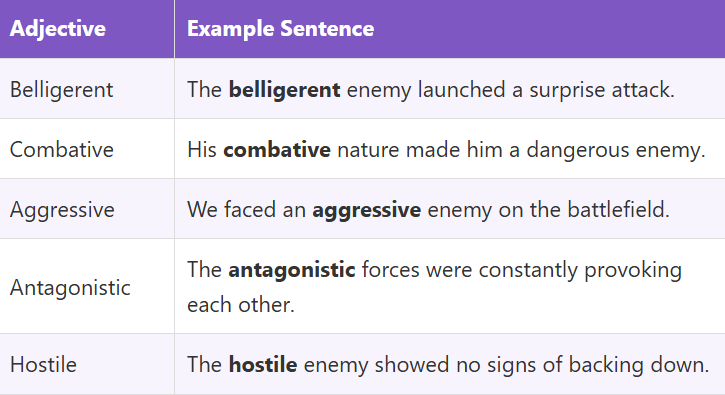
Table of Contents
- Introduction
- Definition of Adjectives for Enemy
- Structural Breakdown
- Types and Categories of Adjectives for Enemy
- Examples of Adjectives for Enemy
- Usage Rules for Adjectives Describing Enemies
- Common Mistakes
- Practice Exercises
- Advanced Topics
- FAQ
- Conclusion
Definition of Adjectives for Enemy
Adjectives used to describe an enemy are words that modify nouns (people, places, or things) associated with opposition, antagonism, or conflict. They provide descriptive details about the enemy’s nature, behavior, capabilities, or impact.
These adjectives can convey a wide range of emotions and perspectives, adding depth and specificity to your language. Understanding the nuances of these adjectives is essential for effective communication and descriptive writing.
Classification: Adjectives can be classified based on their function (descriptive, limiting, possessive, etc.) and their form (simple, compound, participial). Adjectives describing enemies primarily fall under the descriptive category, as they aim to provide qualities or characteristics. For example, “a formidable enemy” uses the adjective ‘formidable’ to describe the enemy’s strength and imposing nature.
Function: The primary function of these adjectives is to provide more information about the enemy, enriching the description and allowing for a more nuanced understanding. They can highlight aspects such as the enemy’s level of danger, their moral character, their tactics, or their overall impact on the situation. For instance, describing an enemy as “a treacherous enemy” immediately conveys their deceitful and untrustworthy nature.
Contexts: These adjectives are used in a variety of contexts, including literature, journalism, history, and everyday conversation. The choice of adjective depends on the specific message you want to convey and the audience you are addressing. In historical accounts, you might read about “implacable foes,” while in a fictional narrative, you might encounter “shadowy adversaries.” The key is to select adjectives that accurately and effectively portray the enemy in the given situation.
Structural Breakdown
Understanding the structure of adjective phrases involving descriptions of enemies helps in constructing grammatically correct and contextually appropriate sentences. Adjectives typically precede the noun they modify, creating phrases like “vicious enemy” or “relentless adversary.” These structures can be expanded by adding adverbs to modify the adjective itself, such as “extremely dangerous enemy” or “utterly ruthless adversary.”
Adjectives can also be used predicatively, following a linking verb such as “is,” “was,” “seems,” or “appears.” In this construction, the adjective still describes the enemy but is placed after the verb. For example, “The enemy is powerful” or “The adversary appears unyielding.” This construction can provide a different emphasis or flow to the sentence.
Complex adjective phrases can involve multiple adjectives, sometimes separated by commas or conjunctions. For example, “a cunning, ruthless enemy” or “a powerful and deceptive adversary.” The order of adjectives can sometimes be significant, with general adjectives often preceding more specific ones. However, in the context of describing enemies, the primary consideration is usually the impact and clarity of the description.
Types and Categories of Adjectives for Enemy
Adjectives for describing enemies can be grouped into several categories based on the specific qualities or characteristics they convey. Here are some key categories:
Hostile Adjectives
These adjectives emphasize the enemy’s antagonistic and aggressive nature. They highlight the enemy’s intent to cause harm or engage in conflict.
Deceptive Adjectives
These adjectives focus on the enemy’s use of trickery, deceit, or manipulation. They suggest that the enemy cannot be trusted and may use underhanded tactics.
Powerful Adjectives
These adjectives highlight the enemy’s strength, influence, or resources. They convey a sense of the enemy’s formidable capabilities.
Ruthless Adjectives
These adjectives emphasize the enemy’s lack of compassion or mercy. They suggest that the enemy is willing to use any means necessary to achieve their goals.
Strategic Adjectives
These adjectives focus on the enemy’s calculated and planned approach to conflict. They suggest that the enemy is intelligent and methodical in their actions.
Despicable Adjectives
These adjectives convey a sense of moral repugnance or contempt for the enemy. They highlight the enemy’s loathsome or reprehensible qualities.
Examples of Adjectives for Enemy
The following tables provide examples of adjectives used to describe enemies, categorized by their specific connotations. Each table includes a wide range of adjectives to illustrate the diversity of options available.
This table showcases various hostile adjectives that vividly describe an enemy, highlighting their aggressive and antagonistic nature. These adjectives help to paint a clear picture of the enemy’s intent to cause harm or engage in conflict.
| Adjective | Example Sentence |
|---|---|
| Belligerent | The belligerent enemy launched a surprise attack. |
| Combative | His combative nature made him a dangerous enemy. |
| Aggressive | We faced an aggressive enemy on the battlefield. |
| Antagonistic | The antagonistic forces were constantly provoking each other. |
| Hostile | The hostile enemy showed no signs of backing down. |
| Warlike | The warlike nation was known for its aggressive expansion. |
| Fierce | The fierce enemy fought with unmatched intensity. |
| Violent | The violent enemy terrorized the civilian population. |
| Militant | The militant group posed a serious threat to the region. |
| Truculent | His truculent demeanor made him a difficult enemy to negotiate with. |
| Pugnacious | The pugnacious opponent was always ready for a fight. |
| Assaultive | The assaultive tactics of the enemy were brutal. |
| Quarrelsome | The quarrelsome tribe was constantly at war with its neighbors. |
| Defiant | The defiant enemy refused to surrender. |
| Implacable | The implacable foe sought nothing less than total destruction. |
| Irreconcilable | Their differences were irreconcilable, leading to perpetual conflict. |
| Rival | The rival faction sought to undermine our power. |
| Opposing | The opposing army was well-equipped and determined. |
| Contentious | The contentious nature of the debate fueled the animosity. |
| Inimical | The inimical forces threatened the stability of the region. |
| Adversarial | The adversarial relationship between the two companies intensified. |
| Confrontational | His confrontational style made him a formidable enemy in negotiations. |
| Scrapping | The two scrapping nations had been at odds for centuries. |
| Brawling | The brawling gangs fought for control of the territory. |
| Agonistic | The agonistic behavior of the animals mirrored the conflict between the tribes. |
This table presents deceptive adjectives which highlight the enemy’s use of trickery, deceit, or manipulation. These adjectives suggest that the enemy cannot be trusted and may resort to underhanded tactics.
| Adjective | Example Sentence |
|---|---|
| Deceptive | The deceptive enemy used propaganda to mislead the public. |
| Treacherous | He was betrayed by a treacherous enemy. |
| Cunning | The cunning enemy devised an elaborate trap. |
| Insidious | The insidious enemy infiltrated our ranks. |
| Scheming | The scheming villain plotted his revenge. |
| Duplicitous | The duplicitous politician was exposed for his lies. |
| Artful | The artful enemy manipulated events to their advantage. |
| Wily | The wily fox outsmarted the hunter. |
| Sly | The sly enemy concealed their true intentions. |
| Guileful | His guileful tactics were difficult to detect. |
| Underhanded | The underhanded methods of the enemy were unethical. |
| Fraudulent | The fraudulent scheme was designed to deceive investors. |
| Deceitful | The deceitful enemy spread false rumors. |
| Machiavellian | His Machiavellian approach to politics was ruthless. |
| Conniving | The conniving adversary always had a hidden agenda. |
| Tricky | The tricky puzzle was designed to confuse. |
| Illusive | The illusive enemy was difficult to track down. |
| Evasive | His evasive answers raised suspicion. |
| Shifty | The shifty character couldn’t be trusted. |
| Subtle | The subtle manipulations of the enemy went unnoticed for a long time. |
| Crafty | The crafty lawyer won the case with clever arguments. |
| Chicanerous | His chicanerous methods were unethical but effective. |
| Beguiling | The beguiling offer seemed too good to be true. |
| Misleading | The misleading information caused confusion. |
| Perfidious | The perfidious ally betrayed our trust. |
This table provides examples of powerful adjectives that highlight the enemy’s strength, influence, or resources. These adjectives convey a sense of the enemy’s formidable capabilities.
| Adjective | Example Sentence |
|---|---|
| Powerful | The powerful empire controlled vast territories. |
| Formidable | We faced a formidable enemy in the war. |
| Dominant | The dominant species ruled the ecosystem. |
| Influential | The influential leader shaped the nation’s policies. |
| Potent | The potent drug had a significant effect. |
| Strong | The strong army was well-equipped and trained. |
| Mighty | The mighty king ruled with an iron fist. |
| Commanding | His commanding presence demanded respect. |
| Imposing | The imposing fortress stood on the hilltop. |
| Unstoppable | The unstoppable force advanced relentlessly. |
| Invincible | The invincible army had never been defeated. |
| Overwhelming | The overwhelming odds were against us. |
| Supreme | The supreme ruler held absolute power. |
| Preeminent | The preeminent scholar was an expert in his field. |
| Vigorous | The vigorous economy showed strong growth. |
| Resilient | The resilient nation recovered quickly from the disaster. |
| Robust | The robust system was able to withstand the attack. |
| Tenacious | The tenacious negotiator refused to give up. |
| Daunting | The daunting task seemed impossible to complete. |
| Redoubtable | The redoubtable opponent was a force to be reckoned with. |
| Formidable | Their formidable navy controlled the seas. |
| Assertive | The assertive leader took control of the situation. |
| Authoritative | The authoritative figure commanded respect. |
| Dominating | The dominating team won every game. |
| Unyielding | The unyielding enemy refused to negotiate. |
This table showcases ruthless adjectives which emphasize the enemy’s lack of compassion or mercy. These adjectives suggest that the enemy is willing to use any means necessary to achieve their goals.
| Adjective | Example Sentence |
|---|---|
| Ruthless | The ruthless dictator showed no mercy to his opponents. |
| Merciless | The merciless enemy slaughtered the prisoners. |
| Brutal | The brutal regime suppressed all dissent. |
| Cruel | The cruel master treated his slaves inhumanely. |
| Savage | The savage tribe was known for its ferocity. |
| Inhuman | The inhuman treatment of the prisoners shocked the world. |
| Callous | The callous landlord evicted the tenants without warning. |
| Heartless | The heartless villain reveled in the suffering of others. |
| Unfeeling | The unfeeling bureaucrat denied the request without explanation. |
| Remorseless | The remorseless killer showed no regret for his crimes. |
| Pitiless | The pitiless storm destroyed the entire village. |
| Relentless | The relentless pursuit continued day and night. |
| Unsparing | The unsparing critic tore apart the performance. |
| Vicious | The vicious attack left the victim severely injured. |
| Ferocious | The ferocious beast defended its territory. |
| Barbaric | The barbaric customs were outlawed. |
| Monstrous | The monstrous act was beyond comprehension. |
| Atrocious | The atrocious conditions in the prison were appalling. |
| Fiendish | The fiendish plot was designed to cause maximum chaos. |
| Grim | The grim reaper claimed another victim. |
| Hardhearted | The hardhearted judge delivered a harsh sentence. |
| Severe | The severe punishment was meant to deter others. |
| Austere | The austere leader demanded strict obedience. |
| Inexorable | The inexorable march of time cannot be stopped. |
| Uncompromising | The uncompromising negotiator refused to budge. |
Usage Rules for Adjectives Describing Enemies
When using adjectives to describe enemies, it’s important to follow certain grammatical rules and consider the context in which the adjectives are used. Here are some key rules:
- Adjective Placement: Adjectives typically precede the noun they modify. For example, “a dangerous enemy” is correct, while “an enemy dangerous” is incorrect in standard English.
- Multiple Adjectives: When using multiple adjectives, follow the general order of adjectives: opinion, size, age, shape, color, origin, material, and purpose. However, this order can be flexible depending on the specific meaning you want to convey. For example, “a vicious, foreign enemy” or “a powerful, ancient foe.”
- Comparative and Superlative Forms: Use the comparative form (e.g., “more dangerous”) to compare two enemies and the superlative form (e.g., “most dangerous”) to compare three or more. For example, “He is a more dangerous enemy than I thought” or “She is the most ruthless enemy we have ever faced.”
- Linking Verbs: When using adjectives after linking verbs (e.g., “is,” “was,” “seems”), the adjective describes the subject of the sentence. For example, “The enemy is powerful” or “The adversary seems unyielding.”
- Contextual Appropriateness: Choose adjectives that accurately and effectively convey the intended meaning in the given context. Consider the tone, audience, and purpose of your writing or speech.
Common Mistakes
Learners often make certain common mistakes when using adjectives to describe enemies. Here are some examples and corrections:
- Incorrect Word Order:
- Incorrect: “an enemy dangerous”
- Correct: “a dangerous enemy”
- Misusing Comparative and Superlative Forms:
- Incorrect: “He is the dangerousest enemy.”
- Correct: “He is the most dangerous enemy.”
- Using Incorrect Adjective Form:
- Incorrect: “The enemy is ruthlessness.”
- Correct: “The enemy is ruthless.”
- Inappropriate Adjective Choice:
- Incorrect: “The friendly enemy.” (Unless used ironically)
- Correct: “The antagonistic enemy.”
- Redundancy:
- Incorrect: “The very ruthless and cruel enemy.”
- Correct: “The ruthless enemy.” or “The cruel enemy.”
Understanding these common mistakes and their corrections can help you avoid errors and use adjectives more effectively.
Practice Exercises
Test your understanding of adjectives for describing enemies with these practice exercises. Each exercise includes multiple questions to help you reinforce your knowledge.
Exercise 1: Fill in the Blanks
Complete the following sentences with an appropriate adjective from the word bank below.
Word Bank: hostile, deceptive, powerful, ruthless, strategic, despicable
| Question | Answer |
|---|---|
| 1. The _______ enemy launched a surprise attack. | hostile |
| 2. He was betrayed by a _______ adversary. | deceptive |
| 3. The _______ empire controlled vast territories. | powerful |
| 4. The _______ dictator showed no mercy to his opponents. | ruthless |
| 5. The _______ general planned the battle with precision. | strategic |
| 6. The _______ traitor was scorned by the entire nation. | despicable |
| 7. Only the _______ were chosen for the task. | strategic |
| 8. The _______ army was well-equipped. | powerful |
| 9. The _______ treatment was inhuman. | ruthless |
| 10. The _______ tactic was designed to mislead. | deceptive |
Exercise 2: Identify the Adjective
Identify the adjective that describes the enemy in each sentence.
| Question | Answer |
|---|---|
| 1. The belligerent forces engaged in a fierce battle. | belligerent |
| 2. The cunning plan was difficult to detect. | cunning |
| 3. The mighty army was undefeated. | mighty |
| 4. The cruel ruler was feared by all. | cruel |
| 5. The calculating mastermind orchestrated the entire operation. | calculating |
| 6. The hated tyrant was finally overthrown. | hated |
| 7. The implacable enemy was difficult to defeat. | implacable |
| 8. The sinister plot was revealed. | sinister |
| 9. The vicious rumor was difficult to refute. | vicious |
| 10. The relentless pursuit never ceased. | relentless |
Exercise 3: Rewrite the Sentences
Rewrite the following sentences using a different adjective to describe the enemy, while maintaining the original meaning.
| Original Sentence | Rewritten Sentence |
|---|---|
| 1. The aggressive enemy attacked without warning. | The hostile enemy attacked without warning. |
| 2. The treacherous foe betrayed our trust. | The deceptive foe betrayed our trust. |
| 3. The powerful army advanced relentlessly. | The mighty army advanced relentlessly. |
| 4. The ruthless dictator showed no compassion. | The merciless dictator showed no compassion. |
| 5. The strategic commander planned the attack carefully. | The calculating commander planned the attack carefully. |
| 6. The despicable traitor was shunned by all. | The hated traitor was shunned by all. |
| 7. The relentless enemy advanced without pause. | The unyielding enemy advanced without pause. |
| 8. The cunning strategist devised a clever trap. | The artful strategist devised a clever trap. |
| 9. The formidable opponent was difficult to beat. | The redoubtable opponent was difficult to beat. |
| 10. The cruel tyrant was universally despised. | The brutal tyrant was universally despised. |
Advanced Topics
For advanced learners, exploring more complex aspects of adjectives for describing enemies can further enhance their understanding and usage. This includes:
- Figurative Language: Using adjectives metaphorically or symbolically to convey deeper meanings. For example, describing an enemy as a “shadowy figure” can suggest their mysterious and elusive nature.
- Connotations and Nuances: Understanding the subtle differences in meaning and emotional associations between similar adjectives. For example, “ruthless” and “cruel” both describe a lack of compassion, but “ruthless” often implies a calculated decision, while “cruel” suggests a more malicious intent.
- Historical and Cultural Context: Recognizing how the meaning and usage of adjectives can vary across different historical periods and cultures. For example, the term “barbarian” has different connotations depending on the historical context and the perspective of the speaker.
- Literary Devices: Employing adjectives in conjunction with other literary devices, such as alliteration, assonance, and imagery, to create more vivid and impactful descriptions.
- Subtlety and Understatement: Sometimes, the most effective descriptions of enemies are those that use subtle or understated language to create a sense of unease or foreboding.
FAQ
Here are some frequently asked questions about using adjectives for describing enemies:
- What is the difference between “hostile” and “aggressive”?“Hostile” implies a general feeling of animosity or opposition, while “aggressive” suggests a more active and forceful approach. A hostile enemy may not always be aggressive, but an aggressive enemy is always hostile.
- How do I choose the right adjective for describing an enemy?Consider the specific qualities or characteristics you want to emphasize, as well as the context in which the adjective will be used. Think about the enemy’s behavior, motivations, and impact on the situation.
- Can I use multiple adjectives to describe an enemy?Yes, but be mindful of the order of adjectives and avoid redundancy. Choose adjectives that complement each other and provide a more nuanced description.
- What is the difference between “cunning” and “deceptive”?“Cunning” suggests cleverness and ingenuity in achieving a goal, while “deceptive” implies the use of trickery or deceit to mislead others. A cunning enemy may not always be deceptive, but a deceptive enemy often relies on cunning tactics.
- How can I avoid making common mistakes when using adjectives?Pay attention to word order, comparative and superlative forms, and the correct usage of adjectives after linking verbs. Review common mistakes and practice using adjectives in context.
- Are there any adjectives that should be avoided when describing enemies?Avoid using adjectives that are offensive, discriminatory, or based on stereotypes. Choose adjectives that are accurate, respectful, and appropriate for the context.
- How do connotations affect the choice of an adjective?Connotations are the emotional associations linked to a word. Consider the emotional impact of the adjectives you choose. For example, “ruthless” has a stronger negative connotation than “determined,” even though both can describe an enemy’s persistence.
- How does the historical context influence the use of certain adjectives?Historical context can greatly influence the meaning and appropriateness of certain adjectives. For example, “barbarian” was used by ancient civilizations to describe outsiders, but its meaning has evolved over time and can carry negative connotations today. Understanding this history is important for accurate and sensitive language use.
- How can I improve my vocabulary of adjectives for describing enemies?Read widely, paying attention to the adjectives that authors use to describe antagonists. Use a thesaurus to explore synonyms and related words. Practice using new adjectives in your own writing and speech.
- What role do adverbs play in modifying adjectives that describe enemies?Adverbs can intensify or qualify the meaning of adjectives. For example, “extremely dangerous enemy” uses the adverb “extremely” to strengthen the adjective “dangerous.” Adverbs add precision and nuance to the description.
Conclusion
Mastering the use of adjectives to describe enemies is an essential skill for effective communication and descriptive writing. By understanding the different types of adjectives, their usage rules, and common mistakes to avoid, you can enhance your ability to create vivid and impactful descriptions.
Remember to consider the context, connotations, and nuances of the adjectives you choose, and practice using them in a variety of situations. With careful attention and continued practice, you can confidently and effectively use adjectives to bring your descriptions of enemies to life.
Continue to expand your vocabulary and explore the subtle differences between similar adjectives. The more you read and write, the more comfortable you will become with using these words in a precise and impactful way.
Don’t be afraid to experiment with different combinations of adjectives and adverbs to achieve the desired effect. With dedication and practice, you can master the art of describing enemies with skill and precision.