

Adjectives are essential for bringing vivid imagery to our descriptions, and when it comes to the supernatural, choosing the right adjective can make all the difference. Understanding how to effectively use adjectives to describe ghosts allows writers and speakers to evoke specific feelings and create a more compelling narrative.
This article delves into the various types of adjectives that can be used to describe ghosts, providing examples, rules, and practice exercises. Whether you’re a student, a writer, or simply someone interested in improving your English grammar, this comprehensive guide will enhance your ability to articulate the spectral world.
By mastering the nuances of adjective usage in the context of ghosts, you can add depth and intrigue to your storytelling. We’ll explore everything from common adjectives to more advanced options, ensuring you have the tools to paint a truly haunting picture.
Let’s unravel the spectral symphony of adjectives!
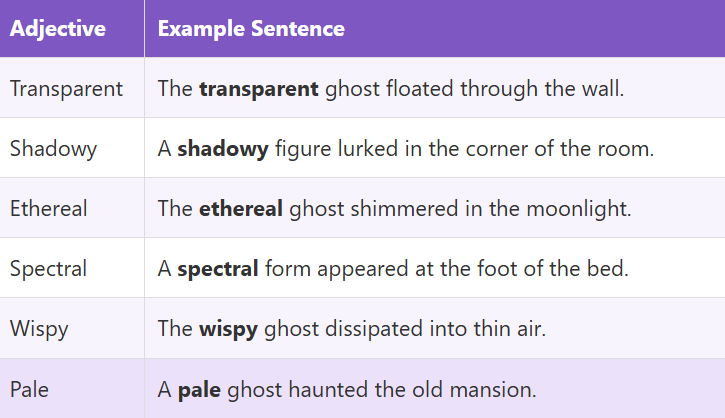
Table of Contents
- Definition of Adjectives for Ghost
- Structural Breakdown
- Types and Categories of Adjectives for Ghost
- Examples of Adjectives for Ghost
- Usage Rules for Adjectives
- Common Mistakes
- Practice Exercises
- Advanced Topics
- FAQ
- Conclusion
Definition of Adjectives for Ghost
An adjective is a word that modifies a noun or pronoun, providing more information about it. When we talk about “adjectives for ghost,” we are referring to words that describe the qualities, characteristics, or attributes of a ghost.
These adjectives help to paint a clearer and more vivid picture of the ghost, enabling the reader or listener to understand its appearance, behavior, and the feelings it evokes.
Adjectives can describe a ghost’s physical appearance (e.g., transparent, shadowy), its emotional state (e.g., mournful, angry), its behavior (e.g., restless, menacing), or its origin (e.g., ancient, colonial). The choice of adjective can significantly impact the tone and atmosphere of a story or description.
In English grammar, adjectives typically precede the noun they modify (e.g., “the eerie ghost”) but can also follow a linking verb (e.g., “the ghost was eerie“). Understanding the function and placement of adjectives is crucial for effective communication.
Structural Breakdown
The structure of adjectives in English is relatively straightforward. Adjectives are typically placed before the noun they modify, creating a noun phrase. For example, in the phrase “the silent ghost,” the adjective “silent” comes before the noun “ghost.”
However, adjectives can also appear after linking verbs such as be, seem, appear, look, feel, taste, and smell. In these cases, the adjective functions as a subject complement, describing the subject of the sentence. For example, “The ghost was terrifying.” Here, “terrifying” describes the ghost and follows the linking verb “was.”
Adjectives can also be modified by adverbs to add further detail. For instance, “the incredibly frightening ghost” uses the adverb “incredibly” to intensify the adjective “frightening.” This combination allows for even more nuanced descriptions.
Adjectives do not change form to agree with the noun they modify in English, unlike in some other languages. This makes their usage relatively simple, although selecting the most appropriate adjective for the context requires a good understanding of vocabulary and nuance.
Types and Categories of Adjectives for Ghost
Adjectives used to describe ghosts can be categorized based on the specific aspects they highlight. Here are some key categories:
Descriptive Adjectives
These adjectives describe the physical appearance or general characteristics of the ghost. They provide concrete details that help to visualize the ghost.
Examples include: transparent, shadowy, ethereal, spectral, wispy, pale, faint, glowing, shimmering, cloaked, veiled, misty, formless, wavering, luminous, translucent, dim, vague, insubstantial, and obscure.
Emotional Adjectives
These adjectives describe the emotional state or the feelings associated with the ghost. They convey the ghost’s mood or the emotions it evokes in others.
Examples include: mournful, sad, angry, vengeful, tormented, lonely, bitter, restless, melancholy, frightened, terrified, haunted, sorrowful, despairing, agonized, resentful, gloomy, wistful, forlorn, and distressed.
Appearance Adjectives
These adjectives focus specifically on the visual aspects of the ghost, such as its clothing, features, or overall form.
Examples include: tattered, decrepit, ancient, bloodstained, white, black, grey, ragged, shrouded, skeletal, gaunt, withered, decaying, spectral, ill-defined, blurry, glowing, shining, dim, and ethereal.
Behavioral Adjectives
These adjectives describe how the ghost acts or behaves. They provide insight into the ghost’s actions and movements.
Examples include: restless, wandering, haunting, menacing, eerie, silent, ominous, playful, mischievous, vengeful, tormenting, watching, observant, creeping, lurking, floating, drifting, hovering, appearing, and disappearing.
Origin Adjectives
These adjectives describe the ghost’s history, background, or the circumstances of its death. They provide context and add depth to the ghost’s story.
Examples include: ancient, colonial, historical, legendary, mythical, cursed, tragic, untimely, murdered, forgotten, vengeful, restless, bound, earthbound, grieving, long-dead, past, old, former, and bygone.
Examples of Adjectives for Ghost
Here are several examples of adjectives used to describe ghosts, organized by category. Each table provides a range of adjectives to enhance your vocabulary and descriptive writing skills.
The following table showcases descriptive adjectives, offering a range of options to illustrate the ghost’s physical characteristics and appearance.
| Adjective | Example Sentence |
|---|---|
| Transparent | The transparent ghost floated through the wall. |
| Shadowy | A shadowy figure lurked in the corner of the room. |
| Ethereal | The ethereal ghost shimmered in the moonlight. |
| Spectral | A spectral form appeared at the foot of the bed. |
| Wispy | The wispy ghost dissipated into thin air. |
| Pale | A pale ghost haunted the old mansion. |
| Faint | The faint ghost was barely visible in the darkness. |
| Glowing | A glowing ghost appeared in the graveyard. |
| Shimmering | The shimmering ghost danced in the moonlight. |
| Cloaked | A cloaked ghost stood silently in the hallway. |
| Veiled | A veiled ghost mourned her lost love. |
| Misty | The misty ghost drifted through the ancient castle. |
| Formless | A formless ghost haunted the abandoned house. |
| Wavering | The wavering ghost flickered in and out of existence. |
| Luminous | A luminous ghost illuminated the dark room. |
| Translucent | The translucent ghost was barely perceptible. |
| Dim | A dim ghost flickered in the shadows. |
| Vague | The vague ghost was hard to make out. |
| Insubstantial | The insubstantial ghost passed right through the wall. |
| Obscure | An obscure ghost haunted the forgotten ruins. |
| Silent | The silent ghost watched from the corner of the room. |
| Still | The ghost remained eerily still, observing the scene. |
| Fearsome | A fearsome ghost guarded the treasure. |
| Doomed | The doomed ghost replayed his final moments every night. |
| Lost | A lost ghost wandered aimlessly through the forest. |
The following table focuses on emotional adjectives, allowing you to describe the feelings and emotional state of the ghost, enhancing the narrative’s emotional depth.
| Adjective | Example Sentence |
|---|---|
| Mournful | The mournful ghost wept silently in the attic. |
| Sad | A sad ghost wandered the halls, searching for peace. |
| Angry | The angry ghost slammed doors and rattled chains. |
| Vengeful | A vengeful ghost sought retribution for past wrongs. |
| Tormented | The tormented ghost relived his final moments. |
| Lonely | A lonely ghost yearned for companionship. |
| Bitter | The bitter ghost resented the living. |
| Restless | A restless ghost paced the floorboards all night. |
| Melancholy | The melancholy ghost sang a haunting melody. |
| Frightened | A frightened ghost cowered in the corner. |
| Terrified | The terrified ghost screamed in the darkness. |
| Haunted | A haunted ghost relived its tragic past. |
| Sorrowful | The sorrowful ghost mourned her lost children. |
| Despairing | A despairing ghost gave up all hope. |
| Agonized | The agonized ghost cried out in pain. |
| Resentful | A resentful ghost plotted revenge. |
| Gloomy | The gloomy ghost cast a pall over the room. |
| Wistful | A wistful ghost longed for the past. |
| Forlorn | The forlorn ghost wandered alone. |
| Distressed | A distressed ghost sought help. |
| Envious | The envious ghost watched the living with disdain. |
| Jealous | A jealous ghost haunted her former lover. |
| Guilty | The guilty ghost sought forgiveness. |
| Ashamed | An ashamed ghost hid from view. |
| Remorseful | The remorseful ghost regretted his actions. |
This table presents appearance adjectives, helping you to describe the visual characteristics of the ghost, such as its attire or physical state. This helps create a more vivid image for the reader.
| Adjective | Example Sentence |
|---|---|
| Tattered | The tattered ghost wore a torn and faded gown. |
| Decrepit | A decrepit ghost haunted the old mansion. |
| Ancient | The ancient ghost had been there for centuries. |
| Bloodstained | A bloodstained ghost sought revenge for his murder. |
| White | The white ghost floated silently through the hall. |
| Black | A black ghost cast a shadow over the room. |
| Grey | The grey ghost faded into the mist. |
| Ragged | The ragged ghost wore tattered clothing. |
| Shrouded | A shrouded ghost hid its face from view. |
| Skeletal | The skeletal ghost rattled its bones. |
| Gaunt | A gaunt ghost wandered the empty halls. |
| Withered | The withered ghost looked ancient and frail. |
| Decaying | A decaying ghost emitted a foul odor. |
| Spectral | The spectral ghost shimmered in the candlelight. |
| Ill-defined | An ill-defined ghost was difficult to see clearly. |
| Blurry | The blurry ghost appeared and disappeared quickly. |
| Glowing | A glowing ghost lit up the dark room. |
| Shining | The shining ghost radiated an eerie light. |
| Dim | A dim ghost flickered weakly. |
| Ethereal | The ethereal ghost seemed to float on air. |
| Pale-faced | The pale-faced ghost stared blankly ahead. |
| Long-haired | A long-haired ghost appeared in the mirror. |
| Empty-eyed | The empty-eyed ghost was devoid of emotion. |
| Clothed | The clothed ghost resembled a living person. |
| Unclothed | An unclothed ghost stood shivering in the cold. |
The following table highlights behavioral adjectives, allowing you to describe the actions and movements of the ghost, bringing it to life in your writing.
| Adjective | Example Sentence |
|---|---|
| Restless | The restless ghost wandered the halls all night. |
| Wandering | A wandering ghost searched for its lost love. |
| Haunting | The haunting ghost returned to its former home. |
| Menacing | A menacing ghost stood at the foot of the bed. |
| Eerie | The eerie ghost watched from the shadows. |
| Silent | A silent ghost observed the living. |
| Ominous | The ominous ghost cast a dark shadow. |
| Playful | A playful ghost moved objects around the room. |
| Mischievous | The mischievous ghost hid the keys. |
| Vengeful | A vengeful ghost sought revenge. |
| Tormenting | The tormenting ghost haunted its victims. |
| Watching | A watching ghost observed from the corner. |
| Observant | The observant ghost noticed every detail. |
| Creeping | A creeping ghost moved slowly and silently. |
| Lurking | The lurking ghost waited in the shadows. |
| Floating | A floating ghost drifted effortlessly. |
| Drifting | The drifting ghost moved with the breeze. |
| Hovering | A hovering ghost remained suspended in the air. |
| Appearing | The appearing ghost materialized suddenly. |
| Disappearing | A disappearing ghost vanished without a trace. |
| Wailing | The wailing ghost cried out in anguish. |
| Groaning | A groaning ghost echoed through the halls. |
| Whispering | The whispering ghost spoke secrets in the dark. |
| Screaming | A screaming ghost terrified the inhabitants. |
| Moaning | The moaning ghost expressed its eternal sorrow. |
This table provides origin adjectives, helping to contextualize the ghost by describing its history, background, or the circumstances surrounding its existence.
| Adjective | Example Sentence |
|---|---|
| Ancient | The ancient ghost had witnessed centuries of history. |
| Colonial | A colonial ghost haunted the historic mansion. |
| Historical | The historical ghost was a figure from the past. |
| Legendary | A legendary ghost was known throughout the region. |
| Mythical | The mythical ghost was a creature of folklore. |
| Cursed | A cursed ghost was trapped in eternal torment. |
| Tragic | The tragic ghost had died an untimely death. |
| Untimely | An untimely ghost was taken too soon. |
| Murdered | The murdered ghost sought justice. |
| Forgotten | A forgotten ghost faded from memory. |
| Vengeful | The vengeful ghost sought retribution. |
| Restless | A restless ghost could not find peace. |
| Bound | The bound ghost was trapped in one place. |
| Earthbound | An earthbound ghost remained on the mortal plane. |
| Grieving | The grieving ghost mourned its loss. |
| Long-dead | A long-dead ghost returned to haunt the living. |
| Past | The past ghost was a relic of another time. |
| Old | An old ghost haunted the ancient castle. |
| Former | The former ghost was once a living person. |
| Bygone | A bygone ghost represented a lost era. |
| Medieval | The medieval ghost wore armor and carried a sword. |
| Victorian | A Victorian ghost haunted the old manor. |
| Prehistoric | The prehistoric ghost roamed the ancient lands. |
| Royal | A royal ghost haunted the palace. |
| Peasant | The peasant ghost worked the fields even in death. |
Usage Rules for Adjectives
Adjectives in English generally follow a set of rules, although there are some exceptions. Understanding these rules is crucial for using adjectives correctly and effectively.
Rule 1: Placement Before Nouns Most adjectives are placed directly before the noun they modify. For example: “the creepy ghost,” “an eerie presence,” and “a silent specter.”
Rule 2: Placement After Linking Verbs Adjectives can follow linking verbs (e.g., be, seem, appear, look, feel, taste, smell). In this case, the adjective describes the subject of the sentence. For example: “The ghost was terrifying,” “It seemed ominous,” and “The atmosphere felt eerie.”
Rule 3: Coordinate Adjectives When using multiple adjectives to describe a noun, use a comma to separate coordinate adjectives (adjectives that independently modify the noun). For example: “the tall, shadowy ghost.” If the adjectives are not coordinate (one adjective modifies the adjective that follows), do not use a comma. For example: “a dark, eerie night.”
Rule 4: Order of Adjectives When using multiple adjectives, follow a general order: opinion, size, age, shape, color, origin, material, and purpose. For example: “a creepy old ghost” (opinion then age).
Rule 5: Proper Adjectives Adjectives derived from proper nouns (e.g., names of places or people) are called proper adjectives and should be capitalized. For example: “a Victorian ghost” (from the Victorian era).
Rule 6: Compound Adjectives Compound adjectives (adjectives made up of two or more words) are often hyphenated, especially when they come before the noun. For example: “a long-dead ghost,” “a blood-stained shroud.”
Rule 7: Comparative and Superlative Forms Adjectives can be used in comparative and superlative forms to compare qualities. Comparative adjectives compare two things (e.g., “The ghost was scarier than the legend.”), while superlative adjectives compare three or more things (e.g., “It was the scariest ghost of all.”).
Common Mistakes
Even experienced English speakers sometimes make mistakes when using adjectives. Here are some common errors to watch out for:
Mistake 1: Misplaced Adjectives Placing an adjective too far from the noun it modifies can cause confusion.
- Incorrect: The ghost appeared suddenly, frightening.
- Correct: The frightening ghost appeared suddenly.
Mistake 2: Incorrect Use of Commas Forgetting to use or incorrectly using commas between coordinate adjectives is a common error.
- Incorrect: The tall shadowy ghost appeared.
- Correct: The tall, shadowy ghost appeared.
Mistake 3: Wrong Order of Adjectives Placing adjectives in the wrong order can sound unnatural.
- Incorrect: An old creepy ghost.
- Correct: A creepy old ghost.
Mistake 4: Using Adverbs Instead of Adjectives Confusing adverbs with adjectives is a frequent mistake. Remember that adjectives modify nouns, while adverbs modify verbs, adjectives, or other adverbs.
- Incorrect: The ghost was eerily.
- Correct: The ghost was eerie.
Mistake 5: Not Capitalizing Proper Adjectives Forgetting to capitalize proper adjectives is a common oversight.
- Incorrect: a victorian ghost
- Correct: A Victorian ghost
Practice Exercises
Test your understanding of adjectives with these practice exercises. Each exercise focuses on different aspects of adjective usage.
Exercise 1: Identifying Adjectives Identify the adjectives in the following sentences.
| Sentence | Answer |
|---|---|
| The ancient ghost haunted the dilapidated mansion. | ancient, dilapidated |
| A mournful spirit drifted through the silent halls. | mournful, silent |
| The ghostly figure was transparent and ethereal. | ghostly, transparent, ethereal |
| An angry ghost sought vengeance for his untimely death. | angry, untimely |
| The restless specter roamed the dark corridors. | restless, dark |
| A shadowy form appeared in the misty graveyard. | shadowy, misty |
| The terrifying apparition screamed in the night. | terrifying |
| A vengeful spirit sought retribution. | vengeful |
| The haunted house stood on a lonely hill. | haunted, lonely |
| The pale ghost flickered in the moonlight. | pale |
Exercise 2: Choosing the Correct Adjective Choose the best adjective to complete each sentence.
| Sentence | Options | Answer |
|---|---|---|
| The ghost had a very ______ appearance. | (a) transparent (b) transparently | (a) transparent |
| A ______ feeling washed over her as she entered the room. | (a) eerie (b) eerily | (a) eerie |
| The ______ ghost floated across the room. | (a) silent (b) silently | (a) silent |
| The ______ apparition vanished into thin air. | (a) quick (b) quickly | (a) quick |
| The ______ legend told of a haunted forest. | (a) old (b) olden | (a) old |
| The _______ specter haunted the castle. | (a) mournful (b) mournfully | (a) mournful |
| The ______ figure lurked in the shadows. | (a) shadowy (b) shadow | (a) shadowy |
| The ______ ghost cried out in pain. | (a) agonizing (b) agonized | (a) agonizing |
| A ______ presence filled the room. | (a) chilling (b) chilled | (a) chilling |
| The ______ spirit roamed the halls. | (a) restless (b) restlessly | (a) restless |
Exercise 3: Using Multiple Adjectives Combine the following adjectives to create descriptive phrases for “ghost.”
| Adjectives | Possible Phrase |
|---|---|
| ancient, mournful | The ancient, mournful ghost |
| shadowy, tall | The tall, shadowy ghost |
| eerie, silent | The eerie, silent ghost |
| restless, pale | The restless, pale ghost |
| terrifying, dark | The terrifying, dark ghost |
| ill-defined, spectral | The ill-defined, spectral ghost |
| vengeful, angry | The angry, vengeful ghost |
| frightened, small | The frightened, small ghost |
| glowing, faint | The faint, glowing ghost |
| decrepit, old | The decrepit, old ghost |
Advanced Topics
For advanced learners, exploring more complex aspects of adjective usage can further enhance their understanding and writing skills.
1. Figurative Language Adjectives can be used in figurative language, such as metaphors and similes, to create vivid and imaginative descriptions. For example: “The ghost was as silent as death” (simile), “The ghost was a shadowy memory” (metaphor).
2. Intensifiers Adverbs can be used to intensify adjectives, adding emphasis and nuance to descriptions. For example: “an incredibly terrifying ghost,” “a remarkably silent specter.”
3. Nominalization Adjectives can sometimes be nominalized, meaning they are used as nouns. This is less common but can be effective in certain contexts. For example: “Only the
brave dared to enter the haunted house.”
4. Subjunctive Mood In more formal or literary contexts, adjectives can be used in the subjunctive mood to express hypothetical or conditional qualities. For example: “Were the ghost real, it would surely terrify us all.”
5. Adjective Clauses Adjective clauses (also known as relative clauses) can provide additional information about a noun. For example: “The ghost, which was ancient and mournful, haunted the castle.”
FAQ
Here are some frequently asked questions about using adjectives to describe ghosts:
What is the best way to choose the right adjective for a ghost?
Consider the specific qualities you want to emphasize. Are you focusing on appearance, emotions, behavior, or origin?
Choose adjectives that accurately and vividly convey these aspects.
Can I use multiple adjectives to describe a ghost?
Yes, using multiple adjectives can create a richer and more detailed description. Just be sure to follow the rules for coordinate adjectives and the correct order of adjectives.
Are there any adjectives I should avoid when describing ghosts?
Avoid clichés and overused adjectives that don’t add specific details. Instead, opt for more unique and evocative words that paint a clearer picture.
How can I improve my vocabulary of adjectives for ghosts?
Read widely in the genre of ghost stories and supernatural literature. Pay attention to the adjectives that authors use and make a note of any new or interesting words.
Is it necessary to use adjectives when describing ghosts?
While not always necessary, adjectives can greatly enhance your descriptions and create a more immersive experience for the reader or listener. They add depth, detail, and emotional impact to your writing.
Conclusion
Mastering the use of adjectives for describing ghosts can significantly enhance your writing and storytelling abilities. By understanding the different types and categories of adjectives, following usage rules, and avoiding common mistakes, you can create vivid and compelling descriptions of the supernatural.
Practice the exercises provided and continue to expand your vocabulary to become a more skilled and effective communicator. Whether you’re writing a horror novel, a spooky poem, or simply engaging in a conversation about ghosts, the right adjectives will bring your spectral visions to life.