

Understanding adjectives that describe effort is crucial for expressing nuances in English. These adjectives allow us to convey the intensity, quality, and characteristics of actions and endeavors.
Mastering these words enhances both writing and speaking, enabling more precise and vivid communication. This guide is designed for English language learners, students, and anyone looking to refine their grasp of descriptive language.
By exploring the different categories, usage rules, and common mistakes, you’ll gain the confidence to use these adjectives effectively and enrich your vocabulary.
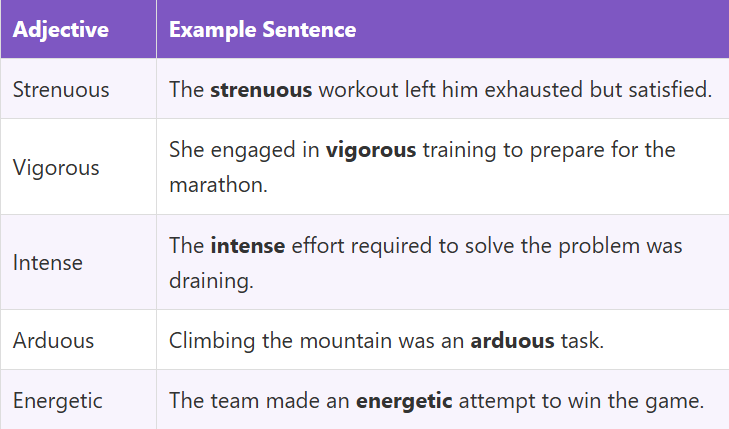
Table of Contents
- Definition of Adjectives for Effort
- Structural Breakdown
- Types of Adjectives for Effort
- Examples of Adjectives for Effort
- Usage Rules
- Common Mistakes
- Practice Exercises
- Advanced Topics
- FAQ
- Conclusion
Definition of Adjectives for Effort
Adjectives for effort are descriptive words that modify nouns related to actions, attempts, or endeavors. They provide information about the nature and extent of the effort being described.
These adjectives enhance our understanding of the noun by specifying its characteristics, such as the level of energy exerted, the quality of the work, or the attitude displayed during the activity. They are essential for creating vivid and precise descriptions in both spoken and written English.
Understanding these adjectives allows for more effective communication of ideas and nuances.
In terms of classification, adjectives for effort fall under the broader category of descriptive adjectives. Their primary function is to add detail and specificity to nouns associated with effort. The context in which these adjectives are used can vary widely, from academic writing to casual conversation. For instance, you might describe a “strenuous workout,” a “diligent student,” or a “half-hearted attempt.” Each adjective provides a different perspective on the effort involved, enriching the overall meaning.
Structural Breakdown
The structure of adjectives for effort is relatively straightforward. They typically precede the noun they modify, following the standard adjective-noun order in English. However, they can also appear after linking verbs, such as is, are, was, and were, to describe the subject. Understanding this structure is crucial for constructing grammatically correct sentences. Let’s explore the common patterns.
The most common pattern is: Adjective + Noun. For example: “vigorous training“, “conscientious effort“, “lackadaisical approach“. In these cases, the adjective directly modifies the noun, providing immediate context and detail.
Another common pattern involves linking verbs: Subject + Linking Verb + Adjective. For example: “The attempt was valiant.“, “Her dedication is unwavering.“, “Their performance seemed lackluster.” Here, the adjective describes the subject through the linking verb.
Adjectives can also be modified by adverbs to further refine their meaning. The pattern is: Adverb + Adjective + Noun. For example: “remarkably diligent student“, “incredibly strenuous hike“, “surprisingly half-hearted attempt“. The adverb intensifies or qualifies the adjective, adding another layer of detail.
Types of Adjectives for Effort
Adjectives for effort can be categorized based on the aspect of effort they describe. We can classify them into four main categories: intensity, quality, attitude, and outcome.
Each category provides a unique perspective on the effort being described. Understanding these categories helps in choosing the most appropriate adjective for a given context.
Adjectives Describing Intensity of Effort
These adjectives describe the degree or strength of the effort. They indicate how much energy or force is being applied. Examples include: strenuous, vigorous, intense, arduous, energetic.
Adjectives Describing Quality of Effort
These adjectives describe the characteristics or nature of the effort. They focus on how well or effectively the effort is being applied. Examples include: diligent, conscientious, thorough, meticulous, careful.
Adjectives Describing Attitude Towards Effort
These adjectives describe the mindset or approach towards the effort. They reveal the person’s feelings or disposition towards the task. Examples include: enthusiastic, determined, reluctant, half-hearted, lackadaisical.
Adjectives Describing Outcome of Effort
These adjectives describe the result or consequence of the effort. They focus on whether the effort was successful or not. Examples include: fruitful, successful, productive, abortive, futile.
Examples of Adjectives for Effort
To solidify understanding, let’s look at specific examples of adjectives for effort in sentences, categorized by the type of effort they describe. These examples will illustrate how each adjective functions in context, providing a clearer picture of their usage.
Examples Describing Intensity of Effort
The following table provides examples of adjectives that describe the intensity of effort. Each example sentence showcases the adjective in a specific context, highlighting its meaning and usage.
| Adjective | Example Sentence |
|---|---|
| Strenuous | The strenuous workout left him exhausted but satisfied. |
| Vigorous | She engaged in vigorous training to prepare for the marathon. |
| Intense | The intense effort required to solve the problem was draining. |
| Arduous | Climbing the mountain was an arduous task. |
| Energetic | The team made an energetic attempt to win the game. |
| Grueling | The soldiers endured a grueling march through the desert. |
| Demanding | The project required a demanding level of concentration. |
| Tough | It was a tough struggle to overcome the obstacles. |
| Exhausting | The exhausting labor left him feeling completely drained. |
| Forceful | The debater delivered a forceful presentation that swayed the audience. |
| Aggressive | The company launched an aggressive marketing campaign to increase sales. |
| Laborious | Writing the report was a laborious process that took several weeks. |
| Herculean | Moving the heavy equipment required a Herculean effort. |
| Backbreaking | Farming in the fields was backbreaking work. |
| Taxing | Dealing with customer complaints can be a taxing experience. |
| Rigorous | The scientific research underwent a rigorous review process. |
| Severe | The athlete suffered a severe strain during the competition. |
| Stiff | The negotiations faced stiff resistance from the opposing party. |
| Uphill | Starting a new business is an uphill battle. |
| Concentrated | The students made a concentrated effort to study for the exam. |
| Intensive | The patient received intensive care after the surgery. |
| Hard | He put in a hard day’s work at the construction site. |
| Full-Throttle | The team launched a full-throttle effort to meet the deadline. |
| All-Out | The runners made an all-out sprint to the finish line. |
| Determined | Despite the setbacks, she showed a determined effort to succeed. |
Examples Describing Quality of Effort
The following table provides examples of adjectives that describe the quality of effort. Notice how they emphasize the manner in which the effort is applied, rather than just its intensity.
| Adjective | Example Sentence |
|---|---|
| Diligent | The diligent student always completed her assignments on time. |
| Conscientious | He made a conscientious effort to recycle and reduce waste. |
| Thorough | The detective conducted a thorough investigation of the crime scene. |
| Meticulous | The artist paid meticulous attention to every detail in the painting. |
| Careful | She made a careful attempt to avoid making mistakes. |
| Painstaking | The restoration of the antique furniture required painstaking work. |
| Precise | The surgeon made a precise incision during the operation. |
| Accurate | The scientist collected accurate data for the experiment. |
| Exact | The carpenter took exact measurements before cutting the wood. |
| Scrupulous | The accountant maintained scrupulous records of all transactions. |
| Systematic | The researcher followed a systematic approach to data analysis. |
| Orderly | The librarian kept the books in an orderly arrangement. |
| Disciplined | The athlete followed a disciplined training regimen. |
| Focused | The student maintained a focused concentration during the exam. |
| Methodical | The engineer took a methodical approach to solving the problem. |
| Studious | The studious apprentice quickly mastered the craft. |
| Assiduous | The assiduous researcher left no stone unturned in their investigation. |
| Masterful | The chef created a masterful dish that impressed the judges. |
| Skillful | The surgeon performed a skillful operation, saving the patient’s life. |
| Effective | The new marketing strategy proved to be highly effective. |
| Efficient | The factory implemented efficient production methods to reduce waste. |
| Competent | The competent technician quickly resolved the technical issue. |
| Proficient | The proficient programmer wrote elegant and bug-free code. |
| Expert | The expert consultant provided valuable insights to the company. |
| Artful | The negotiator employed an artful strategy to reach an agreement. |
| Artistic | The artistic baker created stunning and delicious cakes. |
Examples Describing Attitude Towards Effort
This table showcases adjectives that describe the attitude or mindset behind the effort. They provide insights into the person’s feelings or approach to the task at hand.
| Adjective | Example Sentence |
|---|---|
| Enthusiastic | The enthusiastic volunteer eagerly helped at the charity event. |
| Determined | The determined athlete refused to give up, even when injured. |
| Reluctant | The reluctant student hesitated to participate in the class discussion. |
| Half-hearted | His half-hearted attempt to clean the house was disappointing. |
| Lackadaisical | The lackadaisical worker showed little interest in his tasks. |
| Passionate | She approached the project with passionate dedication. |
| Eager | The eager apprentice was keen to learn new skills. |
| Willing | He was willing to help with any task, no matter how difficult. |
| Zealous | The zealous advocate fought tirelessly for his client’s rights. |
| Apathetic | The apathetic employee showed no interest in improving his performance. |
| Indifferent | She remained indifferent to the plight of the homeless. |
| Unmotivated | The unmotivated student struggled to complete his homework. |
| Disheartened | The team felt disheartened after losing the game. |
| Optimistic | Despite the challenges, she maintained an optimistic outlook. |
| Pessimistic | He had a pessimistic view of the future. |
| Motivated | The motivated team worked hard to achieve their goals. |
| Committed | She was committed to making a difference in the community. |
| Devoted | The devoted volunteer spent countless hours helping others. |
| Resolute | The resolute leader remained firm in the face of adversity. |
| Persistent | The persistent salesman refused to take no for an answer. |
| Tenacious | The tenacious detective pursued the suspect relentlessly. |
| Persevering | The persevering student eventually overcame the academic challenges. |
| Spirited | The spirited debater presented a convincing argument. |
| Animated | The animated speaker engaged the audience with enthusiasm. |
| Ardent | The ardent supporter cheered loudly for the team. |
Examples Describing Outcome of Effort
This table lists adjectives that describe the outcome or result of the effort. They indicate whether the effort was successful, productive, or otherwise.
| Adjective | Example Sentence |
|---|---|
| Fruitful | Their fruitful collaboration led to a successful product launch. |
| Successful | The successful attempt to climb Mount Everest was widely celebrated. |
| Productive | The team had a productive meeting and made significant progress. |
| Abortive | The abortive attempt to start the engine left them stranded. |
| Futile | Their futile efforts to revive the plant were in vain. |
| Effective | The new strategy proved to be an effective solution to the problem. |
| Efficient | The efficient system reduced waste and saved time. |
| Beneficial | The new policy had a beneficial impact on the environment. |
| Advantageous | The merger proved to be advantageous for both companies. |
| Profitable | The business had a profitable year due to increased sales. |
| Constructive | The feedback was constructive and helped improve the project. |
| Valuable | The information proved to be valuable in making the decision. |
| Worthwhile | The volunteer work was a worthwhile experience. |
| Unsuccessful | The unsuccessful attempt to negotiate a deal left them disappointed. |
| Ineffective | The old method proved to be ineffective in solving the problem. |
| Unproductive | The meeting was unproductive and resulted in no decisions. |
| Barren | The barren land yielded no crops despite their efforts. |
| Sterile | The sterile debate produced no new ideas or insights. |
| Wasted | All the effort was wasted when the project was cancelled. |
| Vain | His vain attempts to impress her were unsuccessful. |
| Fruitless | The search for the missing item proved fruitless. |
| Lost | The opportunity was lost due to a lack of planning. |
| Unavailing | Their unavailing efforts to save the company were ultimately unsuccessful. |
| Bootless | The knight’s bootless quest ended in disappointment. |
| Abortive | The abortive mission was called off due to bad weather. |
Usage Rules
Several rules govern the proper usage of adjectives for effort. Understanding these rules is crucial for avoiding common errors and ensuring clarity in communication.
These rules cover adjective order, placement, and agreement.
Adjective Order: When using multiple adjectives, follow the general order: opinion, size, age, shape, color, origin, material, and purpose. Adjectives for effort often fall under the “opinion” or “quality” category. For example: “a meticulous, detailed plan” (opinion then quality).
Placement: Adjectives typically precede the noun they modify. However, they can follow linking verbs. For example: “The strenuous climb” (before the noun) vs. “The climb was strenuous” (after the linking verb).
Agreement: Adjectives do not change form to agree with the noun’s number or gender. For example, “a diligent student” and “diligent students” both use the same form of the adjective.
Exceptions: Some adjectives have specific collocations (words they commonly appear with). For example, “strenuous exercise” is more common than “strenuous activity.”
Intensifiers: Adverbs like very, extremely, and incredibly can be used to intensify adjectives for effort. For example: “an incredibly diligent student“.
Common Mistakes
Several common mistakes arise when using adjectives for effort. Recognizing these errors can help you avoid them and improve your accuracy.
Incorrect Word Choice: Using an adjective that doesn’t accurately reflect the type of effort. For example, saying “a strenuous nap” is incorrect because naps are not typically strenuous.
Misplaced Adjectives: Placing the adjective in an awkward position in the sentence. For example, “The student diligent completed the assignment” should be “The diligent student completed the assignment.”
Incorrect Intensifiers: Using an inappropriate intensifier. For example, saying “a slightly strenuous workout” is contradictory, as strenuous implies a high level of effort.
Redundancy: Using adjectives that are too similar in meaning. For example, “a thorough and meticulous investigation” can be simplified to “a meticulous investigation.”
Here are some examples of common mistakes and their corrections:
| Incorrect | Correct | Explanation |
|---|---|---|
| The nap was strenuous. | The workout was strenuous. | “Strenuous” implies high energy, unsuitable for “nap.” |
| Student the diligent completed the task. | The diligent student completed the task. | Adjective should precede the noun. |
| A slightly strenuous exercise. | A moderately strenuous exercise. | “Slightly” contradicts the intensity of “strenuous.” |
| A thorough and meticulous investigation. | A meticulous investigation. | “Thorough” and “meticulous” are redundant in this context. |
| He was enthusiastic reluctant. | He was somewhat reluctant. | Enthusiastic and reluctant are contradictory. |
Practice Exercises
To test your understanding, complete the following exercises by filling in the blanks with appropriate adjectives for effort. These exercises cover various categories and usage rules discussed earlier.
Answers are provided below for self-assessment.
Exercise 1: Fill in the blanks with adjectives describing intensity of effort.
| Question | Answer |
|---|---|
| 1. The ______ climb up the mountain tested their endurance. | Strenuous |
| 2. She engaged in ______ training to prepare for the competition. | Vigorous |
| 3. The project required ______ focus and dedication. | Intense |
| 4. It was an ______ journey across the desert. | Arduous |
| 5. The team launched an ______ campaign to promote the product. | Energetic |
| 6. The soldiers endured a ______ march through the jungle. | Grueling |
| 7. The task required a ______ level of concentration. | Demanding |
| 8. It was a ______ battle to overcome the challenges. | Tough |
| 9. The ______ labor left him feeling completely exhausted. | Exhausting |
| 10. The speaker delivered a ______ presentation that captivated the audience. | Forceful |
Exercise 2: Fill in the blanks with adjectives describing quality of effort.
| Question | Answer |
|---|---|
| 1. The ______ student always completed her homework on time. | Diligent |
| 2. He made a ______ effort to recycle and reduce waste. | Conscientious |
| 3. The detective conducted a ______ investigation of the crime scene. | Thorough |
| 4. The artist paid ______ attention to detail in the painting. | Meticulous |
| 5. She made a ______ attempt to avoid making mistakes. | Careful |
| 6. The restoration work required ______ skill and patience. | Painstaking |
| 7. The surgeon made a ______ incision during the operation. | Precise |
| 8. The scientist collected ______ data for the experiment. | Accurate |
| 9. The carpenter took ______ measurements before cutting the wood. | Exact |
| 10. The accountant maintained ______ records of all transactions. | Scrupulous |
Exercise 3: Fill in the blanks with adjectives describing attitude towards effort.
| Question | Answer |
|---|---|
| 1. The ______ volunteer eagerly helped at the local shelter. | Enthusiastic |
| 2. The ______ athlete refused to give up despite the injury. | Determined |
| 3. The ______ participant hesitated to voice their opinion. | Reluctant |
| 4. His ______ attempt to clean his room was unconvincing. | Half-hearted |
| 5. The ______ employee showed little interest in improving performance. | Lackadaisical |
| 6. She approached the task with ______ dedication and enthusiasm. | Passionate |
| 7. The ______ student was eager to learn new skills. | Eager |
| 8. He was ______ to help with any task, no matter how difficult. | Willing |
| 9. The ______ activist fought tirelessly for social justice. | Zealous |
| 10. The ______ employee showed no concern for the company’s success. | Apathetic |
Exercise 4: Fill in the blanks with adjectives describing the outcome of effort.
| Question | Answer |
|---|---|
| 1. Their ______ collaboration resulted in a successful product. | Fruitful |
| 2. The ______ mission to Mars was a historic achievement. | Successful |
| 3. The team had a ______ brainstorming session and generated many ideas. | Productive |
| 4. The ______ attempt to start the fire left them cold and hungry. | Abortive |
| 5. Their ______ efforts to save the endangered species were in vain. | Futile |
| 6. The new marketing strategy proved to be an ______ solution to the problem. | Effective |
| 7. The ______ system reduced waste and saved valuable resources. | Efficient |
| 8. The new policy had a ______ impact on employee morale. | Beneficial |
| 9. The merger proved to be ______ for both companies involved. | Advantageous |
| 10. The business had a ______ year due to increased demand. | Profitable |
Advanced Topics
For advanced learners, exploring the nuances of adjectives for effort can lead to a deeper understanding of English. This includes examining subtle differences in meaning between similar adjectives, understanding the impact of context on word choice, and exploring the use of figurative language.
Synonym Nuances: While some adjectives may seem interchangeable, they often carry subtle differences in connotation. For example, diligent implies consistent effort, while conscientious emphasizes moral responsibility. Consider the specific nuances when choosing an adjective.
Contextual Impact: The context in which an adjective is used can significantly alter its meaning. For example, “intense focus” is positive, while “intense pressure” can be negative. Pay attention to the surrounding words and phrases.
Figurative Language: Adjectives for effort can be used figuratively to create vivid imagery and convey abstract ideas. For example, “a Herculean task” implies a task of immense difficulty, even if it doesn’t literally require superhuman strength.
Collocations and Idioms: Understanding common collocations and idioms involving adjectives for effort can enhance fluency and naturalness. For example, “to go the extra mile” is an idiom that signifies making an additional effort.
FAQ
Here are some frequently asked questions about adjectives for effort:
- What is the difference between “strenuous” and “vigorous”?
Both adjectives describe high levels of energy, but “strenuous” often implies difficulty and strain, while “vigorous” suggests energy and enthusiasm. A “strenuous workout” might leave you exhausted, while a “vigorous dance” is full of energy and life. “Strenuous” also suggests a greater use of mental or physical exertion.
- How can I avoid using redundant adjectives?
Carefully consider the meaning of each adjective and eliminate any that are too similar. For example, instead of saying “a thorough and comprehensive report,” simply say “a comprehensive report” if “comprehensive” already implies thoroughness.
- Are there any adjectives for effort that have negative connotations?
Yes, adjectives like “half-hearted,” “lackadaisical,” “futile,” and “abortive” all have negative connotations, implying a lack of effort or a failed attempt.
- Can adjectives for effort be used to describe abstract concepts?
Yes, they can. For example, you can describe an “intense debate,” a “diligent study,” or a “fruitful discussion,” even though these concepts are not physical actions. The adjective is used to describe the nature of the effort involved in the abstract activity.
- How do I choose the right adjective for effort in a sentence?
Consider the specific context and the aspect of effort you want to emphasize. Do you want to highlight the intensity, quality, attitude, or outcome? Choose the adjective that best reflects the intended meaning and creates the desired effect.
- Is it correct to use multiple adjectives for effort in a sentence?
Yes, but use them sparingly and avoid redundancy. When using multiple adjectives, ensure they provide different and complementary information about the effort being described. Follow the general order of adjectives in English.
- What are some common collocations with the adjective “diligent”?
Common collocations with “diligent” include “diligent student,” “diligent worker,” “diligent effort,” and “diligent investigation.” These collocations highlight the consistent and careful nature of the effort.
- How can I improve my vocabulary of adjectives for effort?
Read widely and pay attention to how different adjectives are used in context. Use a dictionary and thesaurus to explore synonyms and related words. Practice using new adjectives in your own writing and speaking.
- What’s the difference between ‘effective’ and ‘efficient’ when describing effort?
‘Effective’ means producing a desired result or achieving a goal. ‘Efficient’ means achieving a goal with minimal waste of time, resources, or effort. An effective solution solves the problem, while an efficient solution solves the problem quickly and with minimal cost.
- Are there any regional differences in the usage of these adjectives?
While the core meanings remain consistent, some adjectives might be more commonly used in certain regions or dialects. Pay attention to the language used by native speakers in your area to gain a better understanding of regional preferences.
Conclusion
Mastering adjectives for effort is essential for expressing nuance and precision in English. By understanding the different types of adjectives, their usage rules, and common mistakes
, you can significantly enhance your communication skills.
Whether you are describing a “strenuous workout,” a “diligent student,” or a “fruitful collaboration,” the right adjective can make all the difference. Continue to practice and explore these words to enrich your vocabulary and improve your ability to convey complex ideas effectively.
Remember to consider the context, choose words carefully, and avoid redundancy. With consistent effort, you’ll become proficient in using adjectives for effort and elevate your language skills to new heights.