

Understanding how to use adjectives effectively to describe bottles is crucial for precise and vivid communication. Whether you’re writing product descriptions, crafting creative narratives, or simply engaging in everyday conversation, the right adjectives can significantly enhance your message.
This guide provides an in-depth exploration of adjectives used to describe bottles, covering their types, usage rules, common mistakes, and practical exercises. This comprehensive resource is designed for English language learners of all levels, from beginners to advanced speakers, and anyone looking to refine their descriptive vocabulary.
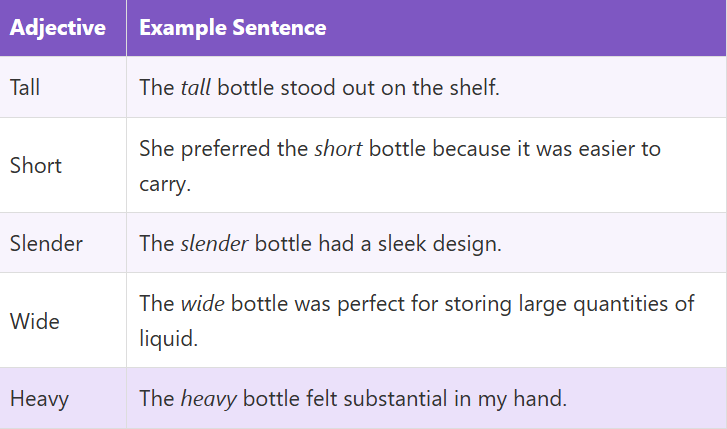
Table of Contents
- Introduction
- Definition of Adjectives
- Structural Breakdown
- Types of Adjectives
- Examples of Adjectives for Bottles
- Usage Rules for Adjectives
- Common Mistakes with Adjectives
- Practice Exercises
- Advanced Topics
- Frequently Asked Questions (FAQ)
- Conclusion
Definition of Adjectives
An adjective is a word that modifies a noun or pronoun, providing more information about it. Adjectives describe the qualities, characteristics, or properties of the noun or pronoun they modify.
They answer questions like “What kind?”, “Which one?”, “How many?”, or “How much?” regarding the noun they describe. Understanding adjectives is essential for creating detailed and engaging descriptions in both written and spoken English.
The primary function of an adjective is to add detail and specificity to nouns. This allows for a more precise and vivid representation of the object, person, or concept being described.
Adjectives can be classified based on their function and the type of information they convey. For example, some adjectives describe physical attributes, while others indicate quantity or origin.
Adjectives can appear before the noun they modify (attributive position) or after a linking verb, such as is, are, was, were, seem, or become (predicative position). The position of the adjective can sometimes affect the nuance of the sentence. For instance, “the blue bottle” (attributive) emphasizes the color as a defining characteristic, while “the bottle is blue” (predicative) simply states the color as a fact.
Structural Breakdown
The structure of sentences involving adjectives is relatively straightforward. An adjective typically precedes the noun it modifies when used in the attributive position.
In the predicative position, the adjective follows a linking verb and describes the subject of the sentence. The placement of multiple adjectives can follow specific rules regarding their order, which will be discussed in detail later.
When multiple adjectives are used to describe a single noun, they can be either coordinate or cumulative. Coordinate adjectives modify the noun independently and are separated by commas or the word “and”. For example, “a tall, slender bottle.” Cumulative adjectives, on the other hand, build upon each other to further define the noun and do not require commas. For example, “a small glass bottle.”
The choice between using coordinate and cumulative adjectives depends on the relationship between the adjectives and the noun. Coordinate adjectives each provide a distinct characteristic, while cumulative adjectives work together to form a more specific description.
Understanding this distinction is crucial for constructing grammatically correct and stylistically effective sentences.
Types of Adjectives
Descriptive Adjectives
Descriptive adjectives, also known as qualitative adjectives, describe the qualities or characteristics of a noun. They provide information about appearance, texture, taste, smell, sound, or other sensory attributes.
They are among the most commonly used adjectives and are essential for creating vivid and detailed descriptions.
Quantitative Adjectives
Quantitative adjectives indicate the quantity or amount of a noun. They answer the question “How many?” or “How much?” and are used to specify the number or amount of the noun being described. These adjectives can be definite (e.g., one, two, three) or indefinite (e.g., some, many, few).
Demonstrative Adjectives
Demonstrative adjectives indicate which noun is being referred to. They include the words this, that, these, and those. These adjectives specify whether the noun is near or far, singular or plural, and are essential for pointing out specific items within a group.
Possessive Adjectives
Possessive adjectives indicate ownership or possession. They include the words my, your, his, her, its, our, and their. These adjectives specify who or what owns the noun being described.
Interrogative Adjectives
Interrogative adjectives are used to ask questions about a noun. They include the words which, what, and whose. These adjectives are always followed by a noun and are used to inquire about a specific characteristic or attribute of the noun.
Material Adjectives
Material adjectives describe what a bottle is made of. Examples include glass, plastic, metal, or ceramic.
Shape Adjectives
Shape adjectives describe the form or outline of the bottle, such as round, square, cylindrical, or conical.
Color Adjectives
Color adjectives specify the hue or shade of the bottle, such as blue, green, red, or clear.
Origin Adjectives
Origin adjectives indicate where the bottle comes from, such as Italian, French, or American.
Purpose Adjectives
Purpose adjectives describe the intended use of the bottle, such as water, wine, or medicine.
Examples of Adjectives for Bottles
The following tables provide a range of examples of adjectives used to describe bottles, categorized by type. Each table includes multiple examples to illustrate the different ways adjectives can be used to add detail and specificity to descriptions.
Table 1: Descriptive Adjectives for Bottles
This table showcases how descriptive adjectives can be used to highlight the physical characteristics and sensory qualities of various bottles. The examples provide a rich vocabulary for describing bottles in detail.
| Adjective | Example Sentence |
|---|---|
| Tall | The tall bottle stood out on the shelf. |
| Short | She preferred the short bottle because it was easier to carry. |
| Slender | The slender bottle had a sleek design. |
| Wide | The wide bottle was perfect for storing large quantities of liquid. |
| Heavy | The heavy bottle felt substantial in my hand. |
| Light | The light bottle was ideal for hiking. |
| Elegant | The elegant bottle was a beautiful addition to the table setting. |
| Rustic | The rustic bottle had a charming, old-fashioned appeal. |
| Modern | The modern bottle featured a minimalist design. |
| Vintage | The vintage bottle was a collector’s item. |
| Smooth | The smooth bottle was comfortable to hold. |
| Textured | The textured bottle provided a better grip. |
| Clear | The clear bottle allowed you to see the contents easily. |
| Opaque | The opaque bottle protected the liquid from light. |
| Refillable | Using a refillable bottle is environmentally friendly. |
| Reusable | The reusable bottle helped reduce plastic waste. |
| Durable | The durable bottle could withstand rough handling. |
| Fragile | Be careful with the fragile bottle; it can break easily. |
| Ornate | The ornate bottle was decorated with intricate designs. |
| Simple | The simple bottle had a clean, straightforward design. |
| Ergonomic | The ergonomic bottle was designed for comfortable use. |
| Insulated | The insulated bottle kept the water cold for hours. |
| Leakproof | The leakproof bottle prevented spills in my bag. |
| Stylish | The stylish bottle was a fashionable accessory. |
| Unique | The unique bottle was unlike any other I had seen. |
| Classic | The classic bottle had a timeless design. |
| Portable | The portable bottle was easy to carry around. |
| Sleek | The sleek bottle had a sophisticated appearance. |
| Elegant | The elegant bottle was perfect for special occasions. |
Table 2: Material, Shape, and Color Adjectives for Bottles
This table provides examples of adjectives that specify the material, shape, and color of bottles, enabling precise descriptions of their physical composition and appearance. These categories are crucial for identifying and differentiating various types of bottles.
| Adjective Type | Adjective | Example Sentence |
|---|---|---|
| Material | Glass | The glass bottle sparkled in the sunlight. |
| Plastic | The plastic bottle was lightweight and durable. | |
| Metal | The metal bottle kept the water cold for hours. | |
| Ceramic | The ceramic bottle was beautifully decorated. | |
| Aluminum | The aluminum bottle was recyclable and eco-friendly. | |
| Stainless steel | The stainless steel bottle was rust-resistant. | |
| Copper | The copper bottle looked very antique. | |
| Shape | Round | The round bottle was easy to grip. |
| Square | The square bottle fit neatly into the box. | |
| Cylindrical | The cylindrical bottle was a common design. | |
| Conical | The conical bottle had a distinctive shape. | |
| Oval | The oval bottle was comfortable to hold. | |
| Rectangular | The rectangular bottle fit perfectly in the cooler. | |
| Triangular | The triangular bottle was an unusual design. | |
| Color | Blue | The blue bottle stood out on the shelf. |
| Green | The green bottle was made of recycled glass. | |
| Red | The red bottle contained a special potion. | |
| Clear | The clear bottle allowed you to see the contents. | |
| Amber | The amber bottle protected the beer from light. | |
| Black | The black bottle looked very modern. | |
| Purple | The purple bottle was a limited edition. |
Table 3: Quantitative, Demonstrative, and Possessive Adjectives for Bottles
This table illustrates the use of quantitative, demonstrative, and possessive adjectives in describing bottles. These adjectives provide information about quantity, specific identification, and ownership, respectively.
| Adjective Type | Adjective | Example Sentence |
|---|---|---|
| Quantitative | One | One bottle was enough for the trip. |
| Few | Few bottles remained after the party. | |
| Many | Many bottles were recycled each week. | |
| Several | Several bottles were arranged on the table. | |
| Some | Some bottles contain water, others contain juice. | |
| Demonstrative | This | This bottle is my favorite. |
| That | That bottle over there is empty. | |
| These | These bottles are for recycling. | |
| Those | Those bottles are on sale. | |
| Possessive | My | My bottle is always with me. |
| Your | Your bottle is leaking. | |
| His | His bottle is full of water. | |
| Her | Her bottle is made of glass. | |
| Their | Their bottles are all different colors. |
Table 4: Origin and Purpose Adjectives for Bottles
This table provides examples of adjectives that specify the origin and purpose of bottles, enhancing descriptions with cultural and functional context. These adjectives are useful for specifying the source and intended use of different types of bottles.
| Adjective Type | Adjective | Example Sentence |
|---|---|---|
| Origin | Italian | The Italian bottle contained olive oil. |
| French | The French bottle was used for wine. | |
| American | The American bottle was designed for water. | |
| German | The German bottle was known for its quality. | |
| Japanese | The Japanese bottle was very well crafted. | |
| Purpose | Water | The water bottle was essential for the hike. |
| Wine | The wine bottle was carefully stored in the cellar. | |
| Medicine | The medicine bottle had a childproof cap. | |
| Baby | The baby bottle was sterilized before use. | |
| Feeding | The feeding bottle was glass and easy to clean. |
Usage Rules for Adjectives
Adjective Order
When using multiple adjectives to describe a noun, there is a generally accepted order in which they should appear. This order is not a strict rule but a guideline that helps ensure clarity and natural-sounding language. The typical order is: Opinion, Size, Age, Shape, Color, Origin, Material, Purpose.
For example, you would say “a beautiful small old round blue Italian glass water bottle,” not “a water glass blue round old small beautiful Italian bottle.” Following this order helps the description flow more logically and is easier for the listener or reader to understand.
Comparative and Superlative Forms
Adjectives can be used to compare two or more nouns. The comparative form is used to compare two things, while the superlative form is used to compare three or more things. For most short adjectives, the comparative is formed by adding “-er” to the adjective, and the superlative is formed by adding “-est.” For longer adjectives, “more” and “most” are used instead.
For example:
* Tall: taller, tallest
* Beautiful: more beautiful, most beautiful
When comparing bottles, you might say: “This bottle is taller than that one” or “This is the tallest bottle I have ever seen.”
Coordinate Adjectives
Coordinate adjectives are adjectives that independently modify the same noun and can be joined by “and” without changing the meaning. They are typically separated by commas.
To determine if adjectives are coordinate, try inserting “and” between them. If the sentence still makes sense, they are coordinate.
For example: “a clean, clear bottle” (a clean and clear bottle) – these are coordinate.
Cumulative Adjectives
Cumulative adjectives build upon each other to modify the noun. They cannot be separated by commas or joined by “and” without changing the meaning.
These adjectives work together to create a more specific description.
For example: “a small glass bottle” (a glass bottle that is small) – these are cumulative.
Common Mistakes with Adjectives
One common mistake is incorrect adjective order. Remember the general order: Opinion, Size, Age, Shape, Color, Origin, Material, Purpose.
Incorrect: a glass blue bottle
Correct: a blue glass bottle
Another common mistake is using the incorrect comparative or superlative form.
Incorrect: This bottle is more taller than that one.
Correct: This bottle is taller than that one.
Misusing coordinate and cumulative adjectives is also a frequent error.
Incorrect: a small, glass bottle (unless you want to emphasize them separately)
Correct: a small glass bottle
Using adjectives as adverbs is another common mistake. Adjectives modify nouns, while adverbs modify verbs, adjectives, or other adverbs.
Incorrect: He poured the water careful into the bottle.
Correct: He poured the water carefully into the bottle.
Practice Exercises
Test your understanding of adjectives with these practice exercises. Choose the correct adjective or adjective form to complete each sentence.
Exercise 1: Identifying Adjectives
Identify the adjectives in the following sentences.
| Question | Answer |
|---|---|
| 1. The tall, glass bottle sat on the wooden table. | tall, glass, wooden |
| 2. She carried a small, blue water bottle. | small, blue, water |
| 3. This reusable bottle is very durable. | reusable, durable |
| 4. The old, ceramic bottle was a family heirloom. | old, ceramic |
| 5. He preferred the lightweight, plastic bottle for hiking. | lightweight, plastic |
| 6. The elegant crystal bottle sparkled in the light. | elegant, crystal |
| 7. Those insulated bottles keep drinks cold. | insulated |
| 8. My favorite bottle is the round, green one. | favorite, round, green |
| 9. The empty bottle rolled off the counter. | empty |
| 10. The antique bottle was very valuable. | antique, valuable |
Exercise 2: Choosing the Correct Adjective Form
Choose the correct form of the adjective in parentheses to complete each sentence.
| Question | Answer |
|---|---|
| 1. This bottle is ______ (tall) than that one. | taller |
| 2. This is the ______ (beautiful) bottle I have ever seen. | most beautiful |
| 3. Which bottle is ______ (heavy), this one or that one? | heavier |
| 4. This is the ______ (durable) bottle in the store. | most durable |
| 5. The ______ (small) bottle is easier to carry. | smaller |
| 6. This is the ______ (good) water bottle I’ve ever owned. | best |
| 7. Is this bottle _______ (expensive) than the other one? | more expensive |
| 8. This bottle is the _______ (popular) one on the market. | most popular |
| 9. This bottle is _______ (light) than the one I had before. | lighter |
| 10. This is the _______ (efficient) bottle for carrying water. | most efficient |
Exercise 3: Correcting Adjective Order
Rewrite the following sentences with the adjectives in the correct order.
| Question | Answer |
|---|---|
| 1. She had a glass blue bottle. | She had a blue glass bottle. |
| 2. It was a water old small bottle. | It was a small old water bottle. |
| 3. He carried a plastic large green bottle. | He carried a large green plastic bottle. |
| 4. The ceramic antique beautiful bottle was displayed prominently. | The beautiful antique ceramic bottle was displayed prominently. |
| 5. A metal insulated small bottle kept the water cold. | A small insulated metal bottle kept the water cold. |
| 6. I saw a red big bottle. | I saw a big red bottle.. |
| 7. She put down her water plastic new bottle. | She put down her new plastic water bottle. |
| 8. The glass tall antique bottle was beautiful. | The beautiful tall antique glass bottle was beautiful. |
| 9. The small reusable metal bottle was full. | The small reusable metal bottle was full. |
| 10. She had a round blue little bottle. | She had a little round blue bottle. |
Advanced Topics
Participial Adjectives
Participial adjectives are adjectives formed from verbs using the present participle (-ing) or past participle (-ed/ -en) form. They describe a noun by indicating an action or state related to the noun.
Examples:
- Boiling water bottle (present participle)
- Recycled plastic bottle (past participle)
Compound Adjectives
Compound adjectives are adjectives made up of two or more words, often joined by a hyphen. They act as a single adjective to modify a noun.
Examples:
- Eco-friendly bottle
- Long-lasting bottle
- Easy-to-clean bottle
Frequently Asked Questions (FAQ)
- What is the correct order of adjectives when describing a bottle?The general order is: Opinion, Size, Age, Shape, Color, Origin, Material, Purpose. For example, “a beautiful small old round blue Italian glass water bottle.”
- How do I know whether to use a comma between adjectives?Use commas between coordinate adjectives, which independently modify the noun and can be joined by “and.” For example, “a clean, clear bottle.” Do not use commas between cumulative adjectives, which build upon each other. For example, “a small glass bottle.”
- What are some common mistakes to avoid when using adjectives?Avoid incorrect adjective order, misuse of comparative and superlative forms, confusing coordinate and cumulative adjectives, and using adjectives as adverbs.
- Can an adjective come after the noun it modifies?Yes, adjectives can come after the noun when used in the predicative position, following a linking verb. For example, “The bottle is blue.”
- What is a participial adjective?A participial adjective is formed from a verb using the present participle (-ing) or past participle (-ed/ -en) form. For example, “boiling water bottle” or “recycled plastic bottle.”
- What is a compound adjective?A compound adjective is made up of two or more words, often joined by a hyphen, that act as a single adjective to modify a noun. For example, “eco-friendly bottle” or “easy-to-clean bottle.”
- How do I form the comparative and superlative of adjectives?For most short adjectives, add “-er” for the comparative and “-est” for the superlative. For longer adjectives, use “more” for the comparative and “most” for the superlative. For example, “taller” and “tallest” or “more beautiful” and “most beautiful.”
- What is the difference between a descriptive and a quantitative adjective?A descriptive adjective describes the qualities or characteristics of a noun (e.g., “tall,” “slender,” “elegant”), while a quantitative adjective indicates the quantity or amount of a noun (e.g., “one,” “few,” “many”).
- How can I use adjectives to make my writing more vivid?Use a variety of descriptive adjectives that appeal to the senses. Think about the bottle’s appearance, texture, weight, and even the sounds it might make. Strong adjectives help your reader create a clear image in their mind.
- Are there any irregular comparative and superlative forms I should know?Yes, some common irregular forms include: good -> better -> best, bad -> worse -> worst, far -> farther/further -> farthest/furthest. Be sure to memorize these exceptions.
Conclusion
Mastering the use of adjectives to describe bottles enhances your ability to communicate effectively and create vivid imagery. Understanding the different types of adjectives, their proper order, and common mistakes to avoid is essential for fluent and accurate English.
By practicing the exercises provided and applying the rules discussed, you can significantly improve your descriptive vocabulary and overall language skills.
Remember to pay attention to the context and purpose of your writing or speaking when choosing adjectives. The right adjectives can transform a simple description into an engaging and memorable one.
Continue practicing and refining your skills to become a more confident and articulate communicator. Keep exploring new adjectives and their nuances to enrich your vocabulary and express yourself with greater precision and creativity.