

Adjectives are essential for bringing language to life, and when it comes to describing our beloved canine companions, they are indispensable. Understanding how to use adjectives effectively not only enriches our vocabulary but also allows us to communicate more precisely about a dog’s unique characteristics, behaviors, and appearance.
This guide provides a comprehensive overview of adjectives for dogs, covering their definition, types, usage rules, and common mistakes. Whether you’re a dog owner, a writer, or simply an English language learner, this article will equip you with the knowledge and skills to describe dogs with accuracy and flair.
Mastering the art of using adjectives for dogs enhances your ability to express yourself vividly and effectively. It allows you to capture the essence of a dog’s personality, from their playful antics to their loyal companionship.
This detailed exploration is designed for dog lovers, students, and anyone eager to refine their descriptive writing skills. By the end of this guide, you’ll be able to choose the perfect adjectives to paint a clear and engaging picture of any dog.
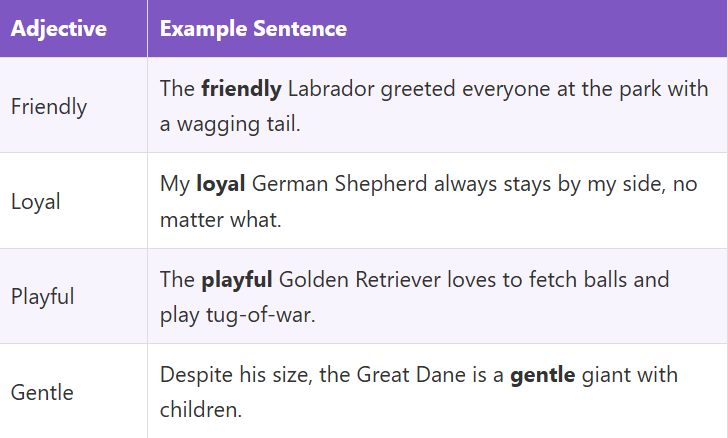
Table of Contents
- Definition of Adjectives for Dogs
- Structural Breakdown of Adjectives
- Types and Categories of Adjectives for Dogs
- Examples of Adjectives for Dogs
- Usage Rules for Adjectives
- Common Mistakes with Adjectives
- Practice Exercises
- Advanced Topics in Adjective Usage
- Frequently Asked Questions
- Conclusion
Definition of Adjectives for Dogs
An adjective is a word that modifies a noun or pronoun, providing additional information about it. In the context of dogs, adjectives describe various aspects such as their physical appearance, personality, size, age, and behavior.
These descriptive words add depth and detail, enabling us to create a more vivid and accurate picture of our canine friends. Adjectives are crucial for effective communication when discussing or writing about dogs.
Adjectives are essential parts of speech that enrich our descriptions of dogs. They allow us to move beyond simple labels and convey specific qualities and characteristics. For instance, instead of just saying “a dog,” we can say “a fluffy dog,” “a loyal dog,” or “a small dog.” The adjectives fluffy, loyal, and small provide additional information, making the description more informative and engaging. The primary function of an adjective is to provide details, often answering questions like “What kind?”, “Which one?”, “How many?”, or “How much?”.
Structural Breakdown of Adjectives
Adjectives typically precede the noun they modify, but they can also follow a linking verb (such as is, are, was, were, seems, becomes). When placed before a noun, they are called attributive adjectives. When placed after a linking verb, they are called predicative adjectives. Understanding this structure helps in constructing grammatically correct and descriptive sentences.
The structure of adjective usage is fundamental to constructing clear and effective sentences. Attributive adjectives directly modify the noun they precede, while predicative adjectives describe the subject of a sentence via a linking verb. For example, in the sentence “The energetic dog ran in the park,” energetic is an attributive adjective. In the sentence “The dog is energetic,” energetic is a predicative adjective. The choice between these structures depends on the sentence’s intended emphasis and flow.
Types and Categories of Adjectives for Dogs
Adjectives can be categorized based on the aspect of the dog they describe. Here are some common categories:
Personality Adjectives
These adjectives describe a dog’s temperament and character. Examples include friendly, loyal, playful, gentle, courageous, and mischievous. These words help convey the unique personality of each dog.
Appearance Adjectives
These adjectives describe a dog’s physical attributes, such as their coat, color, and build. Examples include fluffy, spotted, golden, muscular, and sleek. These words paint a visual picture of the dog.
Size Adjectives
These adjectives describe a dog’s size and build. Examples include small, large, tiny, huge, petite, and giant. These words help to visualize the dog’s dimensions.
Age Adjectives
These adjectives describe a dog’s age. Examples include young, old, puppyish, senior, and mature. These words provide context about the dog’s life stage.
Behavior Adjectives
These adjectives describe a dog’s actions and habits. Examples include obedient, hyperactive, lazy, trained, and well-behaved. These words convey how the dog typically acts.
Breed Adjectives
These adjectives describe characteristics commonly associated with specific breeds. For example, collie-like, terrier-spirited, retriever-friendly, and shepherd-loyal. These adjectives link traits to breed tendencies.
Examples of Adjectives for Dogs
Here are several examples of adjectives used to describe dogs, categorized by type:
Personality Examples
Personality adjectives capture the essence of a dog’s character. These words help us understand their temperament and how they interact with the world.
The following table illustrates various personality adjectives used in sentences about dogs.
| Adjective | Example Sentence |
|---|---|
| Friendly | The friendly Labrador greeted everyone at the park with a wagging tail. |
| Loyal | My loyal German Shepherd always stays by my side, no matter what. |
| Playful | The playful Golden Retriever loves to fetch balls and play tug-of-war. |
| Gentle | Despite his size, the Great Dane is a gentle giant with children. |
| Courageous | The courageous terrier fearlessly chased away the intruder. |
| Mischievous | The mischievous puppy chewed on my shoes when I wasn’t looking. |
| Affectionate | Our affectionate dog loves to cuddle on the couch. |
| Protective | The protective Rottweiler barks at strangers approaching our house. |
| Calm | The calm Greyhound makes a great companion for quiet evenings. |
| Energetic | The energetic Border Collie needs a lot of exercise to stay happy. |
| Intelligent | The intelligent Poodle quickly learns new tricks. |
| Independent | The independent Shiba Inu often prefers to explore on its own. |
| Curious | The curious Beagle always sniffs around new places. |
| Sociable | The sociable dog enjoys playing with other dogs at the dog park. |
| Timid | The timid Chihuahua hides behind my legs when meeting new people. |
| Obedient | The obedient dog always follows commands during training sessions. |
| Patient | The patient dog waits calmly for his treat. |
| Alert | The alert Doberman is always aware of his surroundings. |
| Happy | The happy dog wags his tail constantly whenever he sees his owner. |
| Anxious | The anxious dog barks whenever he is left alone at home. |
| Goofy | The goofy dog always makes his owner smile with his silly antics. |
| Reserved | The reserved Akita tends to be wary of strangers. |
| Spunky | The spunky Jack Russell Terrier has endless energy. |
| Stoic | The stoic Bulldog rarely shows signs of pain or discomfort. |
| Vigilant | The vigilant Anatolian Shepherd Dog is always on guard. |
| Zealous | The zealous pointer is always eager to hunt. |
Appearance Examples
Appearance adjectives describe a dog’s physical characteristics, such as their coat, color, and build. These adjectives help create a vivid mental image of the dog.
The table below provides examples of appearance adjectives used in sentences.
| Adjective | Example Sentence |
|---|---|
| Fluffy | The fluffy Samoyed looked like a cloud of white fur. |
| Spotted | The spotted Dalmatian stood out in the crowd. |
| Golden | The golden retriever’s coat shimmered in the sunlight. |
| Muscular | The muscular pit bull had a powerful build. |
| Sleek | The sleek Doberman Pinscher moved with grace. |
| Brown | The brown Labrador loves to swim in the lake. |
| White | The white German Shepherd looked majestic in the snow. |
| Black | The black Poodle had a curly, elegant coat. |
| Short-haired | The short-haired Chihuahua is easy to groom. |
| Long-haired | The long-haired Afghan Hound requires regular brushing. |
| Big-eared | The big-eared Basset Hound is known for its floppy ears. |
| Small-eyed | The small-eyed bulldog has a distinctive appearance. |
| Tall | The tall Irish Wolfhound is one of the tallest dog breeds. |
| Stocky | The stocky Corgi has short legs and a sturdy build. |
| Wrinkled | The wrinkled Shar-Pei has a unique skin texture. |
| Elegant | The elegant Saluki moves with grace and poise. |
| Beautiful | The beautiful Collie has a long, flowing coat. |
| Cute | The cute Pomeranian is a popular lap dog. |
| Dappled | The dappled Dachshund has a unique coat pattern. |
| Brindle | The brindle Boxer has a striped coat. |
| Bushy-tailed | The bushy-tailed Akita has a distinctive tail that curls over its back. |
| Broad-chested | The broad-chested Bulldog is known for its sturdy build. |
| Coarse-haired | The coarse-haired Irish Wolfhound has a rough coat. |
| Crimped | The crimped Poodle has a curly and textured coat. |
| Cropped-eared | The cropped-eared Doberman has a more assertive appearance. |
| Droopy-eyed | The droopy-eyed Basset Hound always looks a little sad. |
Size Examples
Size adjectives describe a dog’s physical dimensions. These words help us understand how big or small a dog is in relation to other dogs and objects.
Here are some examples of size adjectives in sentences.
| Adjective | Example Sentence |
|---|---|
| Small | The small Chihuahua fit perfectly in my purse. |
| Large | The large Great Dane towered over everyone at the dog park. |
| Tiny | The tiny teacup poodle was incredibly delicate. |
| Huge | The huge Mastiff was an imposing presence. |
| Petite | The petite Yorkshire Terrier weighed only a few pounds. |
| Giant | The giant Irish Wolfhound is known for its impressive size. |
| Medium-sized | The medium-sized Beagle is a popular family dog. |
| Compact | The compact French Bulldog is well-suited for apartment living. |
| Bulky | The bulky Saint Bernard is a strong and sturdy breed. |
| Miniature | The miniature Poodle is a smaller version of the standard Poodle. |
| Full-grown | The full-grown Labrador is a large and active dog. |
| Undersized | The undersized German Shepherd was much smaller than average. |
| Overweight | The overweight dog needed to go on a diet. |
| Lean | The lean Greyhound is built for speed. |
| Stout | The stout Bulldog has a sturdy and muscular build. |
| Broad | The broad chest of the Boxer gives it a powerful appearance. |
| Narrow | The narrow head of the Collie is a breed characteristic. |
| Lengthy | The lengthy body of the Dachshund is quite distinctive. |
| Tall | The tall dog could easily reach the counter. |
| Short | The short legs of the Corgi are a defining feature. |
| Substantial | The substantial build of the Bernese Mountain Dog makes it well-suited for cold climates. |
| Lanky | The lanky Great Dane puppy was still growing into his legs. |
| Petite | The petite Maltese is a popular lap dog. |
| Chunky | The chunky Staffordshire Bull Terrier is known for its muscular build. |
| Sizable | The sizable Akita is a powerful and imposing breed. |
| Diminutive | The diminutive Brussels Griffon is full of personality despite its size. |
Age Examples
Age adjectives describe a dog’s stage of life. These words help us understand whether a dog is a puppy, an adult, or a senior.
Here are some examples of age adjectives used in sentences.
| Adjective | Example Sentence |
|---|---|
| Young | The young puppy was full of energy and curiosity. |
| Old | The old dog slept soundly on his favorite cushion. |
| Puppyish | Even at two years old, the dog still had a puppyish enthusiasm. |
| Senior | The senior dog needed extra care and attention due to his age. |
| Mature | The mature dog was well-behaved and calm. |
| Adolescent | The adolescent dog was going through a rebellious phase. |
| Baby | The baby puppy needed constant supervision. |
| Adult | The adult dog was fully trained and responsible. |
| Geriatric | The geriatric dog was slowing down but still enjoyed gentle walks. |
| Prime | The dog was in his prime, full of energy and vitality. |
| Fledgling | The fledgling pup was just starting to explore the world. |
| Aged | The aged canine had many stories to tell, if only he could talk. |
| Middle-aged | The middle-aged dog still loved to play, but also enjoyed his naps. |
| Junior | The junior member of the pack was eager to learn from the older dogs. |
| Infant | The infant puppy slept most of the day, waking only to eat. |
| Weaned | The weaned puppy was now eating solid food. |
| Seasoned | The seasoned dog had seen many years and many adventures. |
| Elderly | The elderly dog was treated with extra care and respect. |
| Sprightly | Even as a senior, the sprightly dog still enjoyed chasing squirrels. |
| Venerable | The venerable old dog was a wise and respected member of the family. |
| Callow | The callow puppy still had much to learn about the world. |
| Immature | The immature dog still had a lot of growing up to do. |
| Well-seasoned | The well-seasoned dog had a calm and steady demeanor. |
| Time-worn | The time-worn canine had a gentle and wise presence. |
| Experienced | The experienced dog had been through many training sessions. |
| Early-stage | The early-stage puppy was just learning to walk. |
Behavior Examples
Behavior adjectives describe how a dog acts and interacts with its environment. These words help us understand a dog’s habits and tendencies.
The following table provides examples of behavior adjectives in sentences.
| Adjective | Example Sentence |
|---|---|
| Obedient | The obedient dog followed every command without hesitation. |
| Hyperactive | The hyperactive puppy ran around the house non-stop. |
| Lazy | The lazy dog spent most of the day sleeping. |
| Trained | The trained dog performed tricks on command. |
| Well-behaved | The well-behaved dog greeted guests politely. |
| Aggressive | The aggressive dog needed special training to control its behavior. |
| Excitable | The excitable puppy barked whenever the doorbell rang. |
| Docile | The docile dog was gentle and easy to handle. |
| Destructive | The destructive dog chewed on furniture when left alone. |
| Quiet | The quiet dog rarely barked or made noise. |
| Skittish | The skittish dog was easily startled by loud noises. |
| Vocal | The vocal dog barked frequently to communicate. |
| Responsive | The responsive dog reacted quickly to commands. |
| Restless | The restless dog paced around when confined. |
| Alert | The alert dog barked at any approaching strangers. |
| Playful | The playful dog loved to chase balls and play fetch. |
| Gentle | The gentle dog was careful around children. |
| Eager | The eager dog waited patiently for his treat. |
| Attentive | The attentive dog listened closely to his owner’s instructions. |
| Calm | The calm dog remained relaxed during stressful situations. |
| Mischievous | The mischievous dog often got into trouble. |
| Inquisitive | The inquisitive dog loved to explore new places. |
| Tolerant | The tolerant dog allowed the children to play with him gently. |
| Adaptable | The adaptable dog adjusted easily to new environments. |
| Sociable | The sociable dog loved to meet new people and other dogs. |
| Fearful | The fearful dog hid under the table during thunderstorms. |
Usage Rules for Adjectives
Using adjectives correctly involves understanding their placement, order, and forms. These rules ensure clarity and grammatical accuracy in your writing.
Adjective Order
When using multiple adjectives to describe a noun, there is a general order to follow. This order is typically: opinion, size, age, shape, color, origin, material, and purpose.
While not always rigid, following this order helps create a more natural and understandable sentence.
The order of adjectives is a subtle but important aspect of English grammar. While native speakers often follow it intuitively, it’s helpful for learners to understand the underlying principles. For example, it sounds more natural to say “a beautiful small old wooden table” than “a wooden old small beautiful table.” The common mnemonic for remembering the order is OSASCOMP (Opinion, Size, Age, Shape, Color, Origin, Material, Purpose).
Comparative and Superlative Forms
Adjectives have comparative and superlative forms to show degrees of comparison. Comparative adjectives compare two things (e.g., bigger, more playful), while superlative adjectives compare three or more things (e.g., biggest, most playful). The rules for forming these degrees vary depending on the length of the adjective.
Comparative and superlative forms are essential for expressing differences and extremes. Short adjectives typically add “-er” for the comparative and “-est” for the superlative (e.g., small, smaller, smallest). Longer adjectives usually use “more” and “most” (e.g., beautiful, more beautiful, most beautiful). However, there are exceptions and irregular forms that must be memorized (e.g., good, better, best).
Coordinate Adjectives
Coordinate adjectives are two or more adjectives that equally modify the same noun. They are separated by commas and can be rearranged without changing the meaning of the sentence. For example, “a loyal, friendly dog” is correct because both adjectives independently describe the dog. However, “a small brown dog” does not use coordinate adjectives because small and brown do not independently modify the dog.
Coordinate adjectives provide a way to offer multiple descriptive qualities of a noun in a balanced manner. The key test for coordinate adjectives is whether they can be joined by “and” without sounding awkward. For example, “a loyal and friendly dog” sounds natural, while “a small and brown dog” does not, indicating that they are not coordinate.
Common Mistakes with Adjectives
Several common mistakes occur when using adjectives. Being aware of these errors can help you avoid them in your own writing.
Here are some examples:
- Incorrect: “The dog is more taller than the cat.” Correct: “The dog is taller than the cat.” (Avoid using “more” with adjectives that already have “-er” endings.)
- Incorrect: “This is the most unique dog.” Correct: “This is a unique dog.” (Adjectives like “unique” are absolute and do not have comparative or superlative forms.)
- Incorrect: “A beautiful, old, small dog.” Correct: “A beautiful small old dog.” (Incorrect adjective order.)
- Incorrect: “The dog is good.” Correct: “The dog is well-behaved.” (Use “well-behaved” to describe behavior, not “good.”)
- Incorrect: “The dog has long brown hair.” Correct: “The dog has long brown fur.” (Use “fur” instead of “hair” for dogs.)
Another common mistake is using adjectives as adverbs. For example, saying “The dog runs quick” is incorrect; the correct sentence is “The dog runs quickly.” The word “quick” is an adjective, while “quickly” is an adverb.
Adverbs modify verbs, adjectives, or other adverbs, while adjectives modify nouns or pronouns.
Practice Exercises
Test your understanding of adjectives with these practice exercises. Choose the correct adjective to complete each sentence.
| Question | Answer |
|---|---|
| 1. The ________ puppy wagged its tail excitedly. (small, smaller) | small |
| 2. The ________ dog is known for its loyalty. (German Shepherd, German Shepherds) | German Shepherd |
| 3. The ________ dog won the agility competition. (fast, faster) | fast |
| 4. That is the ________ dog I have ever seen. (cutest, cute) | cutest |
| 5. The ________ dog barked loudly at the mailman. (protective, protectively) | protective |
| 6. The ________ dog needs a lot of exercise. (energetic, energetically) | energetic |
| 7. The ________ dog is very friendly with children. (gentle, gently) | gentle |
| 8. The ________ dog loves to play fetch in the park. (playful, playfully) | playful |
| 9. The ________ dog is always happy to see me. (loyal, loyally) | loyal |
| 10. The ________ dog is very intelligent and learns quickly. (smart, smartly) | smart |
Exercise 2: Rewrite the following sentences using more descriptive adjectives.
| Original Sentence | Revised Sentence |
|---|---|
| 1. The dog barked. | The small, yappy dog barked loudly. |
| 2. The puppy played. | The playful, energetic puppy played joyfully. |
| 3. The dog slept. | The old, tired dog slept soundly. |
| 4. The dog ran. | The fast, sleek dog ran quickly. |
| 5. The owner petted the dog. | The owner lovingly petted the fluffy dog. |
| 6. The dog ate. | The hungry dog ate voraciously. |
| 7. The dog watched. | The alert dog watched intently. |
| 8. The girl walked the dog. | The happy girl walked the well-behaved dog. |
| 9. The dog jumped. | The excited dog jumped eagerly. |
| 10. The dog wagged its tail. | The friendly dog wagged its tail enthusiastically. |
Advanced Topics in Adjective Usage
For advanced learners, understanding more complex aspects of adjective usage can further refine their writing skills.
Participial Adjectives
Participial adjectives are derived from verbs and can function as adjectives. They come in two forms: present participles (ending in “-ing”) and past participles (usually ending in “-ed” or “-en”). For example, “a barking dog” (present participle) and “a trained dog” (past participle).
Participial adjectives add dynamism and action to descriptions. They convey a sense of ongoing activity or a completed state. Understanding the difference between present and past participles is crucial for conveying the intended meaning accurately
. For instance, “a running dog” is actively running, while “a tired dog” has already experienced the action of tiring.
Compound Adjectives
Compound adjectives are formed by combining two or more words, often joined by a hyphen. They act as a single adjective modifying a noun. Examples include “a well-behaved dog,” “a short-haired dog,” and “a blue-eyed dog.”
Compound adjectives allow for more precise and nuanced descriptions. They often convey a specific quality that cannot be expressed with single-word adjectives. When using compound adjectives, it’s essential to hyphenate them correctly to avoid ambiguity. For example, “a dog-friendly park” is different from “a dog friendly park.”
Limiting Adjectives
Limiting adjectives restrict the noun they modify, specifying quantity, possession, or identity. They include articles (a, an, the), demonstrative adjectives (this, that, these, those), possessive adjectives (my, your, his, her, its, our, their), and numbers (one, two, three, etc.). For example, “the dog,” “this dog,” “my dog,” and “two dogs” all use limiting adjectives.
Limiting adjectives are essential for providing context and specificity. They help clarify which noun is being referred to and provide additional information about its quantity or ownership.
Understanding the different types of limiting adjectives is crucial for constructing clear and precise sentences.
Frequently Asked Questions
What is the difference between an adjective and an adverb?
An adjective modifies a noun or pronoun, while an adverb modifies a verb, adjective, or another adverb. For example, in the sentence “The quick dog runs,” “quick” is an adjective describing the dog.
In the sentence “The dog runs quickly,” “quickly” is an adverb describing how the dog runs.
Can a noun be used as an adjective?
Yes, a noun can be used as an adjective. This is called a noun adjunct or attributive noun.
For example, in the phrase “dog food,” the noun “dog” is used as an adjective to describe the type of food.
How do I choose the best adjectives to describe a dog?
Consider the specific qualities you want to highlight. Think about the dog’s personality, appearance, size, age, and behavior.
Use a thesaurus to find synonyms and vary your word choice. Also, pay attention to the context and audience of your writing.
Are there any adjectives that should be avoided when describing dogs?
Avoid using overly general or vague adjectives that don’t provide much information. Also, be cautious about using adjectives that could be misinterpreted or offensive.
For example, avoid using negative adjectives without providing context or justification.
What is the correct order of adjectives when describing a dog?
The general order of adjectives is: opinion, size, age, shape, color, origin, material, and purpose. However, this order is not always rigid, and native speakers often follow it intuitively.
When in doubt, try rearranging the adjectives to see what sounds most natural.
Conclusion
Adjectives are powerful tools for describing dogs, allowing us to convey their unique qualities and characteristics vividly and accurately. By understanding the different types of adjectives, their usage rules, and common mistakes to avoid, you can enhance your writing and communication skills.
Whether you’re a dog owner, a writer, or an English language learner, mastering the art of using adjectives for dogs will enable you to paint a more complete and engaging picture of our canine friends.