

Using the right adjectives to describe health conditions, symptoms, and overall well-being is crucial for clear and effective communication. Whether you’re a healthcare professional, a student learning medical terminology, or simply someone who wants to express health-related issues accurately, understanding these adjectives is essential.
This guide will equip you with the knowledge and skills to confidently use adjectives related to health in various contexts. Mastering this aspect of grammar will improve your ability to discuss health matters with precision and understanding.
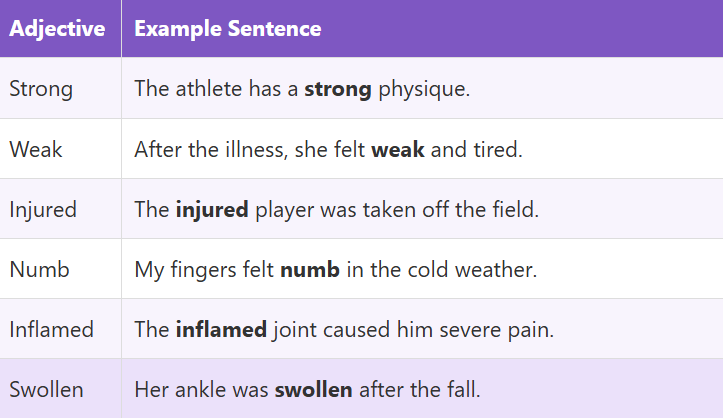
Table of Contents
- Introduction
- Definition of Adjectives for Health
- Structural Breakdown
- Types and Categories of Health Adjectives
- Examples of Health Adjectives
- Usage Rules for Health Adjectives
- Common Mistakes with Health Adjectives
- Practice Exercises
- Advanced Topics
- FAQ: Frequently Asked Questions
- Conclusion
Definition of Adjectives for Health
Adjectives for health are words that describe various aspects of a person’s physical, mental, or emotional state. They provide specific details about a condition, symptom, or overall well-being. These adjectives are essential for accurately communicating information about health and illness. They help to paint a clearer picture of an individual’s health status, enabling better understanding and more effective communication between patients, healthcare providers, and others.
Adjectives modify nouns or pronouns, providing additional information about them. In the context of health, they describe qualities related to the body, mind, and overall wellness. For instance, instead of simply saying “the patient,” we might say “the sick patient” or “the healthy patient,” using adjectives to provide more detail. These adjectives can specify the nature, extent, or severity of a health condition.
The function of health adjectives is to add precision to descriptions of health-related topics. They can indicate whether someone is experiencing pain, fatigue, anxiety, or any other symptom. They can also describe the characteristics of a disease, such as whether it is chronic or acute. The context in which these adjectives are used can vary widely, including medical reports, conversations between doctors and patients, public health campaigns, and everyday discussions about personal health.
Structural Breakdown
The structure of sentences using health adjectives follows standard English grammar rules. Adjectives typically appear before the noun they modify (attributive position) or after a linking verb, such as “is,” “are,” “was,” or “were” (predicative position). Understanding these structural patterns is crucial for constructing grammatically correct and clear sentences.
In the attributive position, the adjective immediately precedes the noun. For example, “chronic pain” or “healthy diet.” This is the most common way to use adjectives in English. The adjective provides a direct description of the noun, specifying a particular attribute or characteristic. Pay attention to the order of adjectives if multiple adjectives are used. There is a general order that native English speakers follow, although it is not always strictly enforced.
In the predicative position, the adjective follows a linking verb and describes the subject of the sentence. For example, “The patient is tired” or “Her heart is strong.” In this case, the adjective serves as a subject complement, providing information about the subject’s state or condition. The linking verb connects the subject to the adjective, indicating a state of being.
Adjectives can also be modified by adverbs to indicate the degree or intensity of the quality they describe. For example, “very healthy” or “extremely painful.” These adverbs add nuance to the description, allowing for a more precise expression of the health condition. The choice of adverb can significantly impact the meaning of the sentence, so it’s important to select the appropriate one.
Types and Categories of Health Adjectives
Health adjectives can be categorized based on the aspect of health they describe. These categories include physical health, mental health, general well-being, and disease-specific conditions.
Each category encompasses a wide range of adjectives that provide specific details about different aspects of health.
Physical Health Adjectives
These adjectives describe the physical condition of the body, including its functions, symptoms, and overall health. They can refer to specific body parts, systems, or general physical characteristics. Examples include: strong, weak, injured, numb, inflamed, swollen, aching, stiff, flexible, and radiant.
Mental Health Adjectives
These adjectives describe a person’s emotional and psychological state. They can refer to feelings, moods, and cognitive functions. Examples include: anxious, depressed, calm, stressed, focused, alert, stable, irritable, optimistic, and pessimistic.
General Well-being Adjectives
These adjectives describe a person’s overall state of health and wellness, encompassing both physical and mental aspects. They often reflect a holistic view of health. Examples include: healthy, unhealthy, fit, well, robust, vigorous, frail, lively, energetic, and rested.
Disease-Specific Adjectives
These adjectives describe conditions or symptoms related to specific diseases or illnesses. They provide details about the nature, severity, or progression of the disease. Examples include: contagious, chronic, acute, terminal, benign, malignant, infectious, debilitating, recurrent, and symptomatic.
Examples of Health Adjectives
The following tables provide extensive examples of health adjectives organized by category. Each table includes specific examples of how these adjectives are used in sentences to describe various health-related situations.
Physical Health Examples
This table lists adjectives related to physical health along with example sentences to illustrate their usage. Understanding how these adjectives are used in context is crucial for effective communication about physical well-being.
| Adjective | Example Sentence |
|---|---|
| Strong | The athlete has a strong physique. |
| Weak | After the illness, she felt weak and tired. |
| Injured | The injured player was taken off the field. |
| Numb | My fingers felt numb in the cold weather. |
| Inflamed | The inflamed joint caused him severe pain. |
| Swollen | Her ankle was swollen after the fall. |
| Aching | He had an aching back from lifting heavy boxes. |
| Stiff | My neck feels stiff after sleeping in a strange position. |
| Flexible | Yoga helps to keep your body flexible. |
| Radiant | She had a radiant complexion after the facial. |
| Agile | The agile dancer moved gracefully across the stage. |
| Tender | The area around the wound was tender to the touch. |
| Sore | My muscles are sore after the workout. |
| Fit | He is a fit and healthy individual. |
| Fragile | The elderly woman had fragile bones. |
| Robust | The baby was born robust and healthy. |
| Athletic | She has an athletic build from years of training. |
| Toned | Regular exercise helps to keep your body toned. |
| Limp | He had a limp after the leg injury. |
| Bruised | Her arm was bruised after the fall. |
| Sprained | He sprained his ankle during the game. |
| Tingling | She felt a tingling sensation in her hand. |
| Strained | He strained his back while lifting the heavy box. |
| Crippled | The disease left him crippled. |
| Paralyzed | He was paralyzed from the waist down after the accident. |
Mental Health Examples
This table focuses on adjectives that describe mental and emotional states. Being able to accurately describe these states is important for discussing mental health and well-being.
The examples provide context for how these adjectives can be used in sentences.
| Adjective | Example Sentence |
|---|---|
| Anxious | She felt anxious before the presentation. |
| Depressed | He was depressed after losing his job. |
| Calm | Meditation helps her feel calm and relaxed. |
| Stressed | He was stressed about the upcoming exams. |
| Focused | She was focused on completing the project. |
| Alert | The security guard remained alert throughout the night. |
| Stable | His mental health is stable with medication. |
| Irritable | Lack of sleep made him irritable. |
| Optimistic | She remained optimistic despite the challenges. |
| Pessimistic | He had a pessimistic outlook on the future. |
| Content | She felt content with her simple life. |
| Happy | The children were happy to receive their gifts. |
| Sad | He was sad after saying goodbye to his friend. |
| Joyful | The wedding was a joyful occasion. |
| Fearful | She was fearful of heights. |
| Nervous | He felt nervous before the job interview. |
| Tranquil | The garden was a tranquil escape from the city. |
| Serene | She had a serene expression on her face. |
| Agitated | He became agitated when he couldn’t find his keys. |
| Restless | She had a restless night’s sleep. |
| Emotional | The movie was very emotional. |
| Sensitive | She is a very sensitive person. |
| Sympathetic | He was sympathetic to her situation. |
| Empathetic | She is an empathetic listener. |
| Resilient | She is a resilient individual who bounces back from adversity. |
General Well-being Examples
This table provides adjectives that describe overall health and well-being. These adjectives often encompass both physical and mental aspects, providing a holistic view of a person’s health status.
| Adjective | Example Sentence |
|---|---|
| Healthy | She eats a healthy diet and exercises regularly. |
| Unhealthy | Smoking is an unhealthy habit. |
| Fit | He is a fit and active individual. |
| Well | She feels well after taking the medication. |
| Robust | The plant is robust and thriving. |
| Vigorous | He maintained a vigorous exercise routine. |
| Frail | The frail old man needed assistance walking. |
| Lively | The children were lively and full of energy. |
| Energetic | She felt energetic after a good night’s sleep. |
| Rested | He felt rested after the vacation. |
| Tired | He was tired after a long day at work. |
| Exhausted | She felt exhausted after running the marathon. |
| Refreshed | She felt refreshed after a cool shower. |
| Invigorated | He felt invigorated after the morning swim. |
| Weakened | His immune system was weakened by the illness. |
| Comfortable | She felt comfortable in her own skin. |
| Uncomfortable | He felt uncomfortable in the crowded room. |
| Balanced | She leads a balanced lifestyle with work and leisure. |
| Imbalanced | His diet was imbalanced and lacked essential nutrients. |
| Vulnerable | The elderly are more vulnerable to infections. |
| Resilient | She is a resilient person who always overcomes challenges. |
| Sustained | She led a sustained and healthy lifestyle. |
| Flourishing | She had a flourishing garden. |
| Withering | The plant was withering due to lack of water. |
| Struggling | He was struggling with his mental health. |
Disease-Specific Examples
This table lists adjectives that describe conditions or symptoms related to specific diseases. These adjectives are essential for accurately describing the nature and progression of illnesses.
| Adjective | Example Sentence |
|---|---|
| Contagious | The flu is highly contagious. |
| Chronic | He suffers from chronic back pain. |
| Acute | She had an acute case of bronchitis. |
| Terminal | He was diagnosed with a terminal illness. |
| Benign | The tumor was benign and not cancerous. |
| Malignant | The malignant tumor required immediate treatment. |
| Infectious | The disease is highly infectious. |
| Debilitating | The illness had a debilitating effect on his health. |
| Recurrent | She suffers from recurrent headaches. |
| Symptomatic | The patient was symptomatic with a fever and cough. |
| Asymptomatic | Many people are asymptomatic carriers of the virus. |
| Endemic | Malaria is endemic in many tropical regions. |
| Epidemic | The city was hit by an epidemic of the flu. |
| Pandemic | The world faced a pandemic of COVID-19. |
| Genetic | The disease has a genetic component. |
| Hereditary | The condition is hereditary and runs in the family. |
| Congenital | The baby was born with a congenital heart defect. |
| Acquired | He had an acquired immune deficiency. |
| Communicable | Tuberculosis is a communicable disease. |
| Preventable | Many diseases are preventable with vaccination. |
| Treatable | The infection is treatable with antibiotics. |
| Incurable | Some diseases are currently incurable. |
| Progressive | Alzheimer’s is a progressive disease. |
| Regressive | The disease had a regressive effect on his mobility. |
| Latent | The virus can remain latent in the body for years. |
Usage Rules for Health Adjectives
Using health adjectives correctly requires understanding their placement and function within a sentence. The primary rules involve attributive and predicative use, as well as the use of intensifiers to modify the degree of the adjective.
Attributive Use
In attributive use, the adjective comes before the noun it modifies. This is the most common way to use adjectives. The adjective directly describes a characteristic of the noun. For example, “a healthy meal,” “an injured athlete,” or “a chronic condition.” The adjective provides immediate and direct information about the noun’s quality or state.
Predicative Use
In predicative use, the adjective follows a linking verb and describes the subject of the sentence. The linking verb connects the subject to the adjective, indicating a state of being or condition. For example, “The patient is tired,” “Her heart is strong,” or “The disease is contagious.” The adjective functions as a subject complement, providing information about the subject’s current state.
Using Intensifiers with Health Adjectives
Intensifiers are adverbs that modify adjectives, indicating the degree or intensity of the quality being described. Common intensifiers include “very,” “extremely,” “quite,” “slightly,” and “somewhat.” For example, “very healthy,” “extremely painful,” or “slightly anxious.” These adverbs add nuance to the description, allowing for a more precise expression of the health condition.
The choice of intensifier can significantly impact the meaning of the sentence. “Very painful” implies a high degree of pain, while “slightly painful” suggests a milder sensation.
It’s important to select the appropriate intensifier to accurately convey the intended meaning.
Common Mistakes with Health Adjectives
One common mistake is using the wrong adjective to describe a health condition. For example, using “infectious” instead of “contagious” or vice versa. Contagious means a disease can be spread by direct or indirect contact, while infectious means a disease is caused by an infection. Another common error is misusing intensifiers, such as saying “very slight pain” when “slight pain” is more appropriate.
Another mistake is incorrect adjective order when using multiple adjectives. While not always strictly enforced, there is a general order: opinion, size, age, shape, color, origin, material, and purpose.
For instance, instead of saying “a red small rash,” it should be “a small red rash.”
Using an adjective as an adverb is also a frequent error. For example, saying “He feels badly” instead of “He feels bad.” “Bad” is an adjective describing his state of being, while “badly” is an adverb describing how he performs an action.
Since “feels” is a linking verb describing a state, the correct choice is “bad.”
Correct: She has chronic pain. Incorrect: She has chronically pain.
Correct: He feels bad. Incorrect: He feels badly.
Correct: The disease is contagious. Incorrect: The disease is infectious (when referring to direct transmission).
Correct: A small red rash. Incorrect: A red small rash.
Practice Exercises
These exercises will help you practice using health adjectives correctly. Each exercise focuses on a different aspect of adjective usage, from identifying adjectives to constructing sentences.
Exercise 1: Identifying Adjectives
Identify the adjectives in the following sentences and indicate which noun they modify.
| Question | Answer |
|---|---|
| 1. The tired patient needed rest. | Tired (modifies patient) |
| 2. She has a strong immune system. | Strong (modifies system) |
| 3. The inflamed area was treated with cream. | Inflamed (modifies area) |
| 4. He felt anxious before the surgery. | Anxious (modifies He) |
| 5. The disease is highly contagious. | Contagious (modifies disease) |
| 6. She maintained a healthy lifestyle. | Healthy (modifies lifestyle) |
| 7. The frail old man needed assistance. | Frail (modifies man) |
| 8. He felt stressed about his job. | Stressed (modifies He) |
| 9. The tumor was benign. | Benign (modifies tumor) |
| 10. She had an acute infection. | Acute (modifies infection) |
Exercise 2: Filling in the Blanks
Fill in the blanks with an appropriate health adjective from the word bank below.
Word Bank: chronic, healthy, weak, anxious, contagious, strong, inflamed, tired, acute, depressed
| Question | Answer |
|---|---|
| 1. She felt ______ after the long journey. | Tired |
| 2. The ______ disease required long-term treatment. | Chronic |
| 3. He felt ______ about the upcoming test results. | Anxious |
| 4. The ______ athlete won the competition. | Strong |
| 5. The wound became ______, requiring antibiotics. | Inflamed |
| 6. The flu is highly ______, so stay home. | Contagious |
| 7. He felt ______ after the loss of his pet. | Depressed |
| 8. She eats a ______ diet to stay fit. | Healthy |
| 9. After the surgery, he felt very ______. | Weak |
| 10. She had an ______ attack of appendicitis. | Acute |
Exercise 3: Sentence Construction
Construct a sentence using each of the following health adjectives.
| Adjective | Example Sentence |
|---|---|
| Frail | The frail patient needed constant care. |
| Energetic | The energetic puppy ran around the yard. |
| Symptomatic | The symptomatic patient was tested for the virus. |
| Optimistic | She remained optimistic about her recovery. |
| Debilitating | The disease had a debilitating effect on his mobility. |
| Resilient | She is a resilient individual who overcame many challenges. |
| Balanced | She maintains a balanced diet and exercise routine. |
| Vulnerable | The elderly are more vulnerable to the flu. |
| Restless | He had a restless night due to the pain. |
| Tranquil | The tranquil atmosphere helped her relax. |
Advanced Topics
For advanced learners, understanding the nuances of medical terminology and the subtle differences between similar health adjectives is crucial. This section explores these complexities in more detail.
Medical Terminology and Adjectives
Medical terminology often involves specialized adjectives that describe specific conditions, symptoms, or anatomical features. These adjectives are derived from Latin and Greek roots and require a solid understanding of medical vocabulary.
For example, “hepatic” refers to the liver, “renal” refers to the kidneys, and “cardiac” refers to the heart. Using these adjectives correctly demonstrates a high level of medical knowledge.
Many medical terms use adjectives as prefixes or suffixes to indicate a specific condition or characteristic. For instance, “hypo-” means “under” or “below,” as in “hypoglycemia” (low blood sugar).
Similarly, “hyper-” means “over” or “above,” as in “hypertension” (high blood pressure). Understanding these prefixes and suffixes can help you decipher complex medical terms.
Subtleties and Nuances in Health Adjectives
Some health adjectives have subtle differences in meaning that can significantly impact the accuracy of your description. For example, “ill” and “sick” are often used interchangeably, but “ill” can sometimes imply a more prolonged or serious condition.
Similarly, “tired” and “exhausted” both describe a lack of energy, but “exhausted” suggests a much greater degree of fatigue.
The context in which an adjective is used can also affect its meaning. For example, “stable” can refer to a patient’s condition not worsening, but it can also describe emotional or mental stability.
Paying attention to the surrounding words and phrases can help you understand the intended meaning of the adjective.
FAQ: Frequently Asked Questions
This section addresses common questions about using adjectives for health, providing clear and concise answers.
- What is the difference between “infectious” and “contagious”?Infectious means a disease is caused by an infection, which can be from bacteria, viruses, or other pathogens. Contagious means that a disease can be spread from one person to another, either directly or indirectly. Not all infectious diseases are contagious (e.g., tetanus), but all contagious diseases are infectious.
- How do I know whether to use an adjective attributively or predicatively?Use an adjective attributively when you want to directly describe a noun by placing the adjective before it (e.g., “a healthy diet”). Use it predicatively when you want to describe the subject of a sentence using a linking verb (e.g., “The diet is healthy”).
- What are some common intensifiers used with health adjectives?Common intensifiers include “very,” “extremely,” “quite,” “slightly,” “somewhat,” “really,” and “incredibly.” These adverbs modify the degree or intensity of the adjective (e.g., “very painful,” “slightly anxious”).
- Can I use multiple adjectives to describe a health condition?Yes, you can use multiple adjectives, but be mindful of the order. A general guideline is: opinion, size, age, shape, color, origin, material, and purpose. For example: “a small, red, inflamed rash.”
- What is the difference between “tired” and “exhausted”?Both adjectives describe a lack of energy, but tired implies a general feeling of weariness, while exhausted suggests a much greater degree of fatigue, often resulting from physical or mental exertion.
- How do I use medical terminology correctly?Familiarize yourself with common medical prefixes, suffixes, and root words. Understand the specific meanings of medical terms and use them in the appropriate context. Consult medical dictionaries or resources when in doubt.
- What are some common mistakes to avoid when using health adjectives?Avoid using the wrong adjective (e.g., “infectious” instead of “contagious”), misusing intensifiers (e.g., “very slight pain” instead of “slight pain”), and using adjectives as adverbs (e.g., “He feels badly” instead of “He feels bad”).
- How can I improve my vocabulary of health adjectives?Read medical articles, journals, and books. Pay attention to how health adjectives are used in context. Create flashcards or lists of new adjectives and practice using them in sentences. Engage in conversations about health-related topics.
- Is it okay to use subjective adjectives when describing health?While objective descriptions are preferred in medical settings, subjective adjectives can be useful for conveying a patient’s personal experience. For example, describing pain as “throbbing” or “stabbing” can provide valuable information.
- How do cultural differences affect the use of health adjectives?Different cultures may have varying perceptions and expressions of health and illness. Be mindful of cultural sensitivities when using health adjectives, and avoid making assumptions based on your own cultural background.
Conclusion
Mastering the use of adjectives for health is essential for clear and accurate communication in various contexts, from medical settings to everyday conversations. By understanding the different categories of health adjectives, their structural rules, and common mistakes to avoid, you can significantly improve your ability to describe health conditions, symptoms, and overall well-being.
This knowledge empowers you to express health-related issues with precision and confidence.
Continue to expand your vocabulary by reading medical articles, engaging in health-related discussions, and practicing the exercises provided in this guide. Remember to pay attention to the nuances of language and the context in which adjectives are used.
With consistent effort, you can become proficient in using adjectives for health, enhancing your communication skills and understanding of health-related topics. Always strive for clarity and accuracy in your descriptions, and be mindful of cultural sensitivities when discussing health issues.