

Describing moments effectively is crucial for clear and vivid communication. Adjectives play a vital role in specifying the nature, quality, and duration of these moments.
Understanding how to use adjectives correctly to modify “moment” can significantly enhance your writing and speaking skills. This article offers a comprehensive guide to adjectives used with “moment,” covering their definitions, usage rules, examples, and common mistakes.
Whether you are a beginner or an advanced learner, this guide will help you master the art of describing moments with precision and flair.
By exploring various types of adjectives and their nuances, you’ll gain the confidence to express yourself more accurately and creatively. This article breaks down the complexities of adjective usage into easily digestible sections, complete with practice exercises to reinforce your learning.
Get ready to elevate your English proficiency by mastering the art of using adjectives with “moment.”
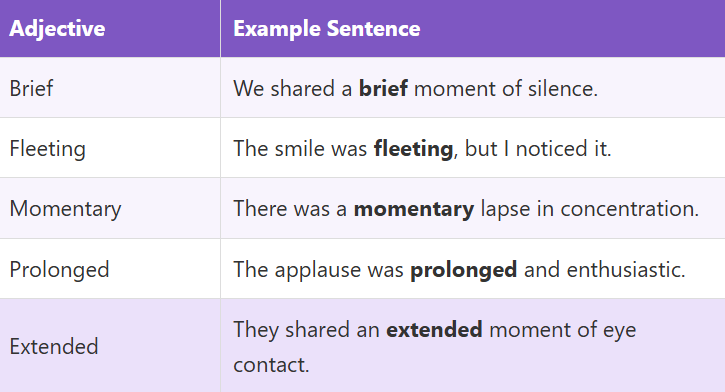
Table of Contents
- Definition of Adjectives for “Moment”
- Structural Breakdown
- Types and Categories of Adjectives for “Moment”
- Examples of Adjectives for “Moment”
- Usage Rules for Adjectives with “Moment”
- Common Mistakes
- Practice Exercises
- Advanced Topics
- FAQ
- Conclusion
Definition of Adjectives for “Moment”
Adjectives that modify “moment” are words that describe or specify the characteristics, qualities, or attributes of a particular instant or period. These adjectives provide additional information about the “moment,” helping to paint a more detailed and vivid picture.
Functionally, they serve to clarify the nature, duration, emotional impact, or significance of a specific point in time. They help distinguish one moment from another, providing context and depth to the description.
Grammatically, these adjectives typically precede the noun “moment” in a sentence. For example, in the phrase “a fleeting moment,” the adjective “fleeting” describes the brief duration of the moment. The context in which these adjectives are used can vary widely, ranging from casual conversations to formal writing. Understanding the nuances of these adjectives is crucial for effective communication and precise expression.
Structural Breakdown
The standard structure involves placing the adjective directly before the noun “moment.” This adheres to the basic English grammar rule where adjectives typically precede the nouns they modify. This structure allows for clear and immediate modification, ensuring the reader or listener understands the specific quality being attributed to the moment.
The adjective provides additional context and detail, enhancing the overall clarity and impact of the sentence.
For example, in the sentence “It was a significant moment for her,” the adjective “significant” is placed before “moment” to emphasize the importance of that particular point in time. Similarly, in “a quiet moment of reflection,” the adjective “quiet” describes the peaceful nature of the moment. While there may be more complex sentence structures, the basic adjacency of adjective and noun remains consistent in most cases.
Types and Categories of Adjectives for “Moment”
Adjectives used to describe “moment” can be categorized based on the specific aspect of the moment they highlight. These categories include duration, quality, importance, emotional impact, and frequency.
Each category offers a unique perspective on the moment, allowing for a more nuanced and descriptive portrayal.
Adjectives Describing Duration
These adjectives specify how long a moment lasts. They can indicate that the moment is very short, relatively long, or somewhere in between.
Words like “brief,” “fleeting,” “momentary,” “prolonged,” and “extended” fall into this category.
Adjectives Describing Quality
These adjectives describe the inherent characteristics or attributes of the moment. They can convey whether the moment is positive, negative, peaceful, chaotic, or anything in between.
Examples include “beautiful,” “awkward,” “tense,” “peaceful,” and “chaotic.” These adjectives add depth and color to the description, helping to evoke a specific feeling or atmosphere.
Adjectives Describing Importance
These adjectives highlight the significance or impact of the moment. They indicate whether the moment is crucial, pivotal, or inconsequential.
Adjectives like “critical,” “pivotal,” “defining,” “significant,” and “momentous” are common in this category. They help emphasize the lasting effects or implications of a particular point in time.
Adjectives Describing Emotional Impact
These adjectives describe the emotional effect the moment has on someone. They can convey feelings of happiness, sadness, fear, excitement, or any other emotion.
Examples include “joyful,” “heartbreaking,” “terrifying,” “exhilarating,” and “poignant.” These adjectives add a personal and subjective dimension to the description, reflecting the emotional experience of the individual.
Adjectives Describing Frequency
These adjectives indicate how often the moment occurs. They can suggest that the moment is rare, frequent, or occasional.
Words like “rare,” “frequent,” “occasional,” “sporadic,” and “recurring” fall into this category. They provide information about the moment’s prevalence or regularity.
Examples of Adjectives for “Moment”
This section provides extensive examples of adjectives used with “moment,” organized by category. Each example illustrates how the adjective modifies the noun to provide a more detailed and specific description.
These examples will help you understand the practical application of these adjectives in various contexts.
Examples: Adjectives Describing Duration
The following table provides examples of adjectives describing the duration of a moment. Each example includes a sentence demonstrating the adjective in context.
| Adjective | Example Sentence |
|---|---|
| Brief | We shared a brief moment of silence. |
| Fleeting | The smile was fleeting, but I noticed it. |
| Momentary | There was a momentary lapse in concentration. |
| Prolonged | The applause was prolonged and enthusiastic. |
| Extended | They shared an extended moment of eye contact. |
| Quick | She took a quick moment to gather her thoughts. |
| Short | He paused for a short moment before answering. |
| Passing | It was just a passing moment of doubt. |
| Transient | Life is filled with transient moments of joy. |
| Ephemeral | The beauty of the cherry blossoms is ephemeral. |
| Split | In a split moment, he made the decision. |
| Instantaneous | The reaction was instantaneous and powerful. |
| Fast | A fast moment of panic washed over her. |
| Swift | The change was swift and unexpected. |
| Abrupt | There was an abrupt moment when the music stopped. |
| Evanescent | The memory was evanescent, fading quickly. |
| Temporary | It was a temporary moment of weakness. |
| Concise | He gave a concise moment to summarize. |
| Blink-and-you-miss-it | It was a blink-and-you-miss-it moment. |
| Snap | In a snap moment, he reacted. |
| Split-second | He made a split-second decision. |
| Fleeting | She had a fleeting moment of happiness. |
| Rapid | There was a rapid moment of silence. |
| Short-lived | It was a short-lived moment. |
| Brief | They had a brief moment to reflect. |
| Passing | It was a passing moment of sadness. |
| Momentary | There was a momentary lapse in concentration. |
| Quick | She took a quick moment to gather her thoughts. |
| Short | He paused for a short moment before answering. |
Examples: Adjectives Describing Quality
The following table provides examples of adjectives describing the quality of a moment. Each example includes a sentence demonstrating the adjective in context.
| Adjective | Example Sentence |
|---|---|
| Beautiful | It was a beautiful moment to witness. |
| Awkward | There was an awkward moment of silence. |
| Tense | The room was filled with a tense moment. |
| Peaceful | We enjoyed a peaceful moment by the lake. |
| Chaotic | It was a chaotic moment during the storm. |
| Serene | The morning offered a serene moment of tranquility. |
| Turbulent | The crisis created a turbulent moment in history. |
| Calm | After the storm, there was a calm moment. |
| Strange | It was a strange moment, I couldn’t explain it. |
| Magical | The sunset provided a magical moment. |
| Wonderful | It was a wonderful moment to remember. |
| Charming | There was a charming moment when they met. |
| Joyful | The wedding was a joyful moment for everyone. |
| Touching | It was a touching moment to witness their reunion. |
| Remarkable | There was a remarkable moment when he scored the goal. |
| Unforgettable | The concert was an unforgettable moment. |
| Precious | The birth of their child was a precious moment. |
| Splendid | It was a splendid moment of victory. |
| Exquisite | The dance was an exquisite moment of art. |
| Lovely | It was a lovely moment to share with friends. |
| Pleasant | The picnic was a pleasant moment in the park. |
| Relaxing | The spa visit was a relaxing moment. |
| Enjoyable | The movie was an enjoyable moment. |
| Interesting | The lecture was an interesting moment. |
| Fascinating | The visit to the museum was a fascinating moment. |
| Amusing | The comedy show was an amusing moment. |
| Delightful | The cake was a delightful moment. |
| Satisfying | Completing the project was a satisfying moment. |
| Gratifying | Helping others was a gratifying moment. |
| Rewarding | Mentoring the student was a rewarding moment. |
Examples: Adjectives Describing Importance
The following table provides examples of adjectives describing the importance of a moment. Each example includes a sentence demonstrating the adjective in context.
| Adjective | Example Sentence |
|---|---|
| Critical | It was a critical moment in the negotiation. |
| Pivotal | The decision marked a pivotal moment in his career. |
| Defining | That game was a defining moment for the team. |
| Significant | The discovery was a significant moment in science. |
| Momentous | The signing of the treaty was a momentous occasion. |
| Key | That was a key moment in the investigation. |
| Crucial | The next few seconds were crucial to their survival. |
| Vital | It was a vital moment for the project’s success. |
| Important | It was an important moment for her to speak up. |
| Essential | That step was essential for the process. |
| Consequential | The verdict marked a consequential moment for justice. |
| Meaningful | The ceremony was a meaningful moment for the veterans. |
| Notable | The achievement was a notable moment in her life. |
| Remarkable | The breakthrough was a remarkable moment in history. |
| Substantial | There was a substantial moment of progress. |
| Serious | The discussion was a serious moment for the company. |
| Weighty | The decision was a weighty moment for the leader. |
| Far-reaching | The policy change had a far-reaching moment. |
| Decisive | The vote was a decisive moment for the nation. |
| Paramount | Safety was a paramount moment. |
| Primary | The first step was a primary moment. |
| Principal | The main principle was a principal moment. |
| Foremost | Their health was a foremost moment. |
| Leading | The experiment was a leading moment. |
| Central | The idea was a central moment. |
| Focal | The presentation was a focal moment. |
| Core | The values were a core moment. |
| Pivotal | The decision was a pivotal moment. |
| Vital | The support was a vital moment. |
| Crucial | The timing was a crucial moment. |
Examples: Adjectives Describing Emotional Impact
The following table provides examples of adjectives describing the emotional impact of a moment. Each example includes a sentence demonstrating the adjective in context.
| Adjective | Example Sentence |
|---|---|
| Joyful | It was a joyful moment for the entire family. |
| Heartbreaking | The news was a heartbreaking moment for everyone. |
| Terrifying | The accident was a terrifying moment. |
| Exhilarating | The victory was an exhilarating moment. |
| Poignant | The farewell was a poignant moment. |
| Emotional | It was an emotional moment for the graduates. |
| Touching | The reunion was a touching moment. |
| Sad | It was a sad moment when they said goodbye. |
| Happy | It was a happy moment when they announced the news. |
| Uplifting | The speech was an uplifting moment. |
| Inspiring | The performance was an inspiring moment. |
| Moving | The story was a moving moment. |
| Thrilling | The rollercoaster ride was a thrilling moment. |
| Exciting | The announcement was an exciting moment. |
| Elating | The promotion was an elating moment. |
| Gratifying | The recognition was a gratifying moment. |
| Satisfying | The accomplishment was a satisfying moment. |
| Fulfilling | The project completion was a fulfilling moment. |
| Hopeful | The diagnosis was a hopeful moment. |
| Optimistic | The outlook was an optimistic moment. |
| Despairing | The failure was a despairing moment. |
| Frustrating | The delay was a frustrating moment. |
| Annoying | The interruption was an annoying moment. |
| Irritating | The noise was an irritating moment. |
| Resentful | The criticism was a resentful moment. |
| Bitter | The defeat was a bitter moment. |
| Aggrieved | The injustice was an aggrieved moment. |
| Enraged | The insult was an enraged moment. |
| Furious | The betrayal was a furious moment. |
| Incensed | The lie was an incensed moment. |
Examples: Adjectives Describing Frequency
The following table provides examples of adjectives describing the frequency of a moment. Each example includes a sentence demonstrating the adjective in context.
| Adjective | Example Sentence |
|---|---|
| Rare | It was a rare moment of complete silence. |
| Frequent | Arguments became a frequent moment in their relationship. |
| Occasional | They shared an occasional moment of laughter. |
| Sporadic | There were sporadic moments of heavy rain. |
| Recurring | He had recurring moments of doubt. |
| Regular | They had a regular moment of reflection each day. |
| Periodic | The machine had periodic moments of malfunction. |
| Intermittent | There were intermittent moments of sunshine. |
| Constant | She felt a constant moment of anxiety. |
| Continual | There was a continual moment of noise from the construction site. |
| Usual | It was a usual moment of chaos before the show. |
| Typical | It was a typical moment of them arguing. |
| Common | Mistakes are a common moment when learning. |
| Prevailing | There was a prevailing moment of optimism. |
| Habitual | Lateness was a habitual moment for him. |
| Customary | It was a customary moment to greet guests. |
| Established | The tradition was an established moment. |
| Settled | The agreement was a settled moment. |
| Fixed | The deadline was a fixed moment. |
| Definite | The plan was a definite moment. |
| Certain | The outcome was a certain moment. |
| Predictable | The result was a predictable moment. |
| Expected | The arrival was an expected moment. |
| Scheduled | The meeting was a scheduled moment. |
| Planned | The event was a planned moment. |
| Arranged | The gathering was an arranged moment. |
| Orchestrated | The surprise was an orchestrated moment. |
| Organized | The conference was an organized moment. |
| Structured | The lesson was a structured moment. |
| Systematic | The review was a systematic moment. |
Usage Rules for Adjectives with “Moment”
When using adjectives with “moment,” it’s important to follow standard English grammar rules. The adjective should be placed directly before the noun “moment.” Ensure the adjective accurately reflects the characteristic you want to emphasize.
Using the correct adjective is essential for conveying the intended meaning.
Pay attention to the context in which you are using the adjective. The same adjective can have different connotations depending on the surrounding words and phrases.
For example, “a tense moment” in a negotiation has a different meaning than “a tense moment” during a horror movie. Always choose adjectives that are appropriate for the specific situation you are describing.
Also, consider using strong, descriptive adjectives to enhance the impact of your writing.
Common Mistakes
One common mistake is using adjectives that don’t accurately describe the moment. For example, saying “a long moment” when you mean “a significant moment” is incorrect.
Another mistake is using adjectives that are redundant or unnecessary. For instance, “a very momentary moment” is redundant because “momentary” already implies a brief duration.
Also, be cautious of using adjectives that are too vague or generic. Adjectives like “good” or “bad” don’t provide enough specific information about the moment.
Instead, try to use more descriptive and precise adjectives such as “joyful,” “heartbreaking,” or “tense.” Avoid using adverbs instead of adjectives. For example, instead of saying “a quickly moment,” say “a quick moment.”
Here are some examples of common mistakes and their corrections:
| Incorrect | Correct |
|---|---|
| A quickly moment | A quick moment |
| A very momentary moment | A momentary moment |
| A good moment | A joyful moment |
| A bad moment | A heartbreaking moment |
| A long moment (when meaning significant) | A significant moment |
Practice Exercises
These practice exercises will help you reinforce your understanding of adjectives used with “moment.” Each exercise focuses on different aspects of adjective usage, from identifying correct adjectives to correcting common errors. Take your time and carefully consider each question.
Exercise 1: Identifying Correct Adjectives
Choose the best adjective to complete each sentence.
| Question | Options | Answer |
|---|---|---|
| 1. It was a _____ moment when they announced the winner. | a) quickly b) joyful c) frequent | b) joyful |
| 2. There was a _____ moment of silence after the news. | a) tense b) rare c) happy | a) tense |
| 3. The _____ moment passed before I could react. | a) important b) fleeting c) constant | b) fleeting |
| 4. It was a _____ moment in the history of the company. | a) beautiful b) defining c) sporadic | b) defining |
| 5. The _____ moments of sunshine made the day better. | a) intermittent b) emotional c) prolonged | a) intermittent |
| 6. That was a _____ moment for the team to win. | a) rare b) awkward c) critical | c) critical |
| 7. The _____ moment made everyone cry. | a) sad b) quick c) nice | a) sad |
| 8. There was a _____ moment of panic. | a) fast b) extended c) great | a) fast |
| 9. It was a _____ moment to relax. | a) regular b) wonderful c) bad | b) wonderful |
| 10. It was a _____ moment of victory. | a) split b) splendid c) usual | b) splendid |
Exercise 2: Sentence Completion
Complete the following sentences with an appropriate adjective.
| Question | Answer |
|---|---|
| 1. The _____ moment will always be remembered. | unforgettable |
| 2. It was a _____ moment of reflection. | peaceful |
| 3. The _____ moment changed everything. | pivotal |
| 4. The _____ moment was filled with joy. | joyful |
| 5. Every _____ moment is precious. | passing |
| 6. It was a _____ moment for the company. | significant |
| 7. The _____ moment was very short. | brief |
| 8. The _____ moment shocked everyone. | terrifying |
| 9. It was a _____ moment in history. | monumentous |
| 10. The _____ moment made her happy. | charming |
Exercise 3: Error Correction
Identify and correct the errors in the following sentences.
| Question | Corrected Answer |
|---|---|
| 1. It was a quickly moment. | It was a quick moment. |
| 2. A very momentary moment happened. | A momentary moment happened. |
| 3. The good moment was great. | The joyful moment was great. |
| 4. The bad moment made me cry. | The heartbreaking moment made me cry. |
| 5. It was a long moment for me. | It was a significant moment for me. |
| 6. The frequent moment was annoying. | The frequent arguments were annoying. |
| 7. It was a nice moment to see her. | It was a lovely moment to see her. |
| 8. The emotional moment was very sad. | The emotional moment was very touching. |
| 9. The important moment changed everything. | The crucial moment changed everything. |
| 10. The beautiful moment happened again. | The wonderful moment happened again. |
Advanced Topics
For advanced learners, exploring more complex aspects of adjectives can further enhance your understanding. Consider the use of compound adjectives, which are formed by combining two or more words to modify “moment.” For example, “a once-in-a-lifetime moment” is a compound adjective describing a unique and rare occurrence.
Additionally, explore the use of figurative language, such as metaphors and similes, to describe moments in a more creative and evocative way. For example, instead of saying “a tense moment,” you might say “a moment as heavy as lead.” Understanding these advanced techniques can elevate your writing and communication skills to a higher level.
FAQ
Here are some frequently asked questions about using adjectives with “moment.”
- What is the correct placement of an adjective when describing a moment?The adjective should be placed directly before the noun “moment.” This is the standard English grammar rule for adjective placement. For example, “a brief moment,” not “a moment brief.”
- Can I use more than one adjective to describe a moment?Yes, you can use multiple adjectives to provide a more detailed description. However, be mindful of not overdoing it, as too many adjectives can make the sentence clunky. For example, “a beautiful, peaceful moment” is acceptable, but “a beautiful, peaceful
, serene, quiet moment” might be excessive. - How do I choose the best adjective to describe a moment?Consider the specific quality or characteristic you want to emphasize. Think about the context, emotional impact, duration, and importance of the moment. Choose an adjective that accurately reflects these aspects.
- Are there any adjectives I should avoid using with “moment”?Avoid using vague or generic adjectives like “good” or “bad.” Instead, opt for more descriptive and precise adjectives. Also, avoid redundant adjectives that repeat the meaning already implied in “moment.”
- What if I can’t think of the perfect adjective?Use a thesaurus to explore synonyms and related words. Sometimes, a slightly different adjective can capture the nuance you’re looking for. Also, consider using a phrase or clause to describe the moment if a single adjective doesn’t suffice.
Conclusion
Mastering the use of adjectives with “moment” is essential for effective and vivid communication. By understanding the different types and categories of adjectives, following usage rules, and avoiding common mistakes, you can significantly enhance your writing and speaking skills.
Practice the exercises provided in this article to reinforce your learning and gain confidence in your ability to describe moments with precision and flair.
Remember, the key to effective communication is choosing the right words to convey your intended meaning. With a solid understanding of adjectives for “moment,” you’ll be well-equipped to express yourself more accurately and creatively.
Continue to explore and experiment with different adjectives to find the perfect words for every moment.