

Understanding how to effectively use adjectives to describe networks is crucial for clear communication in various fields, from technology and business to social sciences. Adjectives provide the necessary details to specify the type, characteristics, and qualities of a network, enabling precise and nuanced descriptions.
This article offers a comprehensive guide to using adjectives with “network,” exploring different categories, providing numerous examples, and offering practical exercises to enhance your understanding and usage.
Whether you’re a student, a professional in IT, or simply someone looking to improve your English grammar, this guide will equip you with the knowledge and skills to confidently and accurately describe networks in any context. By mastering the use of these adjectives, you can convey complex information with clarity and precision.
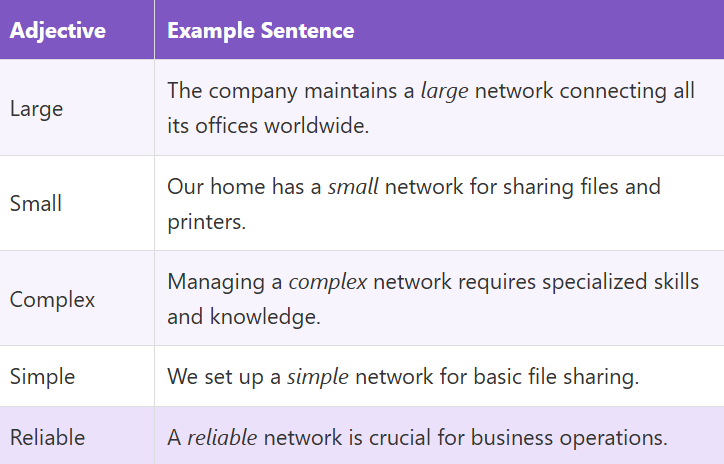
Table of Contents
- Introduction
- Definition of “Network” and the Role of Adjectives
- Structural Breakdown: Adjective Placement
- Types of Adjectives Used with “Network”
- Examples of Adjectives Used with “Network”
- Usage Rules for Adjectives with “Network”
- Common Mistakes When Using Adjectives with “Network”
- Practice Exercises
- Advanced Topics: Nuances and Complex Structures
- Frequently Asked Questions (FAQ)
- Conclusion
Definition of “Network” and the Role of Adjectives
A network, in its broadest sense, refers to a group or system of interconnected people or things. This connection facilitates the exchange of information, resources, or support. The term is used across various disciplines, including technology, biology, and social sciences, each with its specific nuances.
In technology, a network typically refers to a collection of computers, servers, and other devices that are connected to allow data sharing and communication. In biology, a network might describe the interactions between genes, proteins, or cells. In the social sciences, a network can represent relationships between individuals, organizations, or even nations.
Adjectives play a crucial role in specifying the particular characteristics of a network. They provide details about its size, type, function, security, performance, and overall quality. Without adjectives, the term “network” remains vague and lacks the necessary context for clear understanding. For instance, saying “a network” doesn’t convey as much information as saying “a secure network” or “a global network.” The adjectives add essential details, making the meaning more specific and informative.
Structural Breakdown: Adjective Placement
The placement of adjectives in relation to the noun “network” follows standard English grammar rules. Adjectives typically precede the noun they modify. This is known as the attributive position.
For example:
- Local network
- Wireless network
- Complex network
In some cases, adjectives can also appear after a linking verb, such as “is” or “seems.” This is known as the predicative position.
For example:
- The network is secure.
- The network seems unstable.
When multiple adjectives are used to describe a network, they typically follow a specific order, although this order can be flexible depending on the emphasis and context. The general order is: opinion, size, physical quality, shape, age, color, origin, material, and type.
For example:
- A reliable, large, wireless network.
Types of Adjectives Used with “Network”
Adjectives used to describe “network” can be categorized based on the type of information they convey. Here are some common categories:
Descriptive Adjectives
Descriptive adjectives provide general information about the qualities or characteristics of the network. They paint a picture of what the network is like.
Examples:
- Large network
- Small network
- Complex network
- Simple network
- Reliable network
- Unreliable network
- Secure network
- Insecure network
- Private network
- Public network
Technical Adjectives
Technical adjectives specify the technical aspects or functionalities of the network. These adjectives are often used in IT and engineering contexts.
Examples:
- Wireless network
- Wired network
- Ethernet network
- Fiber optic network
- Cloud network
- Peer-to-peer network
- Client-server network
- Virtual network
- Mesh network
- Neural network
Evaluative Adjectives
Evaluative adjectives express a judgment or opinion about the network’s performance, quality, or suitability.
Examples:
- Efficient network
- Inefficient network
- Effective network
- Optimal network
- Suboptimal network
- Robust network
- Vulnerable network
- Scalable network
- User-friendly network
- Cost-effective network
Quantitative Adjectives
Quantitative adjectives provide information about the size, capacity, or number of elements in the network.
Examples:
- Wide network
- Narrow network
- Distributed network
- Centralized network
- Multi-node network
- Single-node network
- High-bandwidth network
- Low-bandwidth network
- Two-tier network
- Three-tier network
Examples of Adjectives Used with “Network”
This section provides extensive examples of how different types of adjectives can be used with “network” in various contexts. These examples are organized into tables for easy reference.
The following table showcases examples of Descriptive Adjectives used with “network,” providing context and illustrating their usage in sentences.
| Adjective | Example Sentence |
|---|---|
| Large | The company maintains a large network connecting all its offices worldwide. |
| Small | Our home has a small network for sharing files and printers. |
| Complex | Managing a complex network requires specialized skills and knowledge. |
| Simple | We set up a simple network for basic file sharing. |
| Reliable | A reliable network is crucial for business operations. |
| Unreliable | The unreliable network caused frequent disruptions in service. |
| Secure | We implemented a secure network to protect sensitive data. |
| Insecure | An insecure network is vulnerable to cyber attacks. |
| Private | The hospital uses a private network for confidential patient information. |
| Public | The library offers free access to a public network. |
| Global | The internet is a global network connecting billions of devices. |
| Local | Our office has a local network for internal communication. |
| Resilient | A resilient network can quickly recover from failures. |
| Vulnerable | The old system represents a vulnerable network node. |
| Modern | The company invested in a modern network infrastructure. |
| Legacy | The legacy network system is scheduled for an upgrade. |
| Decentralized | Blockchain technology utilizes a decentralized network. |
| Centralized | The bank operates a centralized network for its branches. |
| Dynamic | A dynamic network adapts to changing conditions. |
| Static | The static network configuration rarely changes. |
| Robust | A robust network can handle high traffic loads. |
| Fragile | The fragile network connection is prone to errors. |
| Open | The university provides an open network for students. |
| Closed | The government uses a closed network for classified information. |
| Widespread | The internet is a widespread network that has transformed communication. |
| Isolated | The lab maintains an isolated network for testing purposes. |
The table below provides examples of Technical Adjectives used with “network,” highlighting their specific applications in IT contexts.
| Adjective | Example Sentence |
|---|---|
| Wireless | Our office uses a wireless network to connect laptops and mobile devices. |
| Wired | The server room is equipped with a wired network for stability. |
| Ethernet | We installed an Ethernet network for high-speed data transfer. |
| Fiber optic | A fiber optic network provides the fastest internet connection. |
| Cloud | The company migrated its services to a cloud network. |
| Peer-to-peer | A peer-to-peer network allows direct file sharing between users. |
| Client-server | Most enterprise applications rely on a client-server network architecture. |
| Virtual | We created a virtual network for testing new software. |
| Mesh | A mesh network provides redundant connections for increased reliability. |
| Neural | Researchers are developing neural networks for artificial intelligence. |
| Mobile | A mobile network allows users to connect on the go. |
| Satellite | The remote base uses a satellite network for communication. |
| Broadband | A broadband network provides high-speed internet access. |
| Narrowband | Narrowband networks are used for low-bandwidth applications. |
| Digital | A digital network transmits data in binary format. |
| Analog | The old telephone system used an analog network. |
| Converged | A converged network integrates voice, video, and data traffic. |
| Overlay | An overlay network runs on top of an existing physical network. |
| Software-defined | A software-defined network allows for flexible network management. |
| Cellular | The cellular network provides mobile phone service. |
| Optical | An optical network uses light to transmit data. |
| Hybrid | The company uses a hybrid network combining cloud and on-premise resources. |
| Storage | A storage network provides access to shared storage devices. |
| Sensor | A sensor network collects data from environmental sensors. |
| Backbone | The backbone network provides high-speed connectivity between regions. |
| Access | The access network connects users to the internet. |
The subsequent table presents examples of Evaluative Adjectives used with “network,” showcasing how to express judgments about network performance and quality.
| Adjective | Example Sentence |
|---|---|
| Efficient | An efficient network minimizes latency and maximizes throughput. |
| Inefficient | The inefficient network wastes bandwidth and slows down performance. |
| Effective | An effective network meets the needs of its users. |
| Optimal | The optimal network configuration provides the best possible performance. |
| Suboptimal | The suboptimal network setup leads to bottlenecks and delays. |
| Robust | A robust network can withstand heavy traffic and unexpected failures. |
| Vulnerable | A vulnerable network is susceptible to security breaches. |
| Scalable | A scalable network can easily accommodate future growth. |
| User-friendly | A user-friendly network is easy to set up and manage. |
| Cost-effective | A cost-effective network provides good value for the investment. |
| Reliable | A reliable network ensures consistent uptime. |
| Unreliable | An unreliable network causes frequent disruptions. |
| Stable | A stable network maintains consistent performance. |
| Unstable | An unstable network experiences frequent crashes. |
| Fast | A fast network allows for quick data transfer. |
| Slow | A slow network can hinder productivity. |
| Advanced | The company invested in an advanced network system. |
| Basic | The school uses a basic network for simple tasks. |
| Secure | A secure network protects against cyber threats. |
| Insecure | An insecure network is a risk to data privacy. |
| Manageable | A manageable network is easy to monitor and control. |
| Unmanageable | An unmanageable network can be difficult to administer. |
| Flexible | A flexible network can adapt to changing needs. |
| Inflexible | An inflexible network is difficult to modify. |
| Modern | The modern network improves efficiency. |
| Outdated | The outdated network needs updating. |
The following table illustrates the use of Quantitative Adjectives with “network,” demonstrating how to specify the size, capacity, or number of elements within a network.
| Adjective | Example Sentence |
|---|---|
| Wide | A wide network covers a large geographical area. |
| Narrow | A narrow network is limited to a small area. |
| Distributed | A distributed network has resources spread across multiple locations. |
| Centralized | A centralized network has all resources located in one place. |
| Multi-node | A multi-node network consists of multiple interconnected devices. |
| Single-node | A single-node network has only one device connected. |
| High-bandwidth | A high-bandwidth network can transmit large amounts of data quickly. |
| Low-bandwidth | A low-bandwidth network is suitable for simple tasks like email. |
| Two-tier | A two-tier network architecture separates the client and server layers. |
| Three-tier | A three-tier network architecture adds a middle layer for application logic. |
| Extensive | An extensive network spans many countries. |
| Limited | A limited network is confined to a single building. |
| Dense | A dense network has many connections between nodes. |
| Sparse | A sparse network has few connections between nodes. |
| Complex | A complex network involves many interconnected components. |
| Simple | A simple network is easy to understand and manage. |
| Scalable | A scalable network can grow to accommodate more users. |
| Unscalable | An unscalable network cannot handle increased demand. |
| Virtual | A virtual network can be easily reconfigured. |
| Physical | The physical network consists of the actual hardware components. |
| Distributed | A distributed network has computing and storage resources spread across different locations. |
| Centralized | A centralized network stores all data in one location. |
| Tiered | A tiered network architecture improves performance. |
| Flat | A flat network architecture is simple but not scalable. |
| Hierarchical | A hierarchical network is organized into layers. |
| Redundant | A redundant network provides backup paths for data. |
Usage Rules for Adjectives with “Network”
Using adjectives correctly with “network” involves following standard English grammar rules. Here are some key rules to keep in mind:
Agreement
Adjectives in English do not change form to agree with the noun they modify. This means that the adjective remains the same regardless of whether “network” is singular or plural.
For example:
- A secure network (singular)
- Secure networks (plural)
Order of Adjectives
When using multiple adjectives, there is a general order to follow, although this order can be flexible depending on the context and emphasis. A common guideline is:
- Opinion
- Size
- Physical Quality
- Shape
- Age
- Color
- Origin
- Material
- Type
For example:
- A beautiful, large, wireless network.
Exceptions and Special Cases
There are some exceptions to the general rules. For example, certain fixed expressions or idiomatic phrases may have a different word order.
For example:
- A state-of-the-art network (fixed expression)
Common Mistakes When Using Adjectives with “Network”
Here are some common mistakes to avoid when using adjectives with “network”:
- Incorrect: The network is secure very.
Correct: The network is very secure.
- Incorrect: A network fast.
Correct: A fast network.
- Incorrect: The network reliable and secure is.
Correct: The network is reliable and secure.
- Incorrect: Multiple smalls networks
Correct: Multiple small networks
Practice Exercises
Test your understanding with these practice exercises. Fill in the blanks with appropriate adjectives to describe the network.
| Question | Answer |
|---|---|
| 1. The company invested in a ______ network to improve efficiency. | modern |
| 2. A ______ network is essential for protecting sensitive data. | secure |
| 3. The ______ network was causing frequent disruptions. | unreliable |
| 4. We set up a ______ network for file sharing. | simple |
| 5. The ______ network allows employees to work remotely. | wireless |
| 6. A ______ network can handle large amounts of data. | high-bandwidth |
| 7. The ______ network connects all the computers in the office. | local |
| 8. A ______ network is easy to manage and maintain. | user-friendly |
| 9. The ______ network provides internet access to the public. | public |
| 10. The ______ network is used for testing new software. | virtual |
Exercise 2: Choose the best adjective to describe the network in each sentence.
| Question | Options | Answer |
|---|---|---|
| 1. The _______ network ensures that the system remains operational even during peak hours. | (a) fragile (b) robust (c) unstable | (b) robust |
| 2. Due to the lack of security measures, the network is considered highly _______. | (a) secure (b) vulnerable (c) reliable | (b) vulnerable |
| 3. The company opted for a _______ network to minimize costs. | (a) expensive (b) cost-effective (c) inefficient | (b) cost-effective |
| 4. The _______ network is designed to handle future growth without significant modifications. | (a) unscalable (b) static (c) scalable | (c) scalable |
| 5. The _______ network allows for seamless integration of voice, video, and data services. | (a) analog (b) converged (c) isolated | (b) converged |
| 6. We need a _______ network that can handle high volumes of traffic without slowing down. | (a) slow (b) fast (c) intermittent | (b) fast |
| 7. The IT team is upgrading from a _______ network to a more modern system. | (a) advanced (b) outdated (c) complex | (b) outdated |
| 8. A _______ network is essential for maintaining the confidentiality of patient records in the hospital. | (a) public (b) private (c) open | (b) private |
| 9. The _______ network is used to connect devices within a limited physical space. | (a) global (b) local (c) widespread | (b) local |
| 10. The _______ network provides users with the freedom to connect from anywhere. | (a) wired (b) wireless (c) ethernet | (b) wireless |
Advanced Topics: Nuances and Complex Structures
For advanced learners, understanding the nuances of adjective usage with “network” involves exploring more complex sentence structures and idiomatic expressions. This includes using compound adjectives, participial adjectives, and understanding the subtle differences in meaning between similar adjectives.
Compound Adjectives: These are adjectives formed by combining two or more words, often hyphenated. They add specificity and detail to the description of the network.
Example: State-of-the-art network, mission-critical network, high-speed network.
Participial Adjectives: These are adjectives formed from verbs, often ending in “-ing” or “-ed.” They describe the network in terms of its actions or state.
Example: Distributed network, connected network, evolving network.
Understanding the subtle differences between similar adjectives is also important for precise communication. For example, “reliable” and “stable” are both positive adjectives, but “reliable” emphasizes consistency over time, while “stable” emphasizes consistency at a given moment.
Additionally, consider the context in which the adjective is used. The meaning of an adjective can change depending on the specific field or industry.
For example, “scalable” in a business context refers to the ability of the network to grow with the company, while “scalable” in an engineering context refers to the ability of the network to handle increasing amounts of data.
Frequently Asked Questions (FAQ)
- What is the difference between a “local” network and a “global” network?A local network (LAN) connects devices within a limited geographical area, such as a home, office, or school. A global network (WAN), like the internet, connects devices across vast distances, potentially spanning the entire world.
- How do I choose the right adjective to describe a network?Consider the key characteristics you want to emphasize. Is it the network’s security, speed, reliability, or size? Choose an adjective that accurately reflects those qualities. Refer to the categories and examples provided in this article for guidance.
- Can I use more than one adjective to describe a network?Yes, you can and often should! Using multiple adjectives provides a more detailed and nuanced description. However, be mindful of the order of adjectives and avoid using too many, as it can make the sentence cumbersome.
- What is a “virtual” network, and how does it differ from a “physical” network?A physical network consists of tangible hardware components, such as cables, routers, and servers. A virtual network is a software-defined network that runs on top of a physical network. It allows for flexible configuration and management without requiring changes to the underlying hardware.
- What are some common adjectives used to describe network security?Common adjectives include secure, insecure, vulnerable, protected, and encrypted. These adjectives describe the level of protection against unauthorized access and cyber threats.
- How important is it to use accurate adjectives when discussing networks in a technical context?Accuracy is crucial in technical contexts. Using the wrong adjective can lead to misunderstandings, miscommunication, and potentially costly errors. For example, incorrectly describing a network as “secure” when it is actually “vulnerable” could have serious consequences.
- What is the difference between “efficient” and “effective” when describing a network?An efficient network minimizes wasted resources, such as bandwidth and processing power. An effective network achieves its intended goals and meets the needs of its users. A network can be efficient without being effective, and vice versa.
- What are some adjectives used to describe the speed or bandwidth of a network?Common adjectives include fast, slow, high-bandwidth, low-bandwidth, and broadband. These adjectives describe the rate at which data can be transmitted over the network.
- How can I improve my vocabulary of adjectives for describing networks?Read technical articles, documentation, and news reports related to networking. Pay attention to the adjectives used and how they are used. Practice using new adjectives in your own writing and speaking. Consider using a thesaurus to find synonyms and related terms.
- Are there any adjectives that should be avoided when describing networks?Avoid using vague or ambiguous adjectives that don’t provide specific information. Also, avoid using overly technical jargon that may not be understood by your audience. Always strive for clarity and precision.
Conclusion
Mastering the use of adjectives to describe networks is essential for clear and effective communication in various fields. By understanding the different types of adjectives, their structural placement, and the rules governing their usage, you can confidently and accurately convey information about networks in any context.
Remember to pay attention to the specific characteristics you want to emphasize, choose adjectives that accurately reflect those qualities, and practice using these adjectives in your writing and speaking. By continuously expanding your vocabulary and refining your understanding, you can become a more effective communicator and a more knowledgeable professional.
Continue to explore advanced topics, such as compound adjectives and participial adjectives, to further enhance your skills. With practice and dedication, you can confidently navigate the complexities of network descriptions and communicate with clarity and precision.