

Describing teeth effectively involves using a range of adjectives that capture their appearance, condition, and even their function. Mastering these adjectives enhances your ability to communicate clearly and vividly about dental health, aesthetics, and overall oral hygiene.
This guide provides a detailed exploration of adjectives used to describe teeth, suitable for English language learners, dental professionals, and anyone interested in improving their descriptive vocabulary.
This article will cover everything from basic descriptive terms to more nuanced and specialized vocabulary, ensuring you have a comprehensive understanding of how to use adjectives to describe teeth accurately. Whether you’re a student, a healthcare professional, or simply someone looking to expand your language skills, this guide will equip you with the knowledge and tools you need.
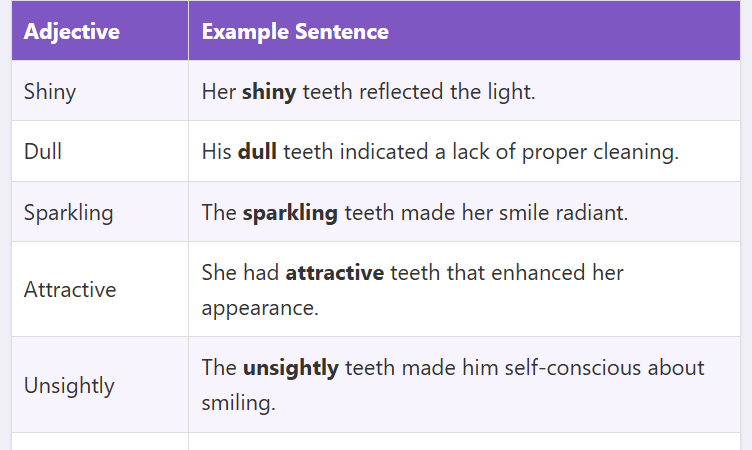
Table of Contents
- Introduction
- Definition of Adjectives for Teeth
- Structural Breakdown
- Types and Categories of Adjectives for Teeth
- Examples of Adjectives for Teeth
- Usage Rules for Adjectives for Teeth
- Common Mistakes When Using Adjectives for Teeth
- Practice Exercises
- Advanced Topics
- Frequently Asked Questions
- Conclusion
Definition of Adjectives for Teeth
Adjectives for teeth are words that describe the characteristics, qualities, or attributes of teeth. These adjectives provide specific details about the appearance, condition, shape, size, color, and position of teeth, allowing for a more precise and descriptive communication regarding dental features. They play a crucial role in both everyday conversations and professional dental contexts.
Adjectives modify nouns, and in this case, the noun is “teeth.” They add detail and specificity, helping to create a clearer picture of what is being described. Using appropriate adjectives is essential for accurate communication, whether you are discussing your dental health with a dentist or simply describing someone’s smile.
In the context of dental descriptions, adjectives can be categorized based on what aspect of the teeth they describe. For instance, some adjectives focus on the appearance (e.g., shiny, crooked), while others describe the condition (e.g., healthy, decayed). Understanding these categories can help you choose the most fitting adjective for a given situation.
Structural Breakdown
The structure of using adjectives for teeth follows the standard English grammar rules for adjective placement. Generally, adjectives are placed before the noun they modify. This is known as the attributive position. For example, “white teeth” or “healthy gums.”
However, adjectives can also be used after linking verbs such as to be, to seem, to appear, etc. This is the predicative position. In this case, the adjective describes the subject of the sentence. For example, “Her teeth are straight,” or “His smile seems genuine.”
When using multiple adjectives to describe teeth, the order generally follows a specific sequence, although this is not a rigid rule and can depend on context and emphasis. A common guideline is to order adjectives by: opinion, size, physical quality, shape, age, color, origin, material, and type. For example, “beautiful, small, healthy, round, old, white, American, porcelain teeth.” However, it’s rare to use so many adjectives at once; usually, two or three well-chosen adjectives are sufficient.
It is also important to consider the use of articles (a, an, the) with adjectives and nouns. For example, “a crooked tooth” or “the whitest teeth.” The choice of article depends on whether you are referring to a specific tooth or teeth (the) or a general category (a/an).
Types and Categories of Adjectives for Teeth
Adjectives for teeth can be categorized based on the specific aspect of the teeth they describe. These categories include appearance, condition, shape, position, color, and size.
Understanding these categories allows for more precise and effective descriptions.
Adjectives Describing Appearance
These adjectives focus on the overall look or aesthetic quality of the teeth. They can describe how attractive or unattractive the teeth appear.
Examples include: shiny, dull, sparkling, attractive, unsightly, flawless, imperfect, well-maintained, neglected, polished, stained, gleaming, radiant, discolored, artificial-looking. These adjectives help convey the visual impact of the teeth.
Adjectives Describing Condition
These adjectives describe the health and state of the teeth. They indicate whether the teeth are healthy, damaged, or in need of dental care.
Examples include: healthy, decayed, strong, weak, brittle, chipped, cracked, eroded, sensitive, filled, crowned, restored, impacted, abscessed, infected, loose, firm, sound, unsound. These adjectives are crucial in dental contexts for assessing and communicating about oral health.
Adjectives Describing Shape
These adjectives describe the form or contour of the teeth. They can indicate whether the teeth are regular, irregular, or have specific shapes.
Examples include: straight, crooked, curved, pointed, rounded, square, triangular, peg-shaped, malformed, uneven, symmetrical, asymmetrical, aligned, misaligned, bucked, slanted, sharp, blunt. These adjectives are useful for describing specific dental characteristics and irregularities.
Adjectives Describing Position
These adjectives describe the placement and alignment of the teeth within the mouth. They indicate whether the teeth are properly positioned or misaligned.
Examples include: aligned, misaligned, crowded, spaced, overlapping, protruding, recessed, impacted, erupted, unerupted, ectopic, rotated, tilted, displaced, forward, backward, inward, outward. These adjectives are important for describing orthodontic issues and dental arrangements.
Adjectives Describing Color
These adjectives describe the shade or hue of the teeth. They indicate whether the teeth are white, yellow, or have other color variations.
Examples include: white, yellow, stained, discolored, bleached, ivory, pearly, bright, dull, opaque, translucent, greyish, brownish, mottled, spotted, off-white, chalky, darkened. These adjectives are commonly used in cosmetic dentistry to describe desired or existing tooth color.
Adjectives Describing Size
These adjectives describe the dimensions or magnitude of the teeth. They indicate whether the teeth are large, small, or of average size.
Examples include: large, small, tiny, oversized, undersized, average-sized, prominent, diminutive, substantial, considerable, miniature, massive, elongated, shortened, broad, narrow. These adjectives are useful for describing dental proportions and anomalies.
Examples of Adjectives for Teeth
The following sections provide extensive examples of adjectives used to describe teeth, organized by category. Each example is presented in a sentence to illustrate its usage in context.
These examples can help you understand how to effectively incorporate these adjectives into your vocabulary.
Appearance Examples
This table provides examples of adjectives describing the appearance of teeth. Each adjective is used in a sentence to illustrate its meaning and usage.
| Adjective | Example Sentence |
|---|---|
| Shiny | Her shiny teeth reflected the light. |
| Dull | His dull teeth indicated a lack of proper cleaning. |
| Sparkling | The sparkling teeth made her smile radiant. |
| Attractive | She had attractive teeth that enhanced her appearance. |
| Unsightly | The unsightly teeth made him self-conscious about smiling. |
| Flawless | Her flawless teeth were the result of years of orthodontic care. |
| Imperfect | He had imperfect teeth, but they were still charming. |
| Well-maintained | Her well-maintained teeth showed her dedication to oral hygiene. |
| Neglected | His neglected teeth needed immediate dental attention. |
| Polished | The polished teeth gleamed after the dental cleaning. |
| Stained | Stained teeth can be whitened with professional treatments. |
| Gleaming | Her gleaming teeth gave her a youthful appearance. |
| Radiant | The radiant teeth brightened her entire face. |
| Discolored | Discolored teeth can be caused by certain medications. |
| Artificial-looking | The veneers gave his teeth an artificial-looking appearance. |
| Chipped | The chipped tooth was a result of a sports injury. |
| Crooked | Her crooked teeth added character to her smile. |
| Perfect | She desired a perfect smile with straight, white teeth. |
| Even | Her even teeth were admired by everyone. |
| Uneven | His uneven teeth made chewing difficult. |
| Well-aligned | Well-aligned teeth are easier to clean and maintain. |
| Noticeable | The noticeable gap between her front teeth was endearing. |
| Unnoticeable | The filling was so well done that it was unnoticeable. |
| Aesthetic | The dentist focused on the aesthetic appearance of the teeth. |
| Natural | She preferred a natural look over overly white teeth. |
Condition Examples
This table provides examples of adjectives describing the condition of teeth. Each adjective is used in a sentence to illustrate its meaning and usage.
| Adjective | Example Sentence |
|---|---|
| Healthy | Healthy teeth are essential for overall well-being. |
| Decayed | The decayed tooth needed a root canal. |
| Strong | Strong teeth can withstand the forces of chewing. |
| Weak | His weak teeth were prone to breaking. |
| Brittle | The brittle teeth were easily chipped. |
| Chipped | The chipped tooth was repaired with a filling. |
| Cracked | The cracked tooth caused sharp pain. |
| Eroded | Her eroded teeth were sensitive to hot and cold. |
| Sensitive | His sensitive teeth reacted to sugary foods. |
| Filled | The filled tooth was protected from further decay. |
| Crowned | The crowned tooth was strengthened and protected. |
| Restored | The restored tooth looked as good as new. |
| Impacted | The impacted wisdom tooth needed to be extracted. |
| Abscessed | The abscessed tooth caused significant pain and swelling. |
| Infected | The infected tooth required antibiotics. |
| Loose | The loose tooth was a sign of gum disease. |
| Firm | Firm teeth are a sign of healthy gums and bone. |
| Sound | The dentist confirmed that his teeth were sound and healthy. |
| Unsound | The unsound tooth needed immediate attention to prevent further damage. |
| Damaged | Her damaged teeth were a result of years of grinding. |
| Fragile | The fragile teeth required extra care when brushing. |
| Vulnerable | His vulnerable teeth were susceptible to decay. |
| Protected | The sealant protected the teeth from cavities. |
| Exposed | The exposed root was sensitive to cold. |
Shape Examples
This table provides examples of adjectives describing the shape of teeth. Each adjective is used in a sentence to illustrate its meaning and usage.
| Adjective | Example Sentence |
|---|---|
| Straight | She had straight teeth after wearing braces. |
| Crooked | His crooked teeth added character to his smile. |
| Curved | The curved shape of the tooth helped with biting. |
| Pointed | The vampire had long, pointed teeth. |
| Rounded | The rounded teeth were ideal for grinding food. |
| Square | His square teeth gave him a strong jawline. |
| Triangular | The triangular teeth were characteristic of certain species. |
| Peg-shaped | The peg-shaped tooth was a developmental anomaly. |
| Malformed | The malformed tooth required surgery to correct. |
| Uneven | The uneven teeth made chewing uncomfortable. |
| Symmetrical | Her symmetrical teeth were aesthetically pleasing. |
| Asymmetrical | His asymmetrical teeth gave him a unique smile. |
| Aligned | Her aligned teeth were the result of orthodontic treatment. |
| Misaligned | His misaligned teeth caused difficulty in chewing. |
| Bucked | The bucked teeth protruded prominently. |
| Slanted | The slanted teeth were a result of jaw misalignment. |
| Sharp | The sharp teeth were effective for tearing meat. |
| Blunt | The blunt teeth were less effective for biting. |
| Regular | The dentist noticed the regular shape of the teeth. |
| Irregular | The irregular shape of the tooth indicated a developmental issue. |
Position Examples
This table provides examples of adjectives describing the position of teeth. Each adjective is used in a sentence to illustrate its meaning and usage.
| Adjective | Example Sentence |
|---|---|
| Aligned | Her aligned teeth showcased the success of her orthodontic treatment. |
| Misaligned | His misaligned teeth contributed to his difficulty in chewing properly. |
| Crowded | The crowded teeth required extraction to create space. |
| Spaced | Her spaced teeth resulted in gaps between each one. |
| Overlapping | The overlapping teeth created an uneven bite. |
| Protruding | His protruding teeth were corrected with braces. |
| Recessed | The recessed teeth were difficult to clean properly. |
| Impacted | The impacted wisdom tooth needed surgical removal. |
| Erupted | The erupted teeth were properly positioned in the dental arch. |
| Unerupted | The unerupted teeth were still beneath the gumline. |
| Ectopic | The ectopic tooth erupted in an unusual location. |
| Rotated | The rotated tooth required orthodontic intervention. |
| Tilted | The tilted tooth affected the overall bite. |
| Displaced | The displaced tooth was a result of trauma. |
| Forward | The forward teeth created an overbite. |
| Backward | The backward teeth were set further back than normal. |
| Inward | The inward teeth caused a crossbite. |
| Outward | The outward teeth were more prone to injury. |
Color Examples
This table provides examples of adjectives describing the color of teeth. Each adjective is used in a sentence to illustrate its meaning and usage.
| Adjective | Example Sentence |
|---|---|
| White | She desired white teeth for her wedding day. |
| Yellow | His yellow teeth were a result of smoking. |
| Stained | Her stained teeth were noticeable despite regular brushing. |
| Discolored | His discolored teeth made him feel self-conscious. |
| Bleached | Her bleached teeth looked remarkably brighter. |
| Ivory | The ivory teeth had a natural, warm tone. |
| Pearly | Her pearly teeth were admired by everyone. |
| Bright | His bright teeth lit up his entire face. |
| Dull | Her dull teeth lacked luster. |
| Opaque | The opaque teeth appeared less natural. |
| Translucent | The translucent teeth had a natural, healthy glow. |
| Greyish | His greyish teeth were indicative of a previous root canal. |
| Brownish | Her brownish teeth were due to coffee consumption. |
| Mottled | His mottled teeth were a result of fluorosis. |
| Spotted | Her spotted teeth were caused by enamel hypoplasia. |
| Off-white | The off-white teeth looked more natural than stark white. |
| Chalky | The chalky teeth were a sign of early decay. |
| Darkened | His darkened teeth were a result of aging. |
Size Examples
This table provides examples of adjectives describing the size of teeth. Each adjective is used in a sentence to illustrate its meaning and usage.
| Adjective | Example Sentence |
|---|---|
| Large | His large teeth made him look intimidating. |
| Small | Her small teeth gave her a delicate appearance. |
| Tiny | The baby had tiny teeth just emerging from the gums. |
| Oversized | His oversized teeth were noticeable when he smiled. |
| Undersized | Her undersized teeth were a developmental anomaly. |
| Average-sized | His average-sized teeth were proportional to his face. |
| Prominent | The prominent teeth were easily seen when he spoke. |
| Diminutive | Her diminutive teeth gave her a youthful look. |
| Substantial | His substantial teeth were strong and durable. |
| Considerable | The considerable size of his teeth made him stand out. |
| Miniature | Her miniature teeth were barely visible. |
| Massive | His massive teeth made it difficult to close his mouth comfortably. |
| Elongated | The elongated teeth were a result of gum recession. |
| Shortened | His shortened teeth were due to grinding over many years. |
| Broad | His broad teeth were ideal for grinding food. |
| Narrow | Her narrow teeth were spaced closely together. |
Usage Rules for Adjectives for Teeth
When using adjectives to describe teeth, several rules and guidelines should be followed to ensure clarity and accuracy. These rules cover adjective order, article usage, and appropriate adjective selection.
Adjective Order: As mentioned earlier, when using multiple adjectives, there is a general order to follow. This order is opinion, size, physical quality, shape, age, color, origin, material, and type. While this order is not strict, following it generally results in more natural-sounding sentences. For example, “beautiful small healthy white teeth” sounds better than “white healthy small beautiful teeth.”
Article Usage: The articles a, an, and the are important when using adjectives with nouns. Use a or an when referring to a general instance of a tooth or teeth, and the when referring to a specific tooth or teeth. For example, “a decayed tooth” refers to any decayed tooth, while “the decayed tooth” refers to a specific decayed tooth that has already been mentioned or is otherwise identifiable.
Appropriate Adjective Selection: Choose adjectives that accurately reflect the characteristics you are trying to describe. Consider the context and the specific details you want to convey. For example, use “stained” instead of “discolored” if the teeth have noticeable stains from coffee or smoking.
Using Commas: When using multiple adjectives of the same category (e.g., multiple appearance adjectives), separate them with commas. For example, “shiny, white, attractive teeth.” However, do not use commas between adjectives that belong to different categories. For example, “small, healthy teeth” (no comma between small and healthy).
Avoiding Redundancy: Avoid using adjectives that are redundant or repetitive. For example, saying “very white teeth” is often unnecessary if “white” already conveys the intended meaning. Instead, consider using a more specific adjective like “bleached” or “radiant.”
Common Mistakes When Using Adjectives for Teeth
Several common mistakes can occur when using adjectives to describe teeth. Being aware of these mistakes can help you avoid them and improve your accuracy in communication.
Incorrect Adjective Order: Placing adjectives in the wrong order can sound unnatural. For example, saying “white small teeth” instead of “small white teeth” is a common mistake. Remember to generally follow the order of opinion, size, physical quality, shape, age, color, origin, material, and type.
Misusing Articles: Incorrectly using articles (a, an, the) can change the meaning of your sentence. For example, saying “I have decayed tooth” instead of “I have a decayed tooth” or “I have the decayed tooth” is a common error.
Using Vague Adjectives: Using vague or generic adjectives can make your description less informative. For example, saying “nice teeth” is less descriptive than saying “straight, white teeth.”
Redundancy: Using redundant adjectives can make your writing or speech sound awkward. For example, saying “very shiny teeth” when “shiny teeth” already conveys the intended meaning is redundant.
Incorrect Adjective Form: Using the wrong form of an adjective (e.g., using an adverb instead of an adjective) is a common mistake. For example, saying “Her teeth are perfectly” instead of “Her teeth are perfect” is incorrect.
Here are some examples of correct vs. incorrect usage:
| Incorrect | Correct |
|---|---|
| I have bad tooth. | I have a bad tooth. |
| White small teeth. | Small white teeth. |
| Teeth are perfectly. | Teeth are perfect. |
| Very white teeth. | Radiant teeth. |
| Nice teeth. | Straight, white teeth. |
Practice Exercises
These practice exercises will help you reinforce your understanding of adjectives for teeth. Each exercise focuses on a different aspect of adjective usage, including adjective selection, order, and article usage.
Exercise 1: Adjective Selection
Choose the most appropriate adjective from the options provided to complete each sentence.
| Question | Options | Answer |
|---|---|---|
| 1. Her _______ teeth made her smile radiant. | a) yellow b) sparkling c) decayed | b) sparkling |
| 2. The _______ tooth needed a root canal. | a) healthy b) decayed c) strong | b) decayed |
| 3. His _______ teeth added character to his smile. | a) straight b) crooked c) aligned | b) crooked |
| 4. The _______ wisdom tooth needed to be extracted. | a) erupted b) impacted c) aligned | b) impacted |
| 5. She desired _______ teeth for her wedding day. | a) yellow b) white c) stained | b) white |
| 6. His _______ teeth made him look intimidating. | a) small b) large c) tiny | b) large |
| 7. The _______ teeth were a sign of early decay. | a) chalky b) pearly c) ivory | a) chalky |
| 8. Her _______ teeth were the result of smoking. | a) white b) bright c) stained | c) stained |
| 9. The _______ teeth were a developmental anomaly. | a) average-sized b) undersized c) substantial | b) undersized |
| 10. His _______ teeth required immediate dental attention. | a) sound b) unsound c) strong | b) unsound |
Exercise 2: Adjective Order
Rearrange the adjectives in the correct order to describe the teeth in each sentence.
| Question | Answer |
|---|---|
| 1. She had (white, small, beautiful) teeth. | She had beautiful small white teeth. |
| 2. He had (decayed, old, several) teeth. | He had several old decayed teeth. |
| 3. They were (straight, new, pearly) teeth. | They were pearly new straight teeth. |
| 4. The (chipped, front, small) tooth was noticeable. | The small chipped front tooth was noticeable. |
| 5. He showed his (white, perfect, many) teeth. | He showed his many perfect white teeth. |
| 6. She has (healthy, strong, two) teeth. | She has two strong healthy teeth. |
| 7. The (yellow, back, old) tooth ached. | The old yellow back tooth ached. |
| 8. He brushed his (stained, few, remaining) teeth. | He brushed his few remaining stained teeth. |
| 9. She polished her (front, even, two) teeth. | She polished her two even front teeth. |
| 10. They admired her (bright, perfect, white) teeth. | They admired her perfect bright white teeth. |
Exercise 3: Article Usage
Fill in the blanks with the correct article (a, an, or the) or leave it blank if no article is needed.
| Question | Answer |
|---|---|
| 1. I have _______ decayed tooth. | a |
| 2. _______ white teeth are desirable. | (no article) |
| 3. She had _______ sparkling smile. | a |
| 4. He needed to see _______ dentist about his sensitive teeth. | a |
| 5. _______ impacted wisdom tooth was causing pain. | The |
| 6. She brushed _______ teeth every morning. | her |
| 7. He wanted _______ perfect smile. | a |
| 8. _______ straight teeth are easier to clean. | (no article) |
| 9. She had _______ appointment with the orthodontist. | an |
| 10. _______ color of his teeth was naturally ivory . | The |
Advanced Topics
For those looking to deepen their understanding of adjectives for teeth, several advanced topics can be explored. These topics include the use of figurative language, specialized dental terminology, and the impact of cultural and regional variations on adjective usage.
Figurative Language:
Adjectives can be used in figurative language to create more vivid and imaginative descriptions of teeth. Metaphors, similes, and personification can add depth and nuance to your writing. For example, instead of saying “white teeth,” you could say “teeth as white as pearls” (simile) or “teeth that sparkled like diamonds” (metaphor). These techniques can make your descriptions more engaging and memorable.
Specialized Dental Terminology:
In professional dental contexts, specialized terminology is often used to describe teeth with greater precision. Adjectives such as “mesial,” “distal,” “buccal,” and “lingual” describe the surfaces and positions of teeth in technical terms. Understanding these terms is essential for dental professionals and those studying dentistry. For example, “mesial surface decay” refers to decay on the surface of the tooth that is closest to the midline of the dental arch.
Cultural and Regional Variations:
The adjectives used to describe teeth can vary across different cultures and regions. Some cultures may place a greater emphasis on certain aesthetic qualities, such as whiteness or straightness, while others may have different standards of beauty. Additionally, regional dialects may include unique adjectives or expressions for describing teeth. Being aware of these variations can help you communicate more effectively with people from different backgrounds.
Adjective Intensifiers:
Using intensifiers such as “very,” “extremely,” “incredibly,” and “exceptionally” can strengthen the impact of adjectives. However, it’s important to use intensifiers judiciously to avoid redundancy or hyperbole. For example, instead of saying “very white teeth,” you could say “exceptionally white teeth” to emphasize the degree of whiteness. Alternatively, consider using a more specific adjective that already conveys the intended meaning, such as “bleached” or “radiant.”
Frequently Asked Questions
This section addresses some frequently asked questions about using adjectives for teeth, providing clear and concise answers to common queries.
What are the most common adjectives used to describe teeth?
The most common adjectives used to describe teeth include white, healthy, straight, crooked, decayed, shiny, and clean. These adjectives cover basic aspects of appearance and condition.
How can I improve my vocabulary of adjectives for teeth?
To improve your vocabulary, read dental health articles, consult dental professionals, and practice using new adjectives in sentences. Pay attention to how adjectives are used in context and make a habit of looking up unfamiliar words.
Is there a specific order to follow when using multiple adjectives for teeth?
Yes, there is a general order to follow: opinion, size, physical quality, shape, age, color, origin, material, and type. However, this order is not strict, and the context of the sentence may influence the most natural arrangement.
What are some adjectives to describe bad teeth?
Adjectives to describe bad teeth include decayed, stained, crooked, chipped, eroded, infected, loose, unsound, and discolored.
How do I use articles (a, an, the) correctly with adjectives for teeth?
Use a or an when referring to a general instance of a tooth or teeth (e.g., “a decayed tooth”). Use the when referring to a specific tooth or teeth that have already been mentioned or are otherwise identifiable (e.g., “the decayed tooth”).
Can adjectives for teeth be used in figurative language?
Yes, adjectives for teeth can be used in figurative language to create more vivid and imaginative descriptions. Metaphors, similes, and personification can add depth and nuance to your writing.
What are some specialized dental terms that can be used as adjectives?
Specialized dental terms that can be used as adjectives include mesial, distal, buccal, lingual, incisal, and occlusal. These terms describe the surfaces and positions of teeth in technical terms.
Conclusion
Mastering the use of adjectives for teeth enhances your ability to communicate clearly and effectively about dental health, aesthetics, and overall oral hygiene. By understanding the different types and categories of adjectives, following usage rules, and avoiding common mistakes, you can improve your descriptive vocabulary and express yourself with greater precision.
Whether you are a student, a healthcare professional, or simply someone looking to expand your language skills, this comprehensive guide has provided you with the knowledge and tools you need to describe teeth accurately and vividly. Continue practicing and exploring advanced topics to further refine your understanding and usage of adjectives for teeth.