

Choosing the right adjectives to describe a venue is crucial for conveying its unique atmosphere, characteristics, and suitability for various events. Whether you’re planning a wedding, promoting a concert, or simply providing feedback about a restaurant, using precise and evocative adjectives can significantly enhance your communication.
This article provides a comprehensive guide to using adjectives effectively to describe venues, covering everything from basic definitions to advanced usage and common mistakes.
Understanding how to use adjectives to describe venues is essential for anyone involved in event planning, marketing, hospitality, or even everyday conversations about places we visit. By mastering this aspect of English grammar, you can paint vivid pictures with your words and ensure that your audience understands exactly what you’re conveying.
This guide is designed for English learners of all levels, from beginners seeking to expand their vocabulary to advanced speakers aiming to refine their descriptive language.
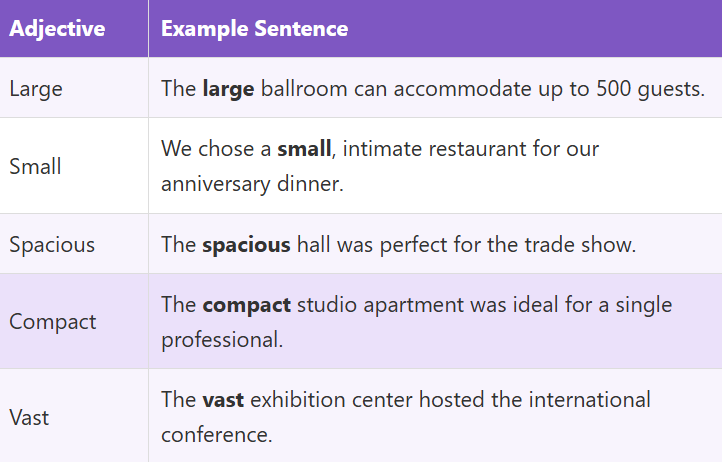
Table of Contents
- Introduction
- Definition of Adjectives for Venues
- Classification of Adjectives
- Function of Adjectives in Describing Venues
- Context of Venue Descriptions
- Structural Breakdown
- Adjective Placement
- Compound Adjectives
- Cumulative Adjectives
- Types and Categories of Adjectives for Venues
- Size Adjectives
- Shape Adjectives
- Appearance Adjectives
- Atmosphere Adjectives
- Amenities Adjectives
- Location Adjectives
- Style Adjectives
- Condition Adjectives
- Examples of Adjectives for Venues
- Size Adjectives Examples
- Appearance Adjectives Examples
- Atmosphere Adjectives Examples
- Amenities Adjectives Examples
- Usage Rules
- Order of Adjectives
- Articles with Adjectives
- Prepositions with Adjectives
- Common Mistakes
- Incorrect Adjective Order
- Misused Adjectives
- Overuse of Adjectives
- Practice Exercises
- Exercise 1: Identifying Adjectives
- Exercise 2: Filling in the Blanks
- Exercise 3: Rewriting Sentences
- Advanced Topics
- Figurative Language
- Formal vs. Informal Adjectives
- Nuance and Connotation
- FAQ
- Conclusion
Definition of Adjectives for Venues
Adjectives are words that describe or modify nouns, providing additional information about their qualities, characteristics, or attributes. When used to describe venues, adjectives help to create a clear and vivid picture of the place, allowing the audience to understand its unique features and atmosphere.
These adjectives can relate to various aspects of the venue, such as its size, appearance, atmosphere, amenities, and location.
Classification of Adjectives
Adjectives can be classified into several categories based on their function and meaning. Some common types include:
- Descriptive Adjectives: These adjectives describe the qualities or characteristics of a noun (e.g., spacious hall, rustic barn).
- Quantitative Adjectives: These adjectives indicate the quantity or amount of a noun (e.g., several rooms, many seats).
- Demonstrative Adjectives: These adjectives point out specific nouns (e.g., this venue, that garden).
- Possessive Adjectives: These adjectives show ownership or belonging (e.g., its entrance, their facilities).
- Interrogative Adjectives: These adjectives ask questions about nouns (e.g., which hall, what amenities).
Function of Adjectives in Describing Venues
The primary function of adjectives in describing venues is to provide detailed information that helps the audience visualize the space. Adjectives can:
- Specify physical attributes: Describing the size (large, cozy), shape (circular, rectangular), and appearance (modern, historic) of the venue.
- Convey atmosphere and ambiance: Evoking feelings and impressions through words like romantic, vibrant, or serene.
- Highlight amenities and features: Emphasizing the availability of specific facilities such as a state-of-the-art sound system or a picturesque garden.
- Indicate location and surroundings: Providing context about the venue’s setting, such as a beachfront location or a downtown setting.
Context of Venue Descriptions
The choice of adjectives to describe a venue often depends on the context and purpose of the description. For instance, a marketing brochure might use more evocative and persuasive adjectives, while a technical report might focus on factual and objective descriptions.
Consider the following contexts:
- Event Planning: Adjectives help clients understand the suitability of a venue for their event (e.g., a grand ballroom for a wedding, a small, intimate restaurant for a private dinner).
- Real Estate: Adjectives are essential for attracting potential buyers or renters by highlighting the unique features and appeal of a property (e.g., a renovated loft, a charming cottage).
- Travel and Tourism: Adjectives create enticing descriptions that encourage travelers to visit a particular destination or venue (e.g., a luxurious resort, a historic landmark).
- Reviews and Feedback: Adjectives allow individuals to express their opinions and experiences about a venue (e.g., a disappointing experience, a memorable visit).
Structural Breakdown
Understanding the structural aspects of how adjectives are used can significantly improve the clarity and effectiveness of your venue descriptions. This section explores adjective placement, compound adjectives, and cumulative adjectives.
Adjective Placement
In English, adjectives typically precede the noun they modify. This is known as the attributive position. For example:
- The spacious hall was perfect for the wedding reception.
- We enjoyed the romantic atmosphere of the restaurant.
Adjectives can also follow a linking verb (such as be, seem, appear, become). This is known as the predicative position. For example:
- The hall was spacious.
- The atmosphere seemed romantic.
Compound Adjectives
Compound adjectives are formed when two or more words are combined to act as a single adjective. These are often hyphenated, especially when they come before the noun.
For example:
- The venue had a state-of-the-art sound system.
- They chose a well-lit room for the conference.
However, if the compound adjective comes after the noun, the hyphen is often omitted. For example:
- The sound system was state of the art.
- The room was well lit.
Cumulative Adjectives
When using multiple adjectives to describe a venue, it’s important to follow the correct order. Adjectives typically appear in the following order:
- Quantity or number
- Opinion
- Size
- Age
- Shape
- Color
- Origin
- Material
- Type
- Purpose
For example:
- They booked a large, historic building for the event. (Size then Age)
- We visited a beautiful, old, stone church. (Opinion, Age, then Material)
Types and Categories of Adjectives for Venues
Adjectives for venues can be categorized based on the specific aspects they describe. Understanding these categories can help you choose the most appropriate words for your descriptions.
Size Adjectives
These adjectives describe the physical dimensions of the venue.
- Large
- Small
- Spacious
- Compact
- Vast
- Tiny
- Immense
- Grand
- Petite
Shape Adjectives
These adjectives describe the form or outline of the venue or its features.
- Circular
- Rectangular
- Square
- Oval
- Triangular
- Curved
- Angular
- Symmetrical
- Asymmetrical
Appearance Adjectives
These adjectives describe the visual aspects of the venue.
- Modern
- Historic
- Elegant
- Rustic
- Chic
- Quaint
- Contemporary
- Ornate
- Minimalist
Atmosphere Adjectives
These adjectives describe the overall feeling or mood of the venue.
- Romantic
- Vibrant
- Serene
- Lively
- Cozy
- Relaxing
- Festive
- Intimate
- Welcoming
Amenities Adjectives
These adjectives describe the available facilities and services at the venue.
- Well-equipped
- State-of-the-art
- Fully furnished
- Accessible
- Comfortable
- Convenient
- Luxurious
- Modernized
- Refurbished
Location Adjectives
These adjectives describe the venue’s geographical setting.
- Beachfront
- Downtown
- Rural
- Urban
- Seaside
- Mountainous
- Riverside
- Suburban
- Central
Style Adjectives
These adjectives describe the venue’s architectural or design style.
- Victorian
- Gothic
- Art Deco
- Baroque
- Renaissance
- Modernist
- Industrial
- Traditional
- Contemporary
Condition Adjectives
These adjectives describe the venue’s state of repair or maintenance.
- Renovated
- Well-maintained
- Dilapidated
- Derelict
- Pristine
- Updated
- Restored
- Refurbished
- Run-down
Examples of Adjectives for Venues
This section provides extensive examples of how to use adjectives to describe venues effectively. Each table focuses on a specific category of adjectives, offering a variety of options for different contexts.
Size Adjectives Examples
The following table showcases examples of sentences using size adjectives to describe various venues.
| Adjective | Example Sentence |
|---|---|
| Large | The large ballroom can accommodate up to 500 guests. |
| Small | We chose a small, intimate restaurant for our anniversary dinner. |
| Spacious | The spacious hall was perfect for the trade show. |
| Compact | The compact studio apartment was ideal for a single professional. |
| Vast | The vast exhibition center hosted the international conference. |
| Tiny | The tiny café offered a cozy and welcoming atmosphere. |
| Immense | The immense cathedral was a marvel of architecture. |
| Grand | The grand hotel lobby impressed visitors with its opulence. |
| Petite | The petite boutique offered unique and handcrafted items. |
| Expansive | The expansive gardens provided a beautiful backdrop for the wedding. |
| Voluminous | The voluminous warehouse was converted into loft apartments. |
| Substantial | The substantial property included a main house and several outbuildings. |
| Considerable | The venue offered a considerable amount of space for the event. |
| Wide | The wide corridors made it easy for guests to navigate the conference center. |
| Narrow | The narrow alleyway led to a hidden gem of a restaurant. |
| Tall | The tall ceilings in the ballroom added to its grandeur. |
| Short | The short bar stools created a casual and relaxed vibe. |
| Deep | The deep swimming pool was a popular attraction at the resort. |
| Broad | The broad staircase led to the upper levels of the historic mansion. |
| Shallow | The shallow pond was home to a variety of aquatic plants. |
Appearance Adjectives Examples
The following table showcases examples of sentences using appearance adjectives to describe various venues.
| Adjective | Example Sentence |
|---|---|
| Modern | The modern art gallery featured cutting-edge installations. |
| Historic | The historic castle stood as a testament to centuries of history. |
| Elegant | The elegant restaurant was known for its impeccable service and refined cuisine. |
| Rustic | The rustic barn provided a charming setting for the country wedding. |
| Chic | The chic boutique hotel attracted fashion-conscious travelers. |
| Quaint | The quaint village pub offered a warm and inviting atmosphere. |
| Contemporary | The contemporary office building featured sleek lines and glass facades. |
| Ornate | The ornate theater was adorned with gold leaf and intricate carvings. |
| Minimalist | The minimalist design of the apartment created a sense of calm and simplicity. |
| Picturesque | The picturesque cottage overlooked the rolling hills and meadows. |
| Grandiose | The grandiose palace was a symbol of the kingdom’s power and wealth. |
| Refined | The refined decor of the club exuded sophistication. |
| Sleek | The sleek design of the office building reflected innovation |
| Polished | The polished floors and surfaces gleamed in the light. |
| Simple | The simple elegance of the chapel made it a popular choice for weddings. |
| Unassuming | The unassuming facade of the restaurant hid a culinary gem. |
| Glamorous | The glamorous nightclub attracted a stylish crowd. |
| Dazzling | The dazzling lights of the casino created an exciting atmosphere. |
| Impressive | The impressive architecture of the museum drew visitors from around the world. |
| Understated | The understated elegance of the hotel appealed to discerning travelers. |
Atmosphere Adjectives Examples
The following table showcases examples of sentences using atmosphere adjectives to describe various venues.
| Adjective | Example Sentence |
|---|---|
| Romantic | The romantic setting of the restaurant made it perfect for a date night. |
| Vibrant | The vibrant atmosphere of the nightclub drew a lively crowd. |
| Serene | The serene gardens provided a peaceful escape from the city. |
| Lively | The lively pub was always buzzing with activity. |
| Cozy | The cozy café was a great place to relax with a book. |
| Relaxing | The relaxing spa offered a range of treatments to soothe the mind and body. |
| Festive | The festive atmosphere of the Christmas market was contagious. |
| Intimate | The intimate theater created a close connection between the performers and the audience. |
| Welcoming | The welcoming staff made us feel right at home at the hotel. |
| Tranquil | The tranquil monastery offered a retreat from the stresses of daily life. |
| Electric | The electric atmosphere of the concert filled the arena. |
| Calm | The calm waters of the lake provided a peaceful setting. |
| Inviting | The inviting aroma of freshly baked bread wafted from the bakery. |
| Homely | The homely atmosphere of the cottage made it feel comfortable. |
| Bustling | The bustling marketplace was full of life and energy. |
| Dynamic | The dynamic energy of the city was reflected in its architecture. |
| Atmospheric | The atmospheric lighting created a sense of mystery. |
| Peaceful | The peaceful countryside offered a respite from urban life. |
| Joyful | The joyful celebration brought smiles to everyone’s faces. |
| Enchanting | The enchanting forest seemed to come alive with magic. |
Amenities Adjectives Examples
The following table showcases examples of sentences using amenities adjectives to describe various venues.
| Adjective | Example Sentence |
|---|---|
| Well-equipped | The well-equipped gym offered a variety of exercise machines and equipment. |
| State-of-the-art | The venue had a state-of-the-art sound system, perfect for live performances. |
| Fully furnished | The fully furnished apartment was ready for immediate occupancy. |
| Accessible | The accessible building was designed to accommodate people with disabilities. |
| Comfortable | The comfortable seating made the movie theater a great place to relax. |
| Convenient | The convenient location of the hotel made it easy to explore the city. |
| Luxurious | The luxurious spa offered a range of pampering treatments. |
| Modernized | The modernized kitchen featured the latest appliances and fixtures. |
| Refurbished | The refurbished hotel rooms offered a fresh and updated look. |
| High-tech | The high-tech conference center was equipped with advanced presentation tools. |
| Comprehensive | The comprehensive fitness center offered a variety of classes and programs. |
| Integrated | The integrated smart home system allowed for remote control of lighting and temperature. |
| Advanced | The advanced security system provided peace of mind for residents. |
| Exclusive | The exclusive members club offered access to premium amenities and services. |
| Premium | The premium internet access allowed for seamless streaming and browsing. |
| Extensive | The extensive library offered a vast collection of books and resources. |
| Abundant | The abundant parking space made it easy for visitors to find a spot. |
| Varied | The varied menu at the restaurant catered to a range of tastes. |
| Complete | The complete set of kitchen appliances made cooking a breeze. |
| Elaborate | The elaborate entertainment system turned the living room into a home theater. |
Usage Rules
To use adjectives effectively when describing venues, it’s essential to understand and follow the basic rules of English grammar. This section covers the order of adjectives, the use of articles with adjectives, and the use of prepositions with adjectives.
Order of Adjectives
As mentioned earlier, when using multiple adjectives before a noun, they generally follow a specific order. This order is based on the type of information the adjective provides.
The general order is:
- Quantity or number
- Opinion
- Size
- Age
- Shape
- Color
- Origin
- Material
- Type
- Purpose
For example, instead of saying “a red beautiful large dress,” you would say “a beautiful large red dress.”
Articles with Adjectives
When using adjectives to describe venues, it’s important to use the correct articles (a, an, the). The choice of article depends on whether the noun is specific or general, and whether the adjective begins with a vowel sound.
- A or An: Use a before adjectives that begin with a consonant sound, and an before adjectives that begin with a vowel sound. For example:
- a spacious hall
- an elegant ballroom
- The: Use the when referring to a specific venue that has already been mentioned or is known to the audience. For example:
- The historic castle was the perfect setting for the wedding.
Prepositions with Adjectives
Some adjectives are commonly used with specific prepositions. These combinations create set phrases that have a particular meaning.
For example:
- Famous for its architecture
- Suitable for weddings
- Close to the beach
- Ideal for conferences
It’s important to learn these common combinations to use adjectives correctly and naturally.
Common Mistakes
Even experienced English speakers can make mistakes when using adjectives to describe venues. This section highlights some common errors and provides correct examples.
Incorrect Adjective Order
One of the most common mistakes is using adjectives in the wrong order. Remember the general order of adjectives and try to follow it as closely as possible.
| Incorrect | Correct |
|---|---|
| A red beautiful dress | A beautiful red dress |
| A old large house | A large old house |
Misused Adjectives
Another common mistake is using adjectives that don’t accurately describe the venue or that have a different meaning than intended.
| Incorrect | Correct |
|---|---|
| The venue was very uninterested. | The venue was very uninspiring. |
| The room was enormous, but it felt cozy. | The room was large, but it felt cozy. |
Overuse of Adjectives
Using too many adjectives can make your descriptions sound cluttered and unnatural. Choose your adjectives carefully and use only those that add significant value to the description.
| Incorrect | Correct |
|---|---|
| The venue was a beautiful, elegant, spacious, modern hall. | The venue was a beautiful, spacious hall. |
| The restaurant had a warm, inviting, cozy, romantic atmosphere. | The restaurant had a warm, romantic atmosphere. |
Practice Exercises
These exercises will help you practice using adjectives to describe venues effectively. Each exercise focuses on a different aspect of adjective usage, from identifying adjectives to rewriting sentences.
Exercise 1: Identifying Adjectives
Identify the adjectives in the following sentences and indicate which noun they modify.
| Sentence | Adjective | Noun |
|---|---|---|
| 1. The grand ballroom was perfect for the wedding. | ||
| 2. The small café offered delicious pastries. | ||
| 3. The modern art gallery featured unique installations. | ||
| 4. The historic castle stood on a hill. | ||
| 5. The romantic restaurant had a cozy atmosphere. | ||
| 6. The vibrant nightclub attracted a lively crowd. | ||
| 7. The serene gardens provided a peaceful escape. | ||
| 8. The well-equipped gym had modern machines. | ||
| 9. The fully furnished apartment was move-in ready. | ||
| 10. The convenient location made it easy to explore. |
Answer Key:
| Sentence | Adjective | Noun |
|---|---|---|
| 1. The grand ballroom was perfect for the wedding. | grand | ballroom |
| 2. The small café offered delicious pastries. | small, delicious | café, pastries |
| 3. The modern art gallery featured unique installations. | modern, unique | gallery, installations |
| 4. The historic castle stood on a hill. | historic | castle |
| 5. The romantic restaurant had a cozy atmosphere. | romantic, cozy | restaurant, atmosphere |
| 6. The vibrant nightclub attracted a lively crowd. | vibrant, lively | nightclub, crowd |
| 7. The serene gardens provided a peaceful escape. | serene, peaceful | gardens, escape |
| 8. The well-equipped gym had modern machines. | well-equipped, modern | gym, machines |
| 9. The fully furnished apartment was move-in ready. | fully furnished | apartment |
| 10. The convenient location made it easy to explore. | convenient | location |
Exercise 2: Filling in the Blanks
Fill in the blanks with appropriate adjectives to describe the venues.
| Sentence | Adjective |
|---|---|
| 1. The __________ beach was perfect for a summer vacation. | |
| 2. The __________ restaurant offered __________ cuisine. | |
| 3. The __________ hotel provided __________ service. | |
| 4. The __________ concert hall had __________ acoustics. | |
| 5. The __________ gardens were a __________ oasis. | |
| 6. The __________ cottage was a __________ retreat. | |
| 7. The __________ museum displayed __________ artifacts. | |
| 8. The __________ café served __________ coffee. | |
| 9. The __________ theater showcased __________ plays. | |
| 10. The __________ park offered __________ trails. |
Answer Key (Example Answers):
| Sentence | Adjective |
|---|---|
| 1. The sandy beach was perfect for a summer vacation. | sandy |
| 2. The elegant restaurant offered exquisite cuisine. | elegant, exquisite |
| 3. The luxurious hotel provided impeccable service. | luxurious, impeccable |
| 4. The modern concert hall had superb acoustics. | modern, superb |
| 5. The lush gardens were a tranquil oasis. | lush, tranquil |
| 6. The charming cottage was a peaceful retreat. | charming, peaceful |
| 7. The historic museum displayed ancient artifacts. | historic, ancient |
| 8. The cozy café served rich coffee. | cozy, rich |
| 9. The grand theater showcased captivating plays. | grand, captivating |
| 10. The sprawling park offered scenic trails. | sprawling, scenic |
Exercise 3: Rewriting Sentences
Rewrite the following sentences, adding adjectives to make the descriptions more vivid and detailed.
| Original Sentence | Rewritten Sentence |
|---|---|
| 1. The hall was booked for the event. | |
| 2. The restaurant served food. | |
| 3. The hotel had rooms. | |
| 4. The park had trees. | |
| 5. The café offered drinks. | |
| 6. The museum displayed art. | |
| 7. The theater presented shows. | |
| 8. The gym had equipment. | |
| 9. The apartment was furnished. | |
| 10. The location was convenient. |
Answer Key (Example Answers):
| Original Sentence | Rewritten Sentence |
|---|---|
| 1. The hall was booked for the event. | The spacious hall was booked for the corporate event. |
| 2. The restaurant served food. | The charming restaurant served delicious Italian food. |
| 3. The hotel had rooms. | The luxurious hotel had comfortable rooms with stunning views. |
| 4. The park had trees. | The beautiful park had towering oak trees. |
| 5. The café offered drinks. | The cozy café offered specialty drinks and freshly baked pastries. |
| 6. The museum displayed art. | The renowned museum displayed priceless art from around the world. |
| 7. The theater presented shows. | The historic theater presented Broadway shows. |
| 8. The gym had equipment. | The modern gym had state-of-the-art equipment. |
| 9. The apartment was furnished. | The newly renovated apartment was fully furnished with stylish decor. |
| 10. The location was convenient. | The central location was incredibly convenient for exploring the city. |
Advanced Topics
For those looking to further refine their use of adjectives, this section explores more advanced topics such as figurative language, formal versus informal adjectives, and the nuances of connotation.
Figurative Language
Adjectives can be used in figurative language to create more vivid and imaginative descriptions. Some common figures of speech include:
- Metaphor: Comparing a venue to something else to emphasize a particular quality (e.g., “The ballroom was a shining beacon of elegance.”).
- Simile: Comparing a venue to something else using “like” or “as” (e.g., “The gardens were as serene as a temple.”).
- Personification: Giving human qualities to a venue (e.g., “The welcoming doors of the inn beckoned weary travelers.”).
Formal vs. Informal Adjectives
The choice of adjectives can also depend on the formality of the context. Formal adjectives are typically used in professional or academic settings, while informal adjectives are more common in casual conversations.
| Formal | Informal |
|---|---|
| Exquisite | Lovely |
| Substantial | Big |
| Impeccable | Great |
| Renowned | Famous |
| Serene | Chill |
Nuance and Connotation
Adjectives can have subtle differences in meaning and connotation, which can significantly impact the overall impression of a venue. For example, “cozy” and “small” both describe size, but “cozy” has a more positive and inviting connotation, while “small” can sound cramped or limiting.
Consider the connotations of adjectives carefully to ensure that you are conveying the intended message.
FAQ
This section answers some frequently asked questions about using adjectives to describe venues.
How many adjectives should I use to describe a venue?
It’s best to use only as many adjectives as necessary to convey the essential qualities of the venue. Using too many adjectives can make your descriptions sound cluttered and unnatural.
Aim for a balance between detail and conciseness.
Can I use adverbs to modify adjectives?
Yes, adverbs can be used to modify adjectives to add more precision or emphasis. For example, “The venue was extremely spacious” or “The atmosphere was incredibly romantic.”
What if I don’t know the correct order of adjectives?
If you’re unsure about the correct order of adjectives, it’s often better to use fewer adjectives or to rewrite the sentence to avoid using multiple adjectives in a row. You can also consult a grammar guide or online resource for assistance.
Are there any adjectives I should avoid using?
Avoid using adjectives that are vague, overused, or cliché, such as “nice,” “good,” or “interesting.” Instead, choose more specific and descriptive adjectives that provide meaningful information about the venue.
How can I improve my vocabulary of adjectives for venues?
Read widely and pay attention to how adjectives are used in different contexts. Make a list of new adjectives you encounter and practice using them in your own writing.
You can also use a thesaurus to find synonyms for common adjectives and expand your vocabulary.
Conclusion
Mastering the use of adjectives to describe venues is a valuable skill for anyone involved in event planning, marketing, hospitality, or simply expressing their opinions about places they visit. By understanding the different types and categories of adjectives, following the rules of English grammar, and avoiding common mistakes, you can create vivid and compelling descriptions that capture the unique qualities of any venue.
Practice the exercises in this guide, expand your vocabulary, and pay attention to how adjectives are used in real-world contexts to continue improving your descriptive language skills.